Exploring the Meaning of Zao in Greek
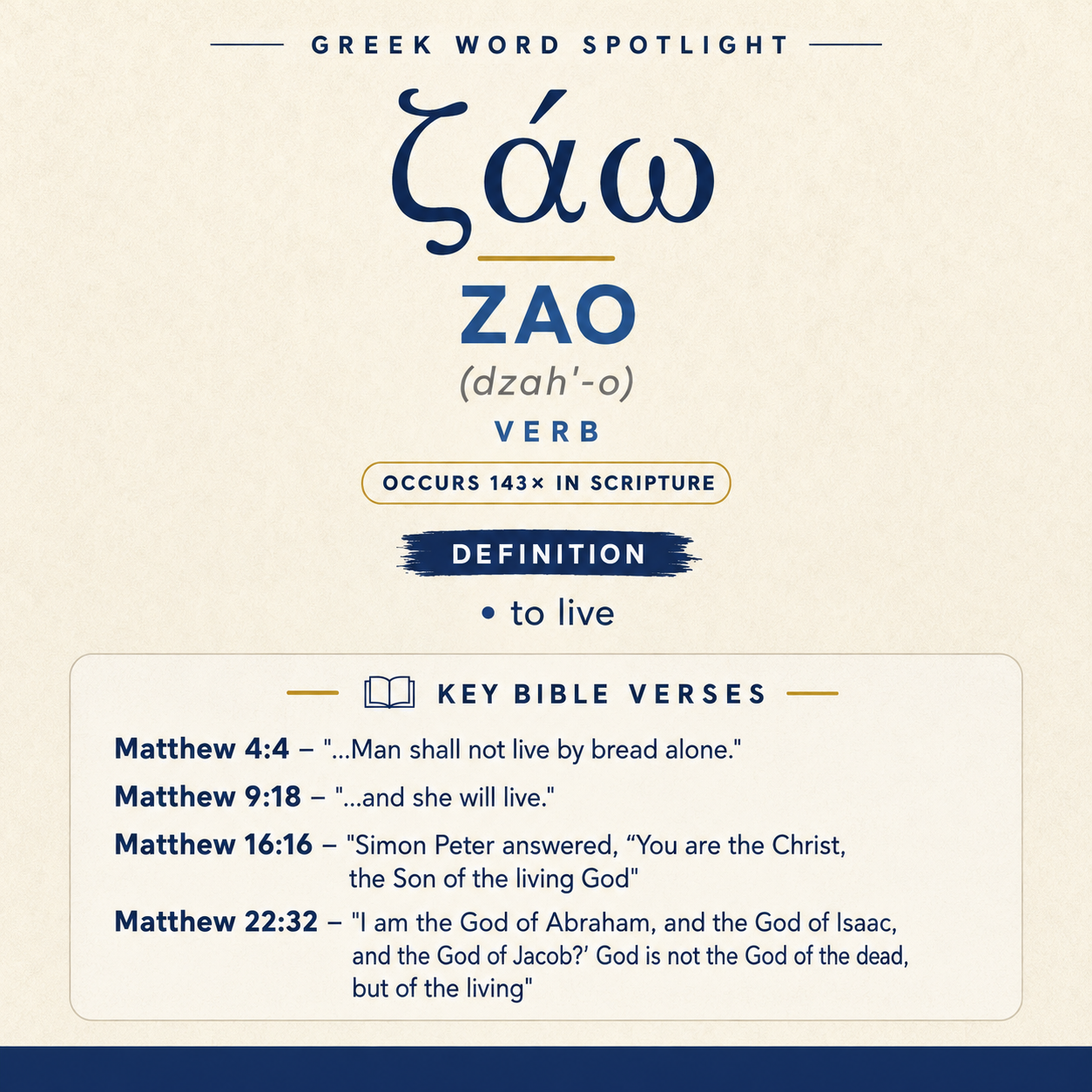
ζάω (Zao) means “to live” and appears 143 times in Scripture, including Matthew 4:4; 16:16; 22:32 and Mark 12:27.
Core Meaning
ζάω means “to live.” In Matthew 4:4 it is used in the statement, “Man shall not live by bread alone.”
Learn More →Living God
In Matthew 16:16 Jesus is called “the Son of the living God.” In Matthew 26:63 the high priest speaks of “the living God.”
Learn More →Living Not Dead
In Matthew 22:32 and Mark 12:27, God is identified as “God … of the living,” not “of the dead.”
Learn More →ζάω means “to live,” and in these Gospel passages it ranges from ordinary human living, to restored life after death’s threat, to God as the one characterized as living. The word appears in sayings of Jesus, in pleas addressed to him, and in confessional and legal speech that invokes “the living God.”
Occurrences
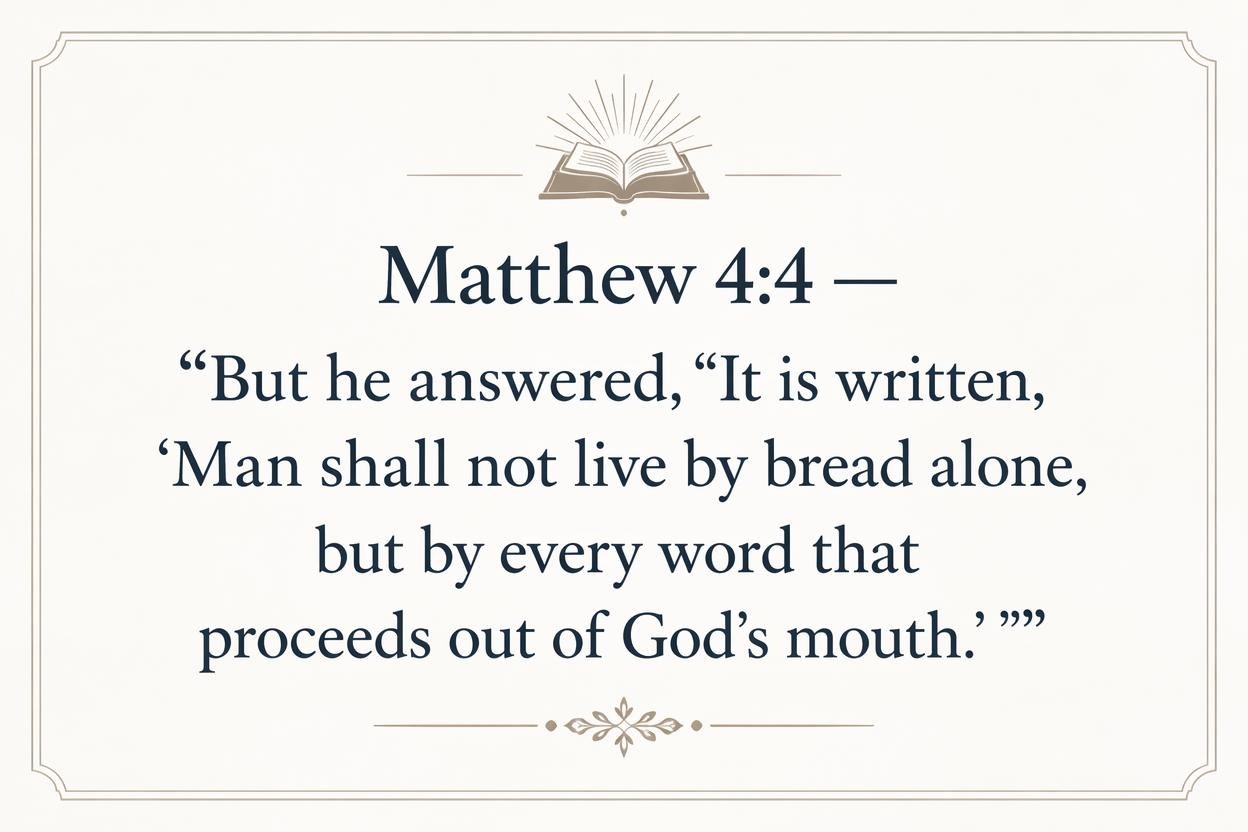
Matthew 4:4 — “But he answered, “It is written, ‘Man shall not live by bread alone, but by every word that proceeds out of God’s mouth.’ ””
Here ζάω is set within a contrast: “bread alone” is inadequate for living, because life is depicted as dependent on “every word that proceeds out of God’s mouth.” The verb frames living as something sustained by a source beyond food, locating true survival and continuance in relation to God’s speech.
Matthew 9:18 — “While he told these things to them, behold, a ruler came and worshiped him, saying, “My daughter has just died, but come and lay your hand on her, and she will live.””
In this plea, ζάω expresses the ruler’s expectation that contact mediated by Jesus (“lay your hand on her”) can reverse the stated condition (“has just died”). “She will live” functions as the hoped-for outcome that stands opposite death, and it is tied to a specific requested action by Jesus.
Matthew 16:16 — “Simon Peter answered, “You are the Christ, the Son of the living God.””
ζάω is used adjectivally in the phrase “the living God,” qualifying God as living in a confessional statement about Jesus’ identity. The word shapes the title by contrasting God’s vitality with what is not living, and it gives weight to Peter’s confession by anchoring it in the character of God named there.
Matthew 22:32 — “‘I am the God of Abraham, and the God of Isaac, and the God of Jacob?’ God is not the God of the dead, but of the living.”
In Jesus’ argument, ζάω appears in a stark antithesis: “the dead” versus “the living.” The statement “God is not the God of the dead, but of the living” uses the living category to define the kind of relationship implied by “I am the God of Abraham…,” making “living” the decisive description for those connected to God.
Matthew 26:63 — “But Jesus held his peace. The high priest answered him, “I adjure you by the living God, that you tell us whether you are the Christ, the Son of God.””
ζάω again qualifies God: “the living God” is invoked as the authority under which the high priest places Jesus (“I adjure you by…”). The adjective heightens the solemnity of the demand, presenting God’s living reality as the warrant for requiring an answer about whether Jesus is “the Christ, the Son of God.”
Matthew 27:63 — “saying, “Sir, we remember what that deceiver said while he was still alive: ‘After three days I will rise again.’””
Here ζάω situates a remembered saying in time: it was spoken “while he was still alive.” The word marks the distinction between the time of speaking and the later context in which the speakers recall it, and it frames “alive” as a prior state associated with the prediction “After three days I will rise again.”
Mark 5:23 — “and begged him much, saying, “My little daughter is at the point of death. Please come and lay your hands on her, that she may be made healthy, and live.””
ζάω concludes a sequence of hoped-for results: the girl is “at the point of death,” yet the father asks for Jesus’ touch “that she may be made healthy, and live.” Living is presented as the culminating outcome of deliverance from imminent death, closely paired with being “made healthy” as the restoration sought.
Mark 12:27 — “He is not the God of the dead, but of the living. You are therefore badly mistaken.”
This repeats the same contrast found in Matthew’s version: God is defined in relation not to “the dead” but to “the living.” ζάω here undergirds the force of Jesus’ correction—“You are therefore badly mistaken”—because the living category is treated as the proper frame for speaking about God.
Mark 16:11 — “When they heard that he was alive, and had been seen by her, they disbelieved.”
ζάω is embedded in reported news: “he was alive,” supported by the claim that “had been seen by her.” The verb expresses the content of the testimony that meets resistance; the focus is not on defining life in the abstract but on the asserted reality of being alive, which becomes the point of disbelief.
Luke 2:36 — “There was one Anna, a prophetess, the daughter of Phanuel, of the tribe of Asher (she was of a great age, having lived with a husband seven years from her virginity,”
Here ζάω describes a portion of Anna’s life history: she had “lived with a husband seven years.” The verb has an ordinary biographical sense, indicating shared life in a defined relationship and timeframe, contributing to the portrayal of her “great age.”
Luke 4:4 — “Jesus answered him, saying, “It is written, ‘Man shall not live by bread alone, but by every word of God.’ ””
This parallels Matthew 4:4, again pairing ζάω with the claim that living cannot be reduced to “bread alone.” Here the sustaining source is phrased “every word of God,” keeping the emphasis on life as dependent on God’s word rather than merely on physical provision.
Luke 10:28 — “He said to him, “You have answered correctly. Do this, and you will live.””
ζάω is used as a promised result attached to an instruction: “Do this, and you will live.” The verb functions as the stated consequence of the required action, presenting living as the outcome that follows from doing what has just been affirmed as “answered correctly.”

Sense and Usage
Across these occurrences, ζάω consistently denotes living, but the scenes show different ways that living is framed and contrasted. In the wilderness sayings (Matthew 4:4; Luke 4:4), living is treated as something sustained, and the point of contrast is between what appears sufficient (“bread alone”) and what is portrayed as truly necessary (“every word that proceeds out of God’s mouth” / “every word of God”). The verb thus anchors a claim about what underwrites human continuance: life is pictured as dependent on God’s word as a sustaining source.
In the healing requests (Matthew 9:18; Mark 5:23), ζάω is the explicit hope set against death’s finality or imminence: “has just died… and she will live,” and “at the point of death… and live.” In both, living is the sought-after reversal and is linked to Jesus’ physical act of laying on hands. The scenes place the verb at the end of an appeal, where it names the restoration desired.
Several passages use “living” to qualify God (Matthew 16:16; 26:63) or to describe those in relation to God (Matthew 22:32; Mark 12:27). The phrase “the living God” places the idea of life on the divine side of the relationship: God is spoken of as living in the context of confession (“the Son of the living God”) and in the context of an oath-like adjuration (“I adjure you by the living God”). In the debate sayings, the contrast “dead” versus “living” becomes a theological boundary marker: God is aligned with the living rather than the dead, and that alignment carries argumentative weight in Jesus’ rebuke.
ζάω also serves ordinary temporal and biographical functions. “While he was still alive” (Matthew 27:63) locates a remembered statement within the timeframe of a person’s life. “Having lived with a husband seven years” (Luke 2:36) summarizes a life segment, contributing to character portrayal through age and experience. Finally, “he was alive” (Mark 16:11) presents living as the content of testimony and the focus of disbelief, showing the verb’s role in reporting and evaluating a claim.
In Luke 10:28, ζάω is set in a conditional pattern: doing is linked to living (“Do this, and you will live”). The verb is future-oriented and tied to obedience, not as a mere biological statement but as a promised outcome connected to a specific directive given in the dialogue.
Imagery
The passages gather around a few recurrent images: the basic necessities of life (“bread”), the sustaining force of God’s spoken word, the vulnerability of a child “at the point of death,” and the courtroom-like solemnity of invoking “the living God.” Together they place ζάω at the intersection of the everyday (eating, family life, years lived) and the contested (death versus life, disbelief versus testimony), where living is variously sustained, restored, confessed, and debated.
Sources: Lexical data from Strong’s Exhaustive Concordance and the Translators Brief Lexicon of Extended Strongs for Greek (STEPBible, CC BY). Occurrence data from the Translators Amalgamated Greek New Testament (STEPBible, CC BY). Scripture quotations from the World English Bible (public domain).