
Exploring the Meaning of Biosis in Greek
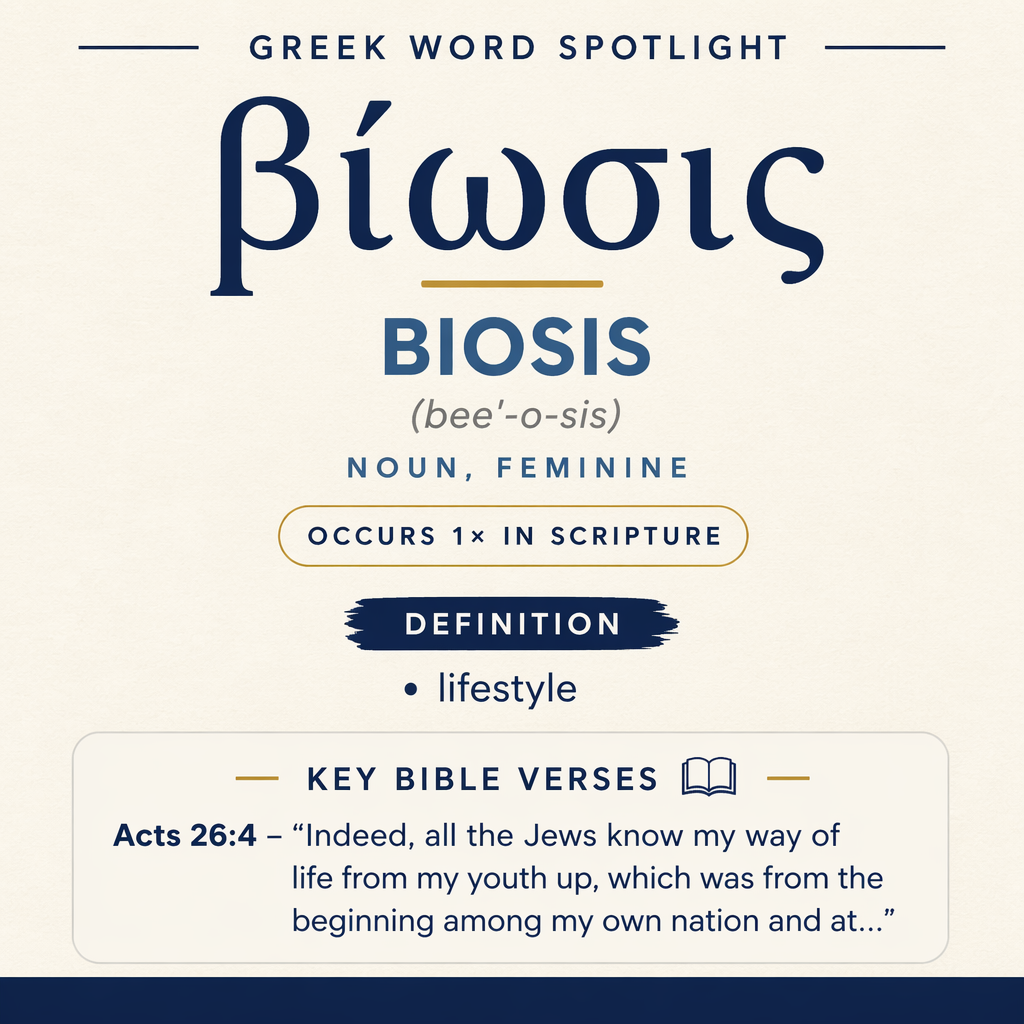
βίωσις (Biosis) means “lifestyle” and appears once in Scripture, in Acts 26:4.
Context Snapshot
In Acts 26:4, it refers to Paul’s way of life from his youth. The verse notes this was known among the Jews.
Learn More →βίωσις speaks of a person’s “lifestyle,” the recognizable pattern of life that can be known, described, and evaluated. In the New Testament it appears in Paul’s defense speech, where he points to what others have long observed about the way he has lived.
Root and Related Words
βίωσις derives from the verb bioō (βιόω), “to live” (Strong’s G980). The relationship between the two words is visible in how Paul treats a “way of life” as something grounded in lived time—life as it is actually carried out.

Occurrences
“Indeed, all the Jews know my way of life from my youth up, which was from the beginning among my own nation and at Jerusalem;” (Acts 26:4)
In Acts 26 Paul is speaking publicly and refers to what “all the Jews know” about him. βίωσις functions here as an appeal to widely shared knowledge: his lifestyle is not a private claim but something known by a community over time. The verse frames that lifestyle with several anchoring details. It reaches “from my youth up,” indicating an extended span rather than a recent shift. It reaches “from the beginning,” not merely as an early phase but as a long-established trajectory. It is located “among my own nation and at Jerusalem,” tying his manner of life to particular social and geographic settings where it could be observed and remembered.
The word also carries a forensic weight in this setting. Paul is not describing an inner intention; he is pointing to a public record of conduct, a life lived in plain view. The force of the sentence depends on the assumption that a lifestyle can be known—by those who have watched it unfold—and therefore can serve as testimony in a defense. In this single use, βίωσις designates the whole shape of Paul’s life as others have seen it: the stable pattern that connects his youth, his nation, and his time in Jerusalem into one continuous, recognizable way of living.
Sense and Usage
The sense “lifestyle” in Acts 26:4 is not a mere description of daily routines; it is a comprehensive label for an observable manner of life that persists through time and across the settings named in the verse. Paul’s statement assumes that lifestyle is something that can be:
1) Publicly known. “All the Jews know my way of life…” casts βίωσις as a shared object of knowledge. It belongs to the realm of what a community can confirm, not just what an individual can assert. The word thus fits naturally into a speech where credibility matters and where a hearer may weigh claims against reputation.
2) Historically extended. “From my youth up” portrays lifestyle as having duration. In this usage, βίωσις is not the snapshot of a single moment but the long-run contour of a life. That contour is strengthened by the added phrase “from the beginning,” which underscores the deep roots of the pattern being described.
3) Socially and geographically situated. The verse ties the lifestyle to “my own nation and at Jerusalem.” Lifestyle here is not an abstract personal brand; it is a way of living that plays out within a people and within a city where one’s conduct is embedded in relationships, expectations, and communal memory. The mention of Jerusalem, in particular, marks the lifestyle as something lived in a place of concentrated public life—again reinforcing its visibility.
4) Relevant as evidence. By choosing a word for “lifestyle” in a defense, Paul treats his way of life as material that can support or undermine a case. The verse’s logic is straightforward: if many people know how he has lived over a long period and in well-known locations, then that known lifestyle carries probative force. βίωσις therefore points to a lived consistency that can be brought forward as part of an argument.
Because the word occurs here only, its usage is shaped entirely by this courtroom-like, testimonial setting. The verse presents lifestyle as a summary of years of living that can be recognized by observers and recalled as a stable pattern. In Paul’s mouth, it is not a decorative detail but a strategic appeal: the kind of term that invites an audience to consult the memory of a community and to consider whether the speaker’s life, taken as a whole, matches the picture he presents.
Imagery
Acts 26:4 attaches βίωσις to the image of a life laid open to public view across formative years: “from my youth up,” “among my own nation,” and “at Jerusalem.” The word evokes a long, traceable path—one that others can point to because it has been walked in familiar places and in the presence of many witnesses.
Sources: Lexical data from Strong’s Exhaustive Concordance and the Translators Brief Lexicon of Extended Strongs for Greek (STEPBible, CC BY). Occurrence data from the Translators Amalgamated Greek New Testament (STEPBible, CC BY). Scripture quotations from the World English Bible (public domain).




