Unraveling the Meaning of ‘Abiy-`albown in Hebrew
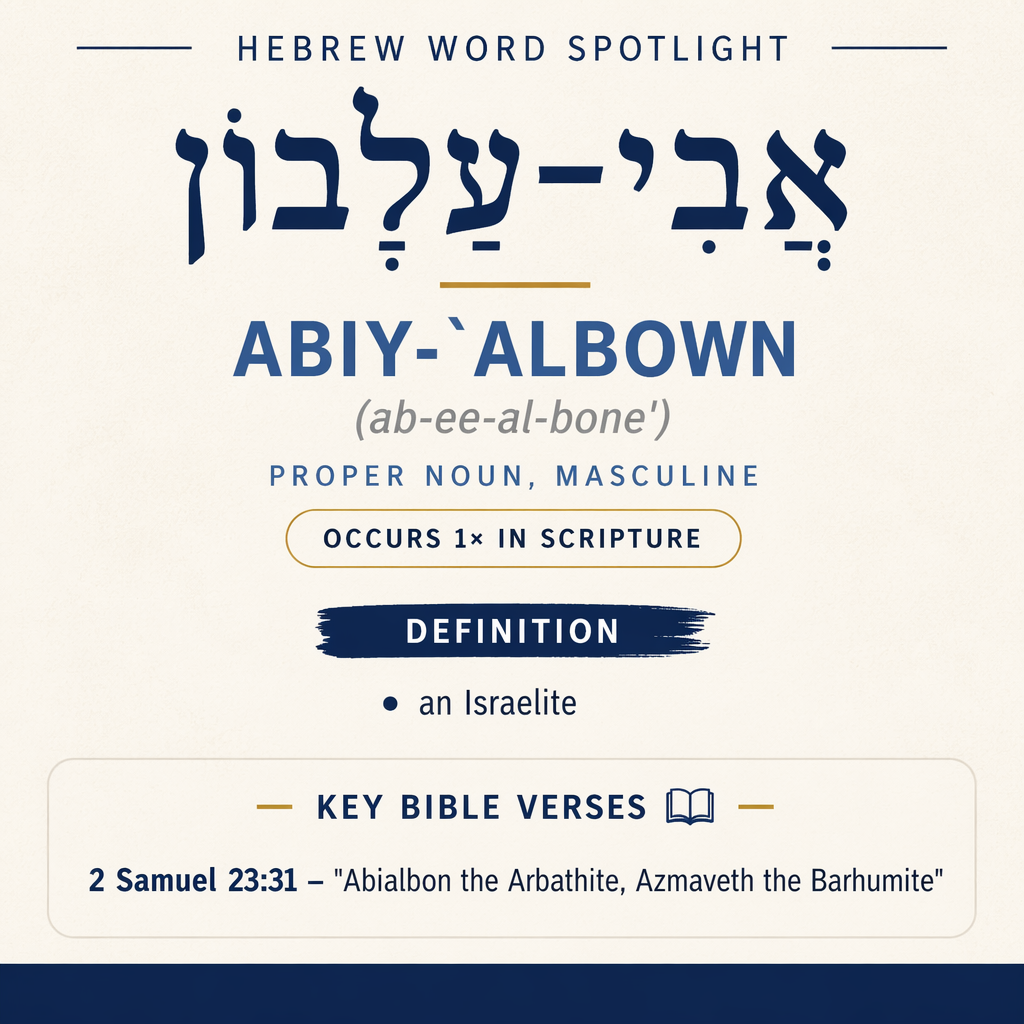
אֲבִי־עַלְבוֹן (Abiy-`albown) means “an Israelite” and appears once in Scripture, in 2 Samuel 23:31.
Biblical Occurrence
This name occurs 1 time in Scripture. It is found in 2 Samuel 23:31.
Learn More →Verse Context
In 2 Samuel 23:31 it appears in a list: “Abialbon the Arbathite, Azmaveth the Barhumite,”.
Learn More →אֲבִי־עַלְבוֹן (Abiy-`albown) is a personal name belonging to an Israelite. It appears in a single list of named men in 2 Samuel 23:31.
Occurrences
“Abialbon the Arbathite, Azmaveth the Barhumite,” (2 Samuel 23:31)
In this verse Abiy-`albown appears as “Abialbon,” presented as one identifiable Israelite among others named in sequence. The wording attaches an identifying descriptor—“the Arbathite”—which functions like a geographic or clan designation, distinguishing this Abialbon from any other person who might share the same name. The verse itself is not a narrative scene with actions or dialogue; it is a compact register of individuals, and the name’s contribution is to anchor one of those individuals in memory and record by pairing a personal name with a specific epithet. Placed alongside “Azmaveth the Barhumite,” Abialbon stands as one item in a structured list: personal name followed by a marker of origin or association.

Sense and Usage
The sense “an Israelite” is expressed here not through a descriptive statement about Abiy-`albown’s character or deeds but through his inclusion in an Israelite roster and through the form of the entry itself: a proper name embedded in a chain of names. This is a common way biblical prose preserves the identity of individuals who belong to Israel—by naming them within lists that function as a kind of public record. In such a context, the name does not communicate role or occupation within the verse; rather, it serves as a fixed identifier, and the accompanying gentilic or locative label (“the Arbathite”) narrows the identification to a particular Abialbon.
Because the word is used as a proper noun, its semantic “range” in this attestation is not a spread of differing senses but a stable reference to one person. The verse shows how the identity of an Israelite can be conveyed with minimal words: the personal name itself, plus an epithet that situates him socially or geographically. The tight, rhythmic pairing of name and descriptor is suited to list style, where the aim is accurate identification rather than description. In this single occurrence, Abiy-`albown functions as one link in the chain of remembered names, integrated into the literary structure by parallelism with the adjacent entry (“Azmaveth the Barhumite”).
In addition, the hyphenated Hebrew form אֲבִי־עַלְבוֹן reflects a compound personal name. The written form signals that the name is constructed from two elements joined together as one onomastic unit, and the English representation “Abialbon” likewise compresses the compound into a single name. Within the list in 2 Samuel 23:31, this compound name stands comfortably beside other names with appended descriptors, showing how such formations are treated as ordinary, fully integrated personal names within Israel’s naming conventions.
Attested Forms
The verse attests the name in English as “Abialbon,” corresponding to the Hebrew אֲבִי־עַלְבוֹן. In this occurrence it is immediately followed by the identifying label “the Arbathite,” forming the complete identifying expression used in the list: “Abialbon the Arbathite.”
Record and Memory
Within the terse register of 2 Samuel 23:31, Abiy-`albown carries the imagery of a name preserved among other names—an Israelite remembered with enough precision to be distinguished by origin: “Abialbon the Arbathite, Azmaveth the Barhumite.” (2 Samuel 23:31) The effect is not pictorial description but the evocation of a roll call, where each name stands as a marker of belonging and identity inside the larger account.
Sources: Lexical data from Strong’s Exhaustive Concordance and the Open Scriptures Hebrew Lexicon. Occurrence data from the Westminster Leningrad Codex with STEPBible reference data (CC BY). Scripture quotations from the World English Bible (public domain).