Understanding the Significance of Bios in Greek
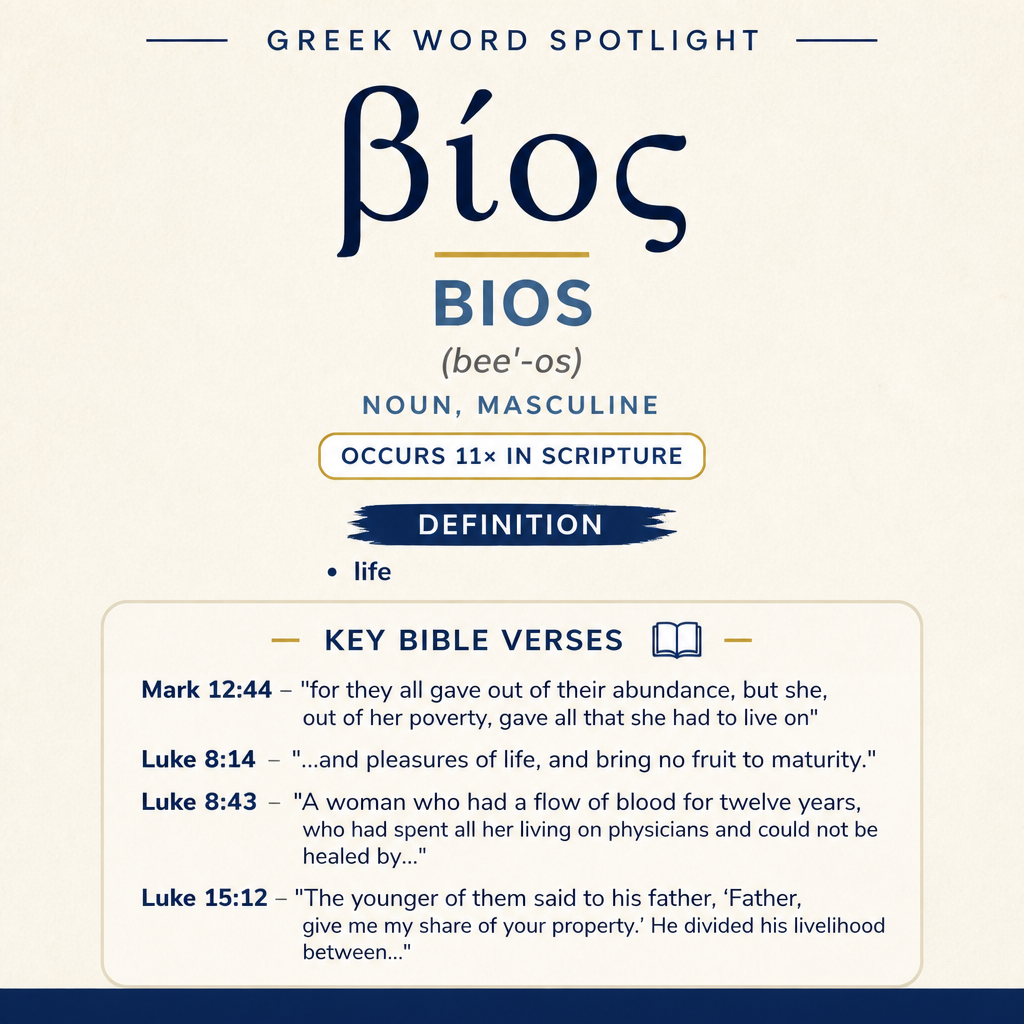
βίος (Bios) means “life” and appears 11 times in Scripture, including Mark 12:44; Luke 8:14, 8:43; Luke 15:12, 15:30; Luke 21:4; 1 Timothy 2:2; 2 Timothy 2:4.
Core Meaning
βίος is defined as “life.” In several passages it refers to what one has to live on or one’s living.
Learn More →Gospel Usage
In Mark 12:44 and Luke 21:4 it describes “all that she had to live on.” In Luke 15:12 and 15:30 it refers to a divided or devoured “living.”
Learn More →Epistle Usage
In 1 Timothy 2:2 it describes a “tranquil and quiet life” in godliness and reverence. In 2 Timothy 2:4 it appears in “the affairs of life.”
Learn More →βίος means “life,” and in the New Testament it appears in scenes that range from daily subsistence to the pressures and patterns that shape a person’s way of living. The passages gathered here use the word in concrete situations—money, property, public order, personal priorities—so that “life” is seen not as an idea but as something carried, spent, shared, or protected.
Occurrences
Mark 12:44 — “for they all gave out of their abundance, but she, out of her poverty, gave all that she had to live on.”
Here βίος is tied to what sustains a person in ordinary existence: the widow gives “all that she had to live on.” The word frames her gift not as a portion of surplus but as what remained for her continuing life—her means of getting through the days ahead.
Luke 8:14 — “That which fell among the thorns, these are those who have heard, and as they go on their way they are choked with cares, riches, and pleasures of life, and bring no fruit to maturity.”
βίος appears in a list of forces that press in on someone over time: “cares, riches, and pleasures of life.” The wording presents “life” as the sphere in which preoccupations and enjoyments accumulate and, in this parable’s image, can choke growth. The emphasis falls on ongoing experience (“as they go on their way”) where life’s concerns shape outcomes.
Luke 8:43 — “A woman who had a flow of blood for twelve years, who had spent all her living on physicians and could not be healed by any”
In this account βίος is what can be “spent”: her “living” is expended in repeated attempts at healing. “Life” is pictured in economic terms—resources bound up with maintaining life—and the sentence places that expenditure alongside the continuing ailment, highlighting the costliness of her long suffering.
Luke 15:12 — “The younger of them said to his father, ‘Father, give me my share of your property.’ He divided his livelihood between them.”
βίος is the “livelihood” that can be apportioned and transferred. The father’s division of βίος makes “life” something distributed as an inheritance-like share, a set of means by which each son may live. The word therefore sits at the intersection of family relationships and the material conditions of life.
Luke 15:30 — “But when this your son came, who has devoured your living with prostitutes, you killed the fattened calf for him.’”
Again βίος is a father’s “living,” but now it is something consumed: the older brother charges that the younger has “devoured” it. The verb choice portrays life as a stock that can be eaten up through destructive choices, and the phrase locates the loss not only in money but in what belonged to the household’s ongoing life.
Luke 21:4 — “for all these put in gifts for God from their abundance, but she, out of her poverty, put in all that she had to live on.”
This repeats the earlier widow scene’s force: βίος is what one relies on for continued living. Contrasted with “abundance,” it underscores how her act reaches down to the level of basic life-support, not merely generosity from excess.
1 Timothy 2:2 — “for kings and all who are in high places, that we may lead a tranquil and quiet life in all godliness and reverence.”
Here βίος is the manner of life a community seeks to “lead”: “a tranquil and quiet life.” The phrase links life to social conditions and public authority (“kings and all who are in high places”), suggesting that stability in civic order affects the character of lived life, which is further described by “godliness and reverence.”
2 Timothy 2:4 — “No soldier on duty entangles himself in the affairs of life, that he may please him who enrolled him as a soldier.”
βίος denotes “the affairs of life” that can entangle someone whose calling demands focus. “Life” is presented as a tangle of commitments and concerns—ordinary matters that compete for attention—and the imagery depends on the contrast between civilian complexity and the single-minded aim “to please” the one who enlisted the soldier.
1 Peter 4:3 — “For we have spent enough of our past time doing the desire of the Gentiles, and having walked in lewdness, lusts, drunken binges, orgies, carousings, and abominable idolatries.”
Although βίος is not explicit in the English wording here, the verse depicts “past time” as a way life was lived: a settled pattern of conduct (“having walked”) expressed in a catalog of actions. In this setting, the word’s contribution is the sense of life as a course or mode, measured in time spent and characterized by behavior that once defined one’s lived experience.
1 John 2:16 — “For all that is in the world, the lust of the flesh, the lust of the eyes, and the pride of life, isn’t the Father’s, but is the world’s.”
βίος stands in the phrase “the pride of life,” alongside desires associated with “flesh” and “eyes.” “Life” here is the arena in which pride can fasten—confidence and boasting bound up with one’s living and standing. The sentence contrasts what is “of the world” with what “isn’t the Father’s,” placing this form of pride within a moral evaluation of life’s orientations.
1 John 3:17 — “But whoever has the world’s goods and sees his brother in need, then closes his heart of compassion against him, how does God’s love remain in him?”
In this practical test of love, βίος is reflected through possession and need: one person “has the world’s goods,” another is “in need,” and the crucial response is compassion. Life is viewed through tangible support that can be offered or withheld, and the verse presses the question of what life looks like when resources exist but mercy is shut off.

Sense and Usage
Across these passages βίος attaches “life” to the concrete stuff by which life is carried forward: money in hand, resources spent, property divided, goods possessed. In Mark 12:44 and Luke 21:4, “life” is what the widow must ordinarily rely on; the word sharpens the weight of her offering because it touches the level of survival, not comfort. In Luke 8:43 the same life is drainable—something a sufferer can exhaust in the hope of healing—showing how life’s maintenance can be costly and uncertain.
Luke 15 uses βίος to describe what belongs to a household and can be parceled out as “livelihood,” then later devoured. In this pairing, “life” is not merely the son’s experience but the father’s estate as a means of life: it can be shared, squandered, and lamented. βίος thus speaks of life as a stock of provision bound up with relationships; the word’s force is felt in how the same “living” can either sustain the family’s future or be consumed in ways that fracture trust.
Other contexts push βίος beyond resources to the patterns and pressures of lived existence. Luke 8:14 portrays “life” as a field where competing forces—care, wealth, pleasure—grow up and choke fruitfulness over time. 1 Timothy 2:2 describes a “tranquil and quiet” life shaped by public conditions and marked by “godliness and reverence,” presenting life as a mode that can be peaceable and ordered. 2 Timothy 2:4 speaks of “the affairs of life” as entanglements; life can become a web of involvements that distract from a defined duty.
In 1 John 2:16, life becomes a platform for pride: “the pride of life” sits with other desires and is evaluated as belonging to “the world.” Here βίος is closely tied to what a person has, pursues, or displays within worldly life. That ethical edge returns in 1 John 3:17, where the possession of “the world’s goods” and the sight of a “brother in need” expose whether compassion is alive. Life, in this cluster, is not reduced to inner feeling; it is measured in orientations and actions within everyday reality.
Imagery
The imagery surrounding βίος repeatedly treats life as something held in the hand and expressed in choices. It can be poured out in generosity (Mark 12:44; Luke 21:4), drained by long struggle (Luke 8:43), divided and then consumed (Luke 15:12, 15:30), choked by competing attractions (Luke 8:14), steadied by peace and reverence (1 Timothy 2:2), or tangled in distracting affairs (2 Timothy 2:4). These texts keep “life” visible: it shows itself in what is spent, what is sought, what is feared, and what is shared.
Sources: Lexical data from Strong’s Exhaustive Concordance and the Translators Brief Lexicon of Extended Strongs for Greek (STEPBible, CC BY). Occurrence data from the Translators Amalgamated Greek New Testament (STEPBible, CC BY). Scripture quotations from the World English Bible (public domain).