
Who was Didymus in the bible?
Didymus is the name used for Thomas in John 11:16, John 20:24, and John 21:2.

Key Moments
Thomas “called Didymus” said, “Let’s go also, that we may die with him” (John 11:16). He “wasn’t with them when Jesus came” (John 20:24).
Learn More →Name Meaning
The lexicon gloss identifies Didymos as meaning “Twin,” derived from a term related to “twice.” In John 21:2, “Thomas called Didymus” is listed among disciples together (John 21:2).
Learn More →Didymus is the name by which Thomas is identified in the Gospel of John; the lexicon gloss explains that the name means “Twin.” In John, “Didymus” functions as a descriptive name attached to Thomas, one of Jesus’ disciples.
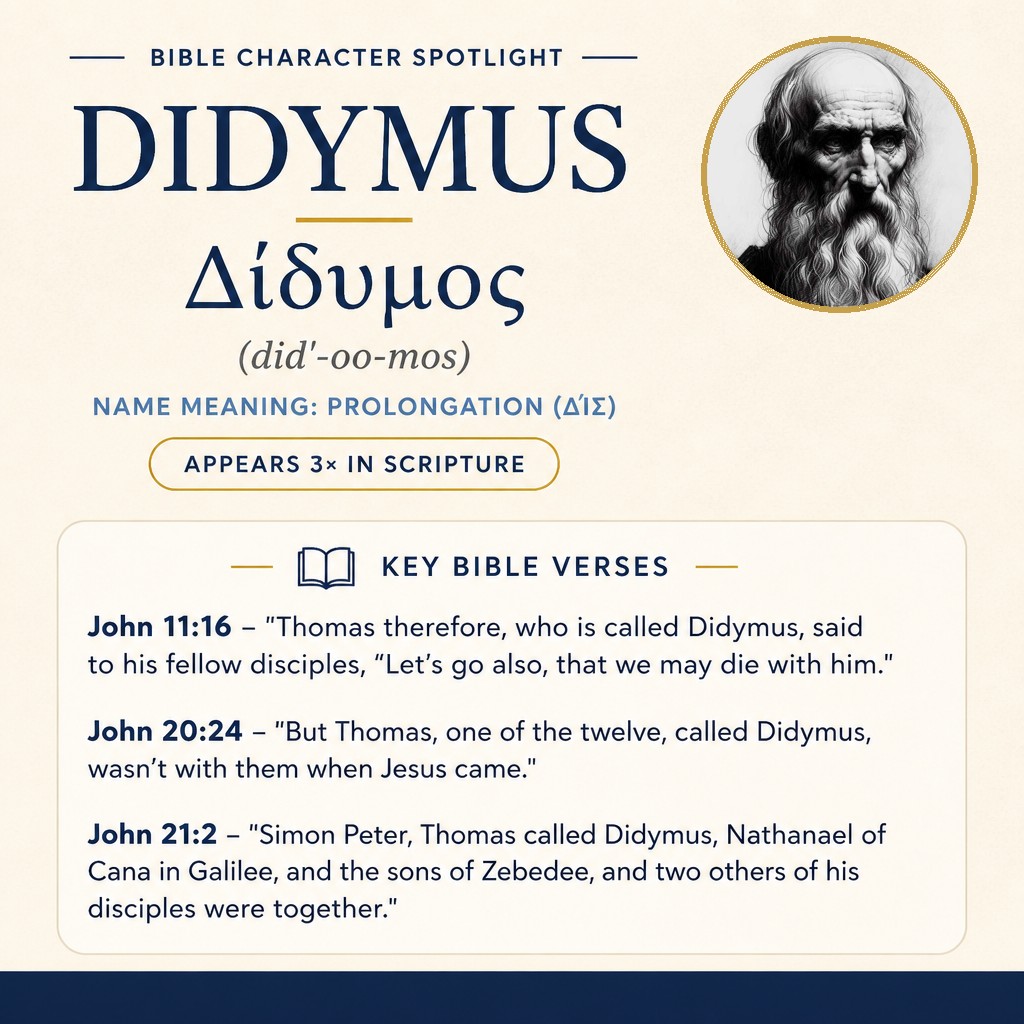
Didymus in Scripture
The first occurrence appears as Jesus speaks plainly to his disciples about Lazarus. John sets the scene with Jesus’ words: “Lazarus is dead.” (John 11:14). He continues, “Nevertheless, let’s go to him.” (John 11:15). In that setting, Thomas is introduced with the name Didymus and voices a grim resolve to go with Jesus:
“Thomas therefore, who is called Didymus, said to his fellow disciples, ‘Let’s go also, that we may die with him.’” (John 11:16)
John then continues the setting around Lazarus’s death. “So when Jesus came, he found that he had been in the tomb four days already.” (John 11:17). The narrative places the location near Jerusalem: “Now Bethany was near Jerusalem, about fifteen stadia away.” (John 11:18). It also describes the presence of mourners: “Many of the Jews had joined the women around Martha and Mary, to console them concerning their brother.” (John 11:19). Within this context, Didymus is not separated from Thomas as another person; rather, Thomas is presented as the disciple “called Didymus,” whose recorded statement is directed “to his fellow disciples” (John 11:16) as they go with Jesus toward the situation described in Bethany.
The second occurrence comes later, in a scene focused on the disciples and Jesus’ coming to them. Immediately before Thomas is mentioned, Jesus speaks to the gathered disciples: “Receive the Holy Spirit!” (John 20:22). He adds words about forgiving or retaining sins: “If you forgive anyone’s sins, they have been forgiven them. If you retain anyone’s sins, they have been retained.” (John 20:23). John then specifies that Thomas, again identified by the name Didymus, was absent at the moment of Jesus’ coming:
“But Thomas, one of the twelve, called Didymus, wasn’t with them when Jesus came.” (John 20:24)
John continues by describing the report given to Thomas and Thomas’s response. “The other disciples therefore said to him, ‘We have seen the Lord!’” (John 20:25). Thomas replies with a condition for belief, focusing on Jesus’ wounds: “Unless I see in his hands the print of the nails, put my finger into the print of the nails, and put my hand into his side, I will not believe.” (John 20:25). After an interval, John describes the scene when Thomas is present: “After eight days again his disciples were inside and Thomas was with them.” (John 20:26). The account emphasizes Jesus’ arrival despite locked doors: “Jesus came, the doors being locked, and stood in the middle, and said, ‘Peace be to you.’” (John 20:26). Jesus then addresses Thomas directly, echoing Thomas’s stated conditions and calling him to faith:
“Then he said to Thomas, ‘Reach here your finger, and see my hands. Reach here your hand, and put it into my side. Don’t be unbelieving, but believing.’” (John 20:27)
In this sequence, Didymus (Thomas) is characterized first by absence—“wasn’t with them when Jesus came” (John 20:24)—and then by presence—“Thomas was with them” (John 20:26)—and by the specific exchange that centers on believing in what the other disciples have announced and what Jesus presents to him (John 20:25–27).
The third occurrence of Didymus appears in a list of disciples gathered together after another revelation of Jesus. John introduces this section: “After these things, Jesus revealed himself again to the disciples at the sea of Tiberias.” (John 21:1). He then names those who were together, including Thomas with the identifier Didymus:
“Simon Peter, Thomas called Didymus, Nathanael of Cana in Galilee, and the sons of Zebedee, and two others of his disciples were together.” (John 21:2)
The narrative immediately describes what this group does next. “Simon Peter said to them, ‘I’m going fishing.’” (John 21:3). The others respond, “We are also coming with you.” (John 21:3). They go out and fish unsuccessfully: “That night, they caught nothing.” (John 21:3). At daybreak, Jesus is present though not recognized: “But when day had already come, Jesus stood on the beach, yet the disciples didn’t know that it was Jesus.” (John 21:4). He addresses them and receives a brief reply: “Jesus therefore said to them, ‘Children, have you anything to eat?’ They answered him, ‘No.’” (John 21:5). In this chapter’s opening, Didymus is included among the named disciples who are “together” (John 21:2) in the setting where Jesus “revealed himself again” (John 21:1) at the sea of Tiberias.
Name and Meaning
The Greek form of the name is Δίδυμος, transliterated Didymos and pronounced did’-oo-mos. Strong’s derivation notes it as a prolongation from G1364 (δίς), with the component word dis (δίς) meaning “twice”; the lexicon identity gloss explains Didymus as meaning “Twin.”
Brief observation
Across John’s references, “Didymus” consistently identifies Thomas—“Thomas therefore, who is called Didymus” (John 11:16) and “Thomas, one of the twelve, called Didymus” (John 20:24)—and the name appears in scenes where John records Thomas’s words and presence among the disciples (John 11:16; 20:25–27; 21:2).
Frequently Asked Questions
What does the name Didymus mean?
Didymus means “twin.”
How many times does Didymus appear in the Bible?
Didymus appears 3 times.
Who was Didymus?
Didymus is a name used for Thomas. John 20:24 calls him “Thomas, one of the twelve, called Didymus.”
What did Thomas called Didymus say in John 11:16?
In John 11:16, “Thomas therefore, who is called Didymus,” said to his fellow disciples, “Let’s go also, that we may die with him.”
Explore Further
If you found this page about Didymus interesting and would like to discover more about other biblical characters, explore our comprehensive Encyclopedia of Biblical Characters. For those looking to delve deeper into the Greek origins of these names and terms, our Greek Lexicon is an invaluable resource.
Sources: Name and occurrence data from Strong’s Exhaustive Concordance and STEPBible reference data (CC BY). Scripture quotations from the World English Bible (public domain).





