
Understanding the Significance of Didumos in Greek
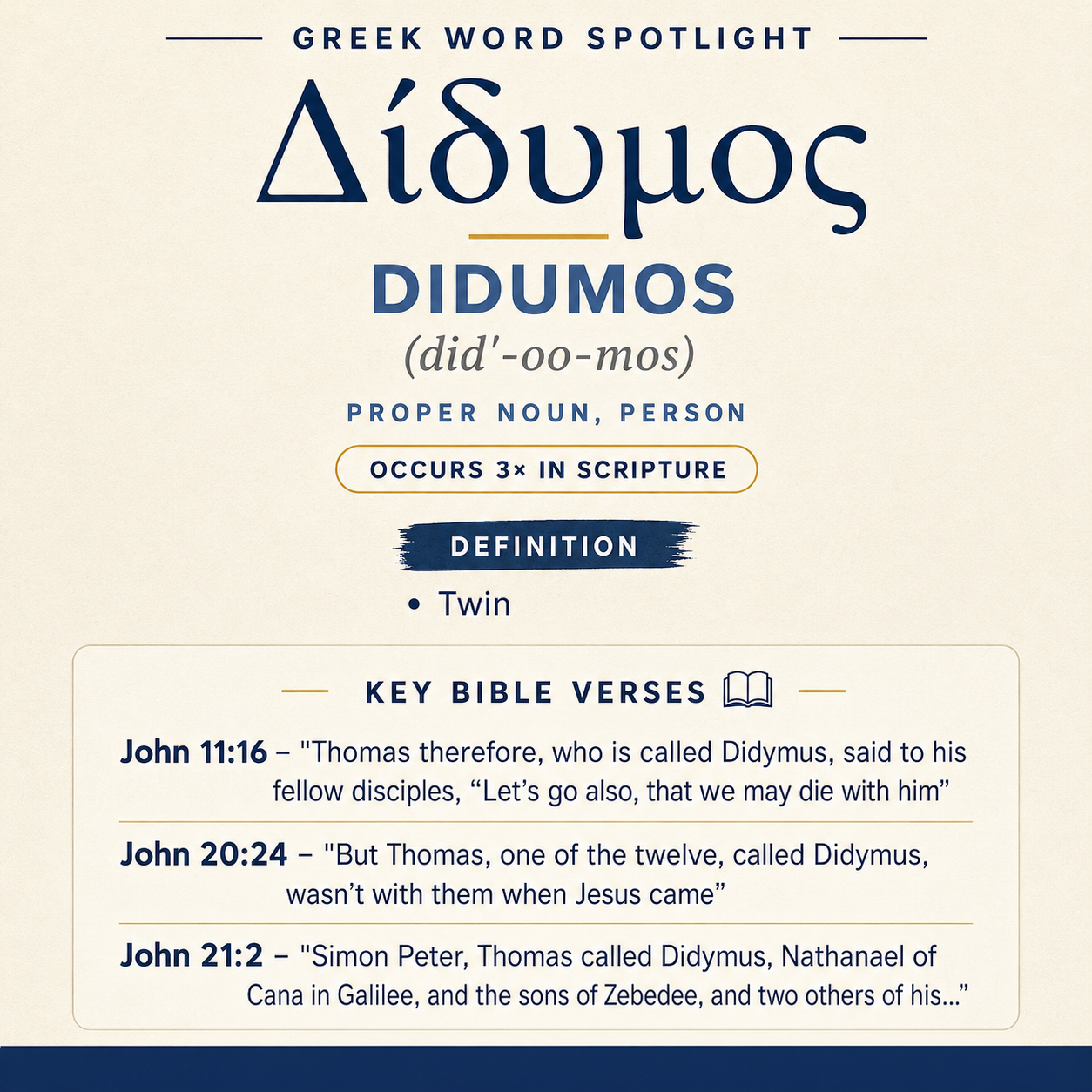
Δίδυμος (Didumos) means “Twin” and appears three times in John’s Gospel (John 11:16; 20:24; 21:2).
Johannine Usage
In John 11:16, Thomas is called Didymus when he urges the disciples to go with Jesus. In John 20:24, Thomas, called Didymus, is noted as absent when Jesus came.
Learn More →Other Occurrence
In John 21:2, Thomas called Didymus is listed among the disciples present.
Learn More →Δίδυμος is used in John’s Gospel as a name attached to Thomas, identifying him with the designation “Twin.” It appears in three brief notices where Thomas is introduced, absent, or listed among disciples.
Root and Related Words
Δίδυμος is connected with dis (δίς), “twice” (Strong’s G1364), a relationship reflected in the idea of a “Twin” as one of two.

Occurrences
John 11:16: Thomas therefore, who is called Didymus, said to his fellow disciples, “Let’s go also, that we may die with him.”
Here “Didymus” is presented as a spoken identifier attached to Thomas: “Thomas therefore, who is called Didymus.” The narrative then immediately places Thomas in a moment of decisive speech to “his fellow disciples,” and the name functions to mark which Thomas is speaking in this tense exchange. Within the verse, the designation sits between Thomas’s introduction and his resolve—“Let’s go also”—so that the reader meets the man under this identifying label at the very point he voices willingness to share the danger implied by going (“that we may die with him”). “Didymus” contributes as an identifying name in the flow of the scene, fastening the statement to Thomas as the speaker known by this additional designation.
John 20:24: But Thomas, one of the twelve, called Didymus, wasn’t with them when Jesus came.
In this notice the designation appears in a careful stack of identifiers: “Thomas, one of the twelve, called Didymus.” “Didymus” is again presented as what Thomas is “called,” set alongside his place within the circle (“one of the twelve”). The verse’s main point is absence—he “wasn’t with them when Jesus came”—and “Didymus” anchors that absence to the particular disciple the reader is meant to track. By adding “called Didymus,” the line does more than supply a label; it ties the later narrative emphasis on where Thomas was (and was not) to the disciple already introduced under this designation.
John 21:2: Simon Peter, Thomas called Didymus, Nathanael of Cana in Galilee, and the sons of Zebedee, and two others of his disciples were together.
Here “Didymus” appears within a gathered-company list. The phrase “Thomas called Didymus” places the designation as a fixed appositive, a way of naming Thomas in community context as the group is assembled: “Simon Peter, Thomas called Didymus, Nathanael… the sons of Zebedee, and two others… were together.” In a verse concerned with who is present and the fact that they “were together,” “Didymus” functions as part of the identifying roll call, distinguishing Thomas by the name attached to him. The designation therefore contributes to the portrait of the disciples’ company: Thomas is not merely present; he is present as the one “called Didymus,” the disciple carrying that identifying title as the narrative frames the group.
Sense and Usage
Across these three passages, “Didymus” consistently operates as a designation attached to Thomas rather than as a separate character. The word’s sense (“Twin”) is not expanded into a story within these verses; instead, it serves the Gospel’s immediate narrative needs: identifying the speaker (John 11:16), pinpointing the absent disciple (John 20:24), and specifying a member of a gathered group (John 21:2). In each case the designation is linked by a formula of naming—“who is called Didymus,” “called Didymus,” “Thomas called Didymus”—which portrays “Didymus” as a recognized identifier used within the narrative world.
Because it is used only in such naming phrases, the sense of “Twin” functions indirectly: it is carried as a stable label that accompanies Thomas wherever he is introduced or reintroduced. The effect is that Thomas is repeatedly encountered through a double naming, “Thomas” alongside “Didymus,” which makes the designation part of his narrative identity. The repeated use in contexts of presence and absence (“wasn’t with them,” “were together”) also makes the name a tracking marker for Thomas’s movements in relation to the other disciples: the one called “Twin” is the one who speaks up in a dangerous decision, the one missing at a crucial moment, and the one counted among those together.
Imagery and Resonance
In these verses the imagery carried by “Didymus” is quiet and relational: a name meaning “Twin” sits on a disciple whose life is constantly shown in relation to others—“his fellow disciples” (John 11:16), “them” from whom he is separated (John 20:24), and the group who “were together” (John 21:2). The designation itself appears precisely where the text highlights belonging, separation, and reunion within the company of disciples, so that the name’s force is felt in how it accompanies Thomas through those shifting group scenes.
Sources: Lexical data from Strong’s Exhaustive Concordance and the Translators Brief Lexicon of Extended Strongs for Greek (STEPBible, CC BY). Occurrence data from the Translators Amalgamated Greek New Testament (STEPBible, CC BY). Scripture quotations from the World English Bible (public domain).




