Who was Thomas in the bible?
Thomas (a name of Chaldee origin) is listed among the twelve in the Gospels and Acts, and is called Didymus in John (Matthew 10:3; John 20:24; Acts 1:13).

Words in John
Thomas said, “Lord, we don’t know where you are going. How can we know the way?” (John 14:5). He also said to his fellow disciples, “Let’s go also, that we may die with him.” (John 11:16).
Learn More →Seeing and Believing
Thomas said, “Unless I see in his hands the print of the nails… I will not believe.” (John 20:25). After Jesus spoke to him, Thomas answered, “My Lord and my God!” (John 20:28).
Learn More →Thomas is named among Jesus’ disciples and is identified as “one of the twelve,” also being “called Didymus.” In John’s Gospel he speaks frankly among “his fellow disciples,” and he is remembered for moving from stated doubt to a direct confession of Jesus.
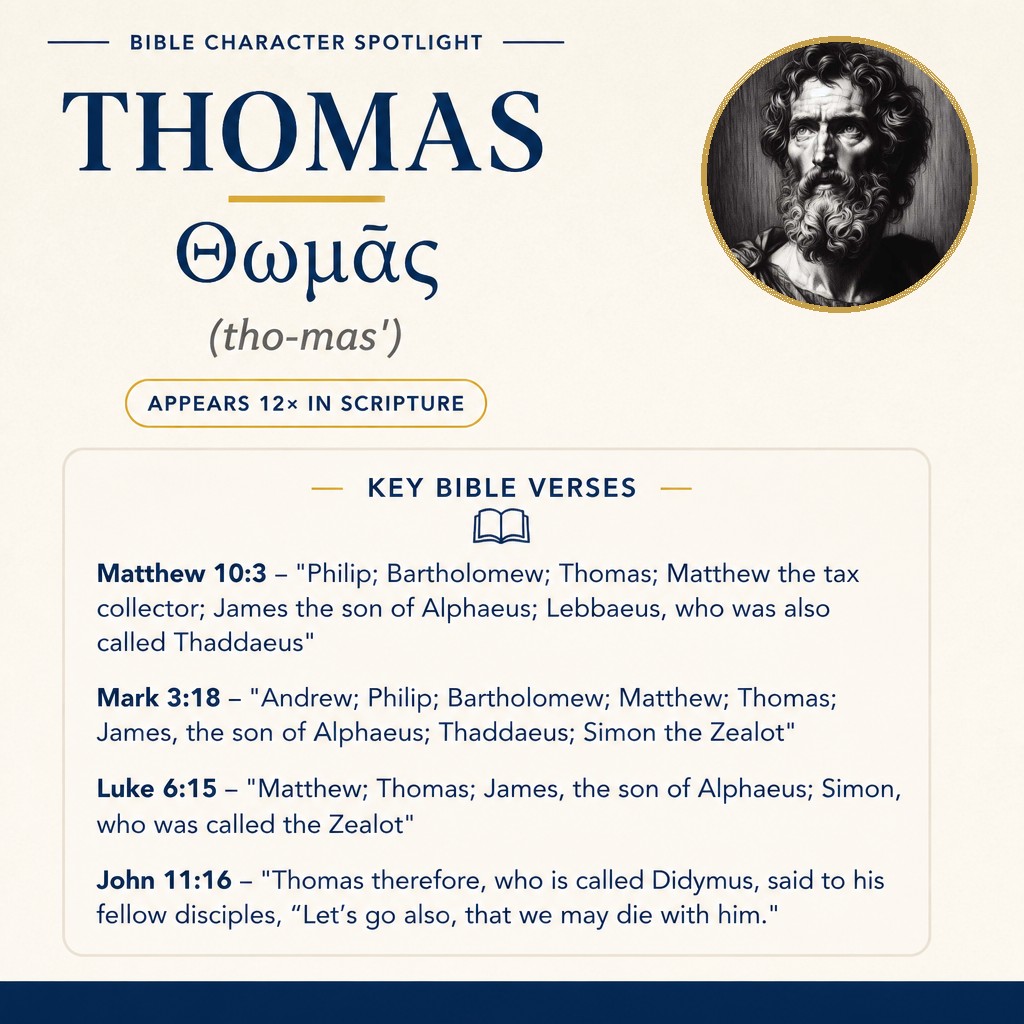
Thomas in Scripture
Thomas appears in lists of the disciples. Matthew records him among others in a roster of names:
“Philip; Bartholomew; Thomas; Matthew the tax collector; James the son of Alphaeus; Lebbaeus, who was also called Thaddaeus;” (Matthew 10:3)
Mark likewise includes him in a list of appointed disciples:
“Andrew; Philip; Bartholomew; Matthew; Thomas; James, the son of Alphaeus; Thaddaeus; Simon the Zealot;” (Mark 3:18)
Luke includes Thomas as well, placing him near Matthew and James the son of Alphaeus:
“Matthew; Thomas; James, the son of Alphaeus; Simon, who was called the Zealot;” (Luke 6:15)
In John’s Gospel, Thomas is presented as a recognizable figure among the disciples, and John provides a second name for him. When Jesus’ disciples are facing a dangerous situation, Thomas speaks with resolution:
“Thomas therefore, who is called Didymus, said to his fellow disciples, ‘Let’s go also, that we may die with him.’ ” (John 11:16)
Later, in a conversation in which Thomas addresses Jesus directly, he admits uncertainty and asks a practical question:
“Thomas said to him, ‘Lord, we don’t know where you are going. How can we know the way?’ ” (John 14:5)
John 20 contains the most extended narrative involving Thomas, set amid the disciples’ reactions after the tomb is found open and Jesus is seen. The chapter opens with Mary Magdalene coming “early, while it was still dark, to the tomb,” seeing “the stone taken away from the tomb,” and reporting to Simon Peter and “the other disciple whom Jesus loved,” saying:
“They have taken away the Lord out of the tomb, and we don’t know where they have laid him!” (John 20:2)
Peter and the other disciple run to the tomb and see “the linen cloths lying” and “the cloth that had been on his head… rolled up in a place by itself” (John 20:6–7). After this, Mary remains outside weeping, sees two angels, and then sees Jesus but initially does not recognize him. When Jesus speaks her name, she responds, and Jesus sends her to report to “my brothers” that he is ascending “to my Father and your Father, to my God and your God” (John 20:17). Mary then “came and told the disciples that she had seen the Lord” (John 20:18).
That same day, as evening comes, the disciples are gathered behind locked doors “for fear of the Jews,” and Jesus comes and stands among them, greeting them and showing them his wounds:
“When therefore it was evening on that day, the first day of the week, and when the doors were locked where the disciples were assembled, for fear of the Jews, Jesus came and stood in the middle, and said to them, ‘Peace be to you.’ ” (John 20:19)
“When he had said this, he showed them his hands and his side. The disciples therefore were glad when they saw the Lord.” (John 20:20)
Jesus again says, “Peace be to you,” and commissions them: “As the Father has sent me, even so I send you” (John 20:21). He “breathed on them,” telling them, “Receive the Holy Spirit!” and speaks about forgiving or retaining sins (John 20:22–23).
Thomas’ part in this chapter begins with the note that he missed that first appearance to the gathered disciples:
“But Thomas, one of the twelve, called Didymus, wasn’t with them when Jesus came.” (John 20:24)
When the other disciples report their experience to Thomas, he sets out a specific requirement for belief that focuses on seeing and touching Jesus’ wounds:
“The other disciples therefore said to him, ‘We have seen the Lord!’ But he said to them, ‘Unless I see in his hands the print of the nails, put my finger into the print of the nails, and put my hand into his side, I will not believe.’ ” (John 20:25)
Eight days later, Thomas is present with the disciples indoors. Again the setting emphasizes the locked doors and Jesus’ sudden presence in their midst:
“After eight days again his disciples were inside and Thomas was with them. Jesus came, the doors being locked, and stood in the middle, and said, ‘Peace be to you.’ ” (John 20:26)
Jesus then directly addresses Thomas with an invitation that matches Thomas’ earlier stated conditions and calls him from unbelief to belief:
“Then he said to Thomas, ‘Reach here your finger, and see my hands. Reach here your hand, and put it into my side. Don’t be unbelieving, but believing.’ ” (John 20:27)
Thomas responds with a brief confession addressed to Jesus:
“Thomas answered him, ‘My Lord and my God!’ ” (John 20:28)
Jesus replies by connecting Thomas’ belief to seeing, and pronounces a blessing on those who believe without seeing:
“Jesus said to him, ‘Because you have seen me, you have believed. Blessed are those who have not seen, and have believed.’ ” (John 20:29)
The chapter closes by stating that Jesus did “many other signs in the presence of his disciples,” and that what is written has the purpose “that you may believe that Jesus is the Christ, the Son of God, and that believing you may have life in his name” (John 20:30–31). Within this stated purpose, Thomas’ movement from “I will not believe” (John 20:25) to “My Lord and my God!” (John 20:28) functions as a narrated example of belief reached through Jesus’ self-disclosure.
After John 20, Thomas appears again in a brief gathering of disciples where he is explicitly named together with others:
“Simon Peter, Thomas called Didymus, Nathanael of Cana in Galilee, and the sons of Zebedee, and two others of his disciples were together.” (John 21:2)
In Acts, Thomas is listed among those staying in an upper room after Jesus’ ascension is assumed as part of the narrative setting, and he appears among a familiar set of names:
“When they had come in, they went up into the upper room where they were staying; that is Peter, John, James, Andrew, Philip, Thomas, Bartholomew, Matthew, James the son of Alphaeus, Simon the Zealot, and Judas the son of James.” (Acts 1:13)
Name and Meaning
In Greek script the name is written Θωμᾶς, transliterated Thomas and pronounced tho-mas’. Lexically, the name is described as being of Chaldee origin.
Observation
Across John 20, Thomas is presented as one who demanded, “I will not believe” without seeing and touching (John 20:25), yet who answered Jesus with the confession, “My Lord and my God!” (John 20:28), after Jesus told him, “Don’t be unbelieving, but believing” (John 20:27).
Frequently Asked Questions
What does the name Thomas mean?
Thomas is a Greek form of a name of Chaldee origin.
How many times does Thomas appear in the Bible?
Thomas appears 12 times.
Who was Thomas in the Bible?
Thomas is listed among the twelve disciples (Matthew 10:3; Mark 3:18; Luke 6:15) and is called Didymus (John 11:16; John 20:24).
What did Thomas say when Jesus spoke to him after the resurrection?
Thomas answered Jesus, “My Lord and my God!” (John 20:28).
Explore Further
If you found this page about Thomas interesting and would like to discover more about other biblical characters, explore our comprehensive Encyclopedia of Biblical Characters. For those looking to delve deeper into the Greek origins of these names and terms, our Greek Lexicon is an invaluable resource.
Sources: Name and occurrence data from Strong’s Exhaustive Concordance and STEPBible reference data (CC BY). Scripture quotations from the World English Bible (public domain).