
Who was Nathanael in the bible?
Nathanael appears in John 1:45–49 and John 21:2, where Philip brings him to Jesus and he is named among the disciples together.

Meeting Jesus
Nathanael asked, “Can any good thing come out of Nazareth?” and Philip replied, “Come and see” (John 1:46, WEB). When Jesus said, “Before Philip called you, when you were under the fig tree, I saw you,” Nathanael confessed, “Rabbi, you are the Son of God! You are King of Israel!” (John 1:48–49, WEB).
Learn More →With Disciples
Nathanael is listed among those present: “Simon Peter, Thomas called Didymus, Nathanael of Cana in Galilee... and two others of his disciples” (John 21:2, WEB). His name is of Hebrew origin (Strong’s G3482).
Learn More →Nathanael is a man named in the Gospel of John, presented as one whom Philip brought to Jesus and who responded by confessing Jesus’ identity. The Greek form of his name is Ναθαναήλ (Nathanael), a name of Hebrew origin.
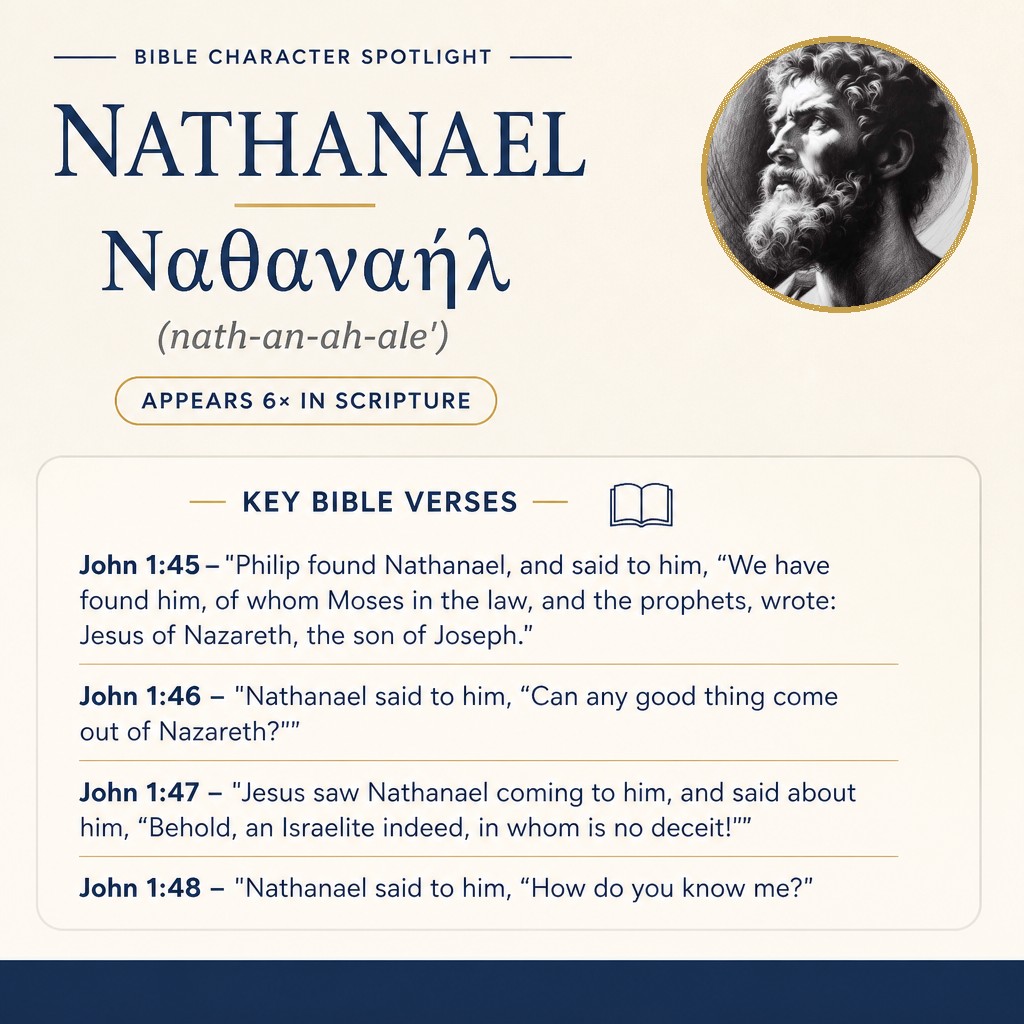
Nathanael in Scripture
Nathanael appears within John’s opening narrative about the Word made flesh, John’s testimony, and the first gatherings of disciples around Jesus. John introduces the setting broadly: “In the beginning was the Word, and the Word was with God, and the Word was God.” (John 1:1). The chapter continues with the witness of John: “There came a man, sent from God, whose name was John.” (John 1:6). John testifies about Jesus in strong terms, including, “Behold, the Lamb of God, who takes away the sin of the world!” (John 1:29) and, “I have seen, and have testified that this is the Son of God.” (John 1:34). Against this backdrop of testimony and calling, John narrates the first steps of following Jesus.
After two disciples begin following Jesus (John 1:35–39) and Andrew brings Simon to Jesus (John 1:40–42), the narrative moves to Philip. “On the next day, he was determined to go out into Galilee, and he found Philip. Jesus said to him, “Follow me.”” (John 1:43). Immediately after Philip is found, Philip finds Nathanael, and Nathanael becomes part of the early sequence of encounters that define Jesus’ initial reception.
Philip found Nathanael, and said to him, “We have found him, of whom Moses in the law, and the prophets, wrote: Jesus of Nazareth, the son of Joseph.” (John 1:45)
This first direct mention places Nathanael as the recipient of Philip’s announcement. Philip frames Jesus in terms of expectation grounded in “Moses in the law, and the prophets” (John 1:45), and identifies him as “Jesus of Nazareth, the son of Joseph.” (John 1:45). Nathanael’s immediate reply is skeptical about Nazareth as a place associated with good things. Philip answers not with an argument but with an invitation to encounter Jesus directly.
Nathanael said to him, “Can any good thing come out of Nazareth?” Philip said to him, “Come and see.” (John 1:46)
The narrative then shifts to Jesus’ perspective as Nathanael approaches. Jesus speaks about Nathanael before Nathanael speaks about himself, describing him in moral terms and identifying him as an Israelite without deceit.
Jesus saw Nathanael coming to him, and said about him, “Behold, an Israelite indeed, in whom is no deceit!” (John 1:47)
Nathanael’s response is a question about recognition: “How do you know me?” (John 1:48). Jesus answers with a statement that implies prior sight and knowledge, tied to Philip’s earlier call and a specific location: “under the fig tree.”
Nathanael said to him, “How do you know me?” Jesus answered him, “Before Philip called you, when you were under the fig tree, I saw you.” (John 1:48)
On hearing this, Nathanael’s skepticism gives way to a confession directed to Jesus, using titles that, in John’s narrative, mark the recognition of Jesus’ status and role.
Nathanael answered him, “Rabbi, you are the Son of God! You are King of Israel!” (John 1:49)
Jesus replies by connecting Nathanael’s belief to the “fig tree” statement and promising that greater things will follow. In the continuation of the chapter’s dialogue, Jesus says:
Jesus answered him, “Because I told you, ‘I saw you underneath the fig tree,’ do you believe? You will see greater things than these!” (John 1:50)
Jesus then speaks more broadly in a promise of what “you will see,” using imagery of heaven opened and angels ascending and descending “on the Son of Man.” Though the statement is addressed in the same exchange, it expands beyond the initial recognition to a larger revelation that follows the first calling narratives.
He said to him, “Most certainly, I tell you all, hereafter you will see heaven opened, and the angels of God ascending and descending on the Son of Man.” (John 1:51)
Beyond John 1, Nathanael is named once more in John in a list of disciples gathered together. This later mention supplies his place of association: Cana in Galilee. The text reads:
Simon Peter, Thomas called Didymus, Nathanael of Cana in Galilee, and the sons of Zebedee, and two others of his disciples were together. (John 21:2)
Here Nathanael is counted among a group explicitly identified as “his disciples” (John 21:2). In that verse he is placed alongside named disciples—“Simon Peter” and “Thomas called Didymus”—as well as “the sons of Zebedee,” plus “two others of his disciples.” (John 21:2). The descriptive phrase “Nathanael of Cana in Galilee” (John 21:2) is the only geographical qualifier attached to his name in the provided passages.
Name and Meaning
The name appears in Greek as Ναθαναήλ, transliterated Nathanael and pronounced nath-an-ah-ale’. According to the provided lexicon information, the name is of Hebrew origin (H05417); this derivation is a linguistic note about the name’s source rather than a narrative detail from the verses themselves.
Closing Observation
In John’s presentation, Nathanael moves from questioning—“Can any good thing come out of Nazareth?” (John 1:46)—to direct confession—“Rabbi, you are the Son of God! You are King of Israel!” (John 1:49)—after Jesus’ statement, “Before Philip called you, when you were under the fig tree, I saw you.” (John 1:48).
Frequently Asked Questions
What does the name Nathanael mean?
Nathanael is a Greek form of a name of Hebrew origin.
How many times does Nathanael appear in the Bible?
Nathanael appears 6 times.
Who was Nathanael?
Nathanael is a person mentioned in the Gospel of John. In John 1:47, Jesus says about him, “Behold, an Israelite indeed, in whom is no deceit!”
What did Nathanael say about Jesus?
In John 1:49, Nathanael says to Jesus, “Rabbi, you are the Son of God! You are King of Israel!”
Explore Further
If you found this page about Nathanael interesting and would like to discover more about other biblical characters, explore our comprehensive Encyclopedia of Biblical Characters. For those looking to delve deeper into the Greek origins of these names and terms, our Greek Lexicon is an invaluable resource.
Sources: Name and occurrence data from Strong’s Exhaustive Concordance and STEPBible reference data (CC BY). Scripture quotations from the World English Bible (public domain).





