
Who was Lazarus in the bible?
Lazarus is a name used in Luke 16:20–25 and John 11:1–44; 12:1–2 for a beggar in a story and a man from Bethany loved by Jesus.

Bethany Lazarus
“Now Jesus loved Martha, and her sister, and Lazarus” (John 11:5). Jesus said plainly, “Lazarus is dead,” then cried, “Lazarus, come out!” (John 11:14, 11:43).
Learn More →After Raised
John says Jesus came to Bethany, “where Lazarus was, who had been dead, whom he raised from the dead” (John 12:1). At a supper there, “Lazarus was one of those who sat at the table with him” (John 12:2).
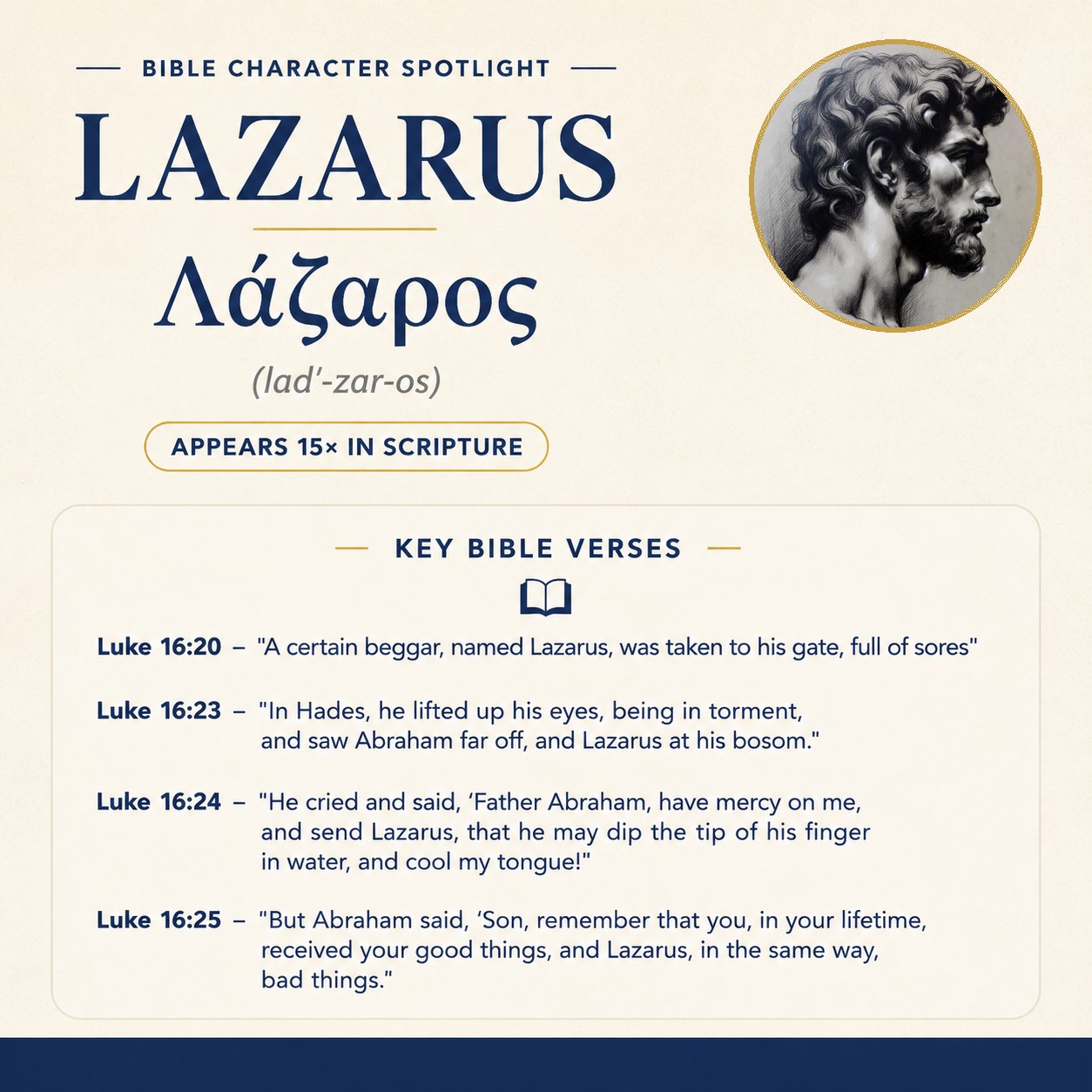
Learn More →Lazarus is a Greek-named figure (Λάζαρος, Lazaros) who appears in two distinct Gospel contexts: a beggar named Lazarus in Luke’s account, and a man from Bethany—brother of Mary and Martha—whom Jesus loved and raised from the dead in John.
Lazarus in Scripture
1) Lazarus the beggar (Luke 16)
Luke presents “a certain beggar, named Lazarus,” pictured in suffering and then in comfort after death.
“A certain beggar, named Lazarus, was taken to his gate, full of sores,” (Luke 16:20, WEB)
“In Hades, he lifted up his eyes, being in torment, and saw Abraham far off, and Lazarus at his bosom.” (Luke 16:23, WEB)
In the same scene, the man in torment pleads for relief involving Lazarus.
“He cried and said, ‘Father Abraham, have mercy on me, and send Lazarus, that he may dip the tip of his finger in water, and cool my tongue! For I am in anguish in this flame.’” (Luke 16:24, WEB)
Abraham’s reply contrasts the earthly experience of “good things” and “bad things” with the reversal described there.
“But Abraham said, ‘Son, remember that you, in your lifetime, received your good things, and Lazarus, in the same way, bad things. But here he is now comforted, and you are in anguish.” (Luke 16:25, WEB)
2) Lazarus from Bethany (John 11–12)
John introduces Lazarus as a man from Bethany, identified within a family: “Mary and her sister, Martha.”
“Now a certain man was sick, Lazarus from Bethany, of the village of Mary and her sister, Martha.” (John 11:1, WEB)
“It was that Mary who had anointed the Lord with ointment and wiped his feet with her hair, whose brother, Lazarus, was sick.” (John 11:2, WEB)
The chapter’s narrative begins with the sisters sending word to Jesus about Lazarus’ illness: “Lord, behold, he for whom you have great affection is sick” (John 11:3). Jesus interprets the illness in terms of divine purpose: “This sickness is not to death, but for the glory of God, that God’s Son may be glorified by it” (John 11:4). John explicitly describes Jesus’ love for the family.
“Now Jesus loved Martha, and her sister, and Lazarus.” (John 11:5, WEB)
After hearing the report, Jesus delays: “he stayed two days in the place where he was” (John 11:6), then tells his disciples, “Let’s go into Judea again” (John 11:7). When the disciples object because “the Jews were just trying to stone you” (John 11:8), Jesus answers with imagery about walking in daylight versus stumbling at night (John 11:9–10).
Jesus then speaks of Lazarus in a way that the disciples misunderstand.
“Our friend, Lazarus, has fallen asleep, but I am going so that I may awake him out of sleep.” (John 11:11, WEB)
The disciples think he means literal sleep and recovery (John 11:12–13), so Jesus states the situation plainly:
“Lazarus is dead.” (John 11:14, WEB)
Jesus adds, “I am glad for your sakes that I was not there, so that you may believe. Nevertheless, let’s go to him” (John 11:15). Thomas responds to the group, “Let’s go also, that we may die with him” (John 11:16).
When Jesus arrives, Lazarus has already been buried for some time.
“So when Jesus came, he found that he had been in the tomb four days already.” (John 11:17, WEB)
The setting is near Jerusalem (John 11:18), and “many of the Jews had joined the women around Martha and Mary, to console them concerning their brother” (John 11:19). Martha goes to meet Jesus while Mary stays in the house (John 11:20). Martha expresses grief and confidence at once: “Lord, if you would have been here, my brother wouldn’t have died” (John 11:21), and “Even now I know that whatever you ask of God, God will give you” (John 11:22). Jesus tells her, “Your brother will rise again” (John 11:23). Martha replies, “I know that he will rise again in the resurrection at the last day” (John 11:24).
Jesus responds with a self-description tied to life and death, and asks for Martha’s belief.
“I am the resurrection and the life. He who believes in me will still live, even if he dies.” (John 11:25, WEB)
“Whoever lives and believes in me will never die. Do you believe this?” (John 11:26, WEB)
Martha answers: “Yes, Lord. I have come to believe that you are the Christ, God’s Son, he who comes into the world” (John 11:27). She then calls Mary, telling her, “The Teacher is here and is calling you” (John 11:28). Mary goes quickly (John 11:29). Jesus is still outside the village where Martha met him (John 11:30). Those consoling Mary follow, assuming, “She is going to the tomb to weep there” (John 11:31).
Mary reaches Jesus, falls at his feet, and repeats the same sorrowful thought as Martha: “Lord, if you would have been here, my brother wouldn’t have died” (John 11:32). Seeing Mary and others weeping, Jesus “groaned in the spirit, and was troubled” (John 11:33), and asks, “Where have you laid him?” They reply, “Lord, come and see” (John 11:34). John records the brief line, “Jesus wept” (John 11:35). Some interpret his tears as affection—“See how much affection he had for him!” (John 11:36)—while others question why he did not prevent the death (John 11:37).
Jesus goes to the tomb: “a cave, and a stone lay against it” (John 11:38). He commands, “Take away the stone” (John 11:39). Martha objects based on the time elapsed: “Lord, by this time there is a stench, for he has been dead four days” (John 11:39). Jesus replies, “Didn’t I tell you that if you believed, you would see God’s glory?” (John 11:40). The stone is removed (John 11:41). Jesus prays openly, explaining that he speaks “because of the multitude standing around… that they may believe that you sent me” (John 11:42).
Then Jesus calls Lazarus by name.
“When he had said this, he cried with a loud voice, ‘Lazarus, come out!’” (John 11:43, WEB)
The narrative describes Lazarus’ emergence from death and Jesus’ command to release him.
“He who was dead came out, bound hand and foot with wrappings, and his face was wrapped around with a cloth. Jesus said to them, ‘Free him, and let him go.’” (John 11:44, WEB)
The result is division among the witnesses: “many of the Jews who came to Mary and saw what Jesus did believed in him” (John 11:45), while others report the event to the Pharisees (John 11:46). The chief priests and Pharisees convene and worry, “For this man does many signs” (John 11:47), fearing, “everyone will believe in him” (John 11:48). The chapter continues with counsel and decisions among leaders (John 11:49–53), and Jesus’ subsequent withdrawal to “a city called Ephraim” (John 11:54) as Passover approaches (John 11:55–57).
John later places Lazarus alive in Bethany shortly before Passover, explicitly identifying him as one whom Jesus raised.
“Then six days before the Passover, Jesus came to Bethany, where Lazarus was, who had been dead, whom he raised from the dead.” (John 12:1, WEB)
“So they made him a supper there. Martha served, but Lazarus was one of those who sat at the table with him.” (John 12:2, WEB)
Multiple bearers
The name Lazarus refers to more than one individual in the passages cited. Luke describes “a certain beggar, named Lazarus” (Luke 16:20), who is later seen “at [Abraham’s] bosom” (Luke 16:23). John describes “Lazarus from Bethany” (John 11:1), “whose brother, Lazarus, was sick” (John 11:2), who dies (John 11:14), is called from the tomb—“Lazarus, come out!” (John 11:43)—and later sits at supper in Bethany after having been raised (John 12:1–2).
Name and Meaning
The name is written in Greek as Λάζαρος (transliterated Lazaros, pronounced lad’-zar-os). Strong’s lexicon associates it as probably of Hebrew origin (H0499) and identifies it as the personal name Lazarus.
Observation
Across these passages, Lazarus is presented either as a suffering beggar later “comforted” (Luke 16:25) or as Jesus’ “friend” (John 11:11) whose death and restoration become a public sign that led many observers to belief (John 11:45).
Frequently Asked Questions
What does the name Lazarus mean?
Lazarus is a Greek form of a name probably of Hebrew origin, used as the name “Lazarus.”
How many times does Lazarus appear in the Bible?
The name Lazarus occurs 15 times.
Who was Lazarus?
In Luke 16, Lazarus is named as a beggar (Luke 16:20). In John 11–12, Lazarus is from Bethany and is the brother of Mary and Martha (John 11:1–2).
What happened when Jesus called Lazarus?
Jesus cried with a loud voice, “Lazarus, come out!” (John 11:43).
Explore Further
If you found this page about Lazarus interesting and would like to discover more about other biblical characters, explore our comprehensive Encyclopedia of Biblical Characters. For those looking to delve deeper into the Greek origins of these names and terms, our Greek Lexicon is an invaluable resource.
Sources: Name and occurrence data from Strong’s Exhaustive Concordance and STEPBible reference data (CC BY). Scripture quotations from the World English Bible (public domain).





