
Exploring the Meaning of Tragos in Greek
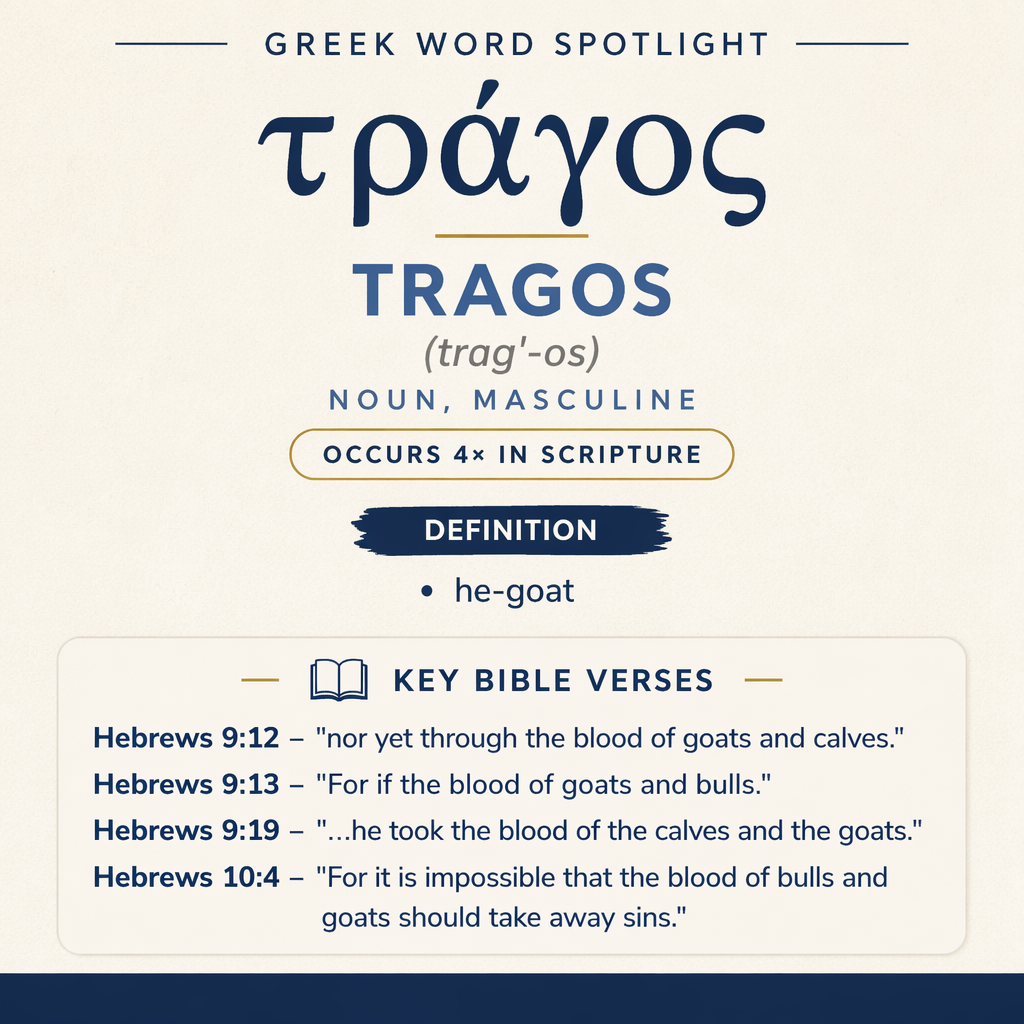
τράγος means “he-goat” and appears four times in Scripture, all in Hebrews (9:12, 9:13, 9:19; 10:4).
Hebrews Context
All four occurrences are in Hebrews. The passages mention blood of goats in sacrificial and purification contexts.
Learn More →Key Emphasis
Hebrews 10:4 states it is impossible for the blood of bulls and goats to take away sins.
Learn More →τράγος refers to a he-goat, appearing in Hebrews in a sustained discussion of sacrificial blood and its effects. In these passages, the term is consistently set within paired lists of sacrificial animals and is used to frame a contrast between what such blood accomplishes and what it cannot accomplish.
Root and Related Words
Strong’s connects τράγος with the verb τρώγω (trogo), “to eat” (Strong’s G5176).
Occurrences
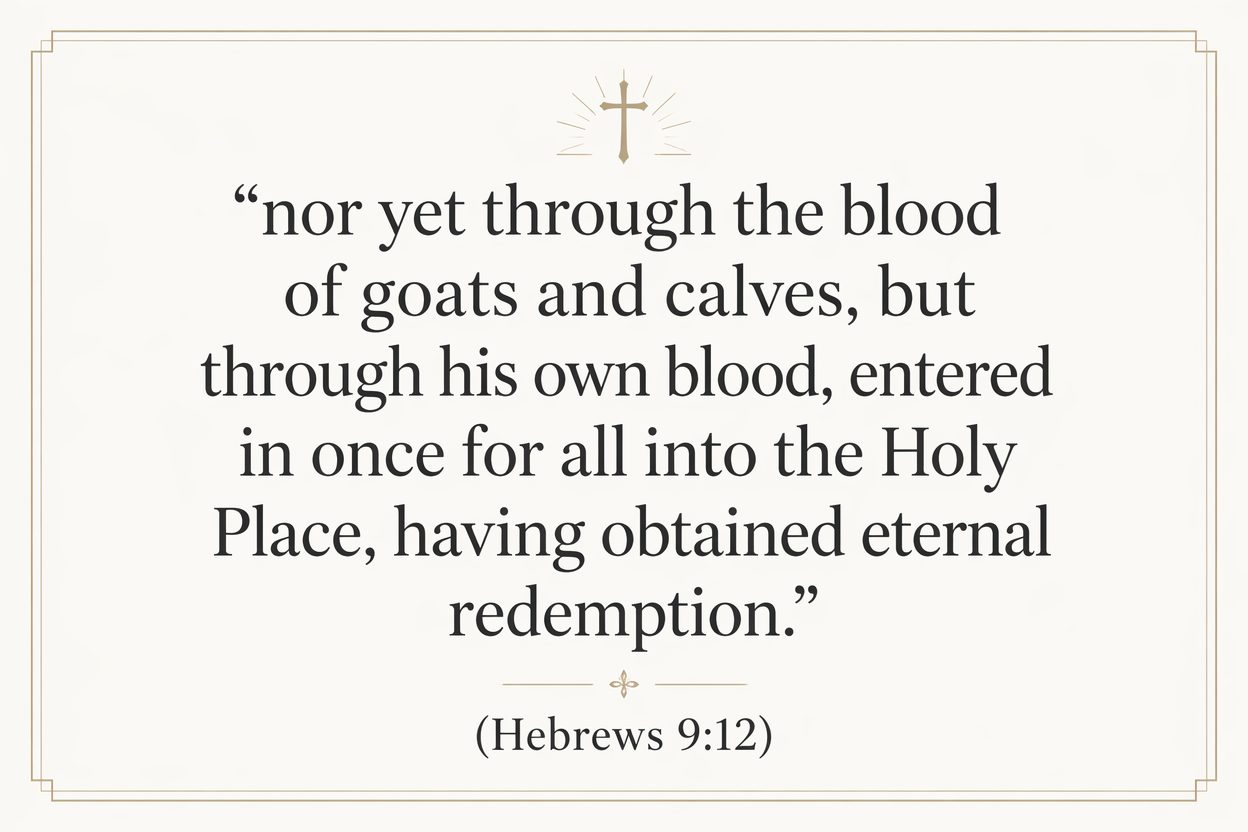
“nor yet through the blood of goats and calves, but through his own blood, entered in once for all into the Holy Place, having obtained eternal redemption.” (Hebrews 9:12)
Here τράγος appears in the plural within the phrase “the blood of goats and calves.” The word contributes to a comparison framed by two parallel means of entry: “through the blood of goats and calves” versus “through his own blood.” In the immediate wording, goats are not discussed as animals in themselves but as sources of blood used in a cultic approach to “the Holy Place.” By naming goats alongside “calves,” the verse evokes an established category of sacrificial blood, and the contrast turns on whose blood is involved and what it secures: the latter is linked to a decisive action (“entered in once for all”) and a stated result (“having obtained eternal redemption”). τράγος thus functions as part of the baseline against which the verse’s climactic alternative is set.
“For if the blood of goats and bulls, and the ashes of a heifer sprinkling those who have been defiled, sanctify to the cleanness of the flesh,” (Hebrews 9:13)
In this conditional statement, τράγος again appears in the plural: “the blood of goats and bulls.” The term contributes to an argument from a recognized ritual effect: these materials—blood (from goats and bulls) and “ashes of a heifer”—are described as “sprinkling those who have been defiled” and thereby producing sanctification “to the cleanness of the flesh.” The he-goat, represented by its blood, is treated as one element within a set of purification resources, and the emphasis is on the kind of cleansing specified: an outward, bodily category (“flesh”) rather than an unspecified or generalized notion. Within the sentence’s logic, τράγος helps anchor the premise: if such rites have a real, definable cleansing effect in their sphere, then a further conclusion can be drawn in the broader argument of the passage.
“For when every commandment had been spoken by Moses to all the people according to the law, he took the blood of the calves and the goats, with water and scarlet wool and hyssop, and sprinkled both the book itself and all the people,” (Hebrews 9:19)
This occurrence embeds τράγος in a narrative recollection of a law-related ceremony. The verse situates the blood “of the calves and the goats” among additional concrete elements—“water and scarlet wool and hyssop”—used for sprinkling. τράγος contributes specificity to what is handled and applied: not merely “blood,” but blood associated with particular sacrificial animals. The verse also identifies the targets of the sprinkling: “both the book itself and all the people.” In this scene, goats are part of the material means by which a community is brought into contact with what has been “spoken…according to the law.” The he-goat is not foregrounded as a symbol but as a tangible contributor to a rite that marks both sacred objects (“the book”) and persons (“all the people”).
“For it is impossible that the blood of bulls and goats should take away sins.” (Hebrews 10:4)
Here τράγος is placed in a stark negation: “the blood of bulls and goats” cannot achieve a stated moral-spiritual result—“take away sins.” The term’s contribution is to identify, again, a representative class of sacrificial blood, now assessed with an absolute judgment (“it is impossible”). The pairing with “bulls” keeps the focus on sacrificial categories rather than on a single animal, and the phrase “blood of…goats” stands for the sacrificial system’s offerings at their most concrete. In this sentence, τράγος participates in setting a limit: whatever efficacy such blood has in ritual contexts, it does not extend to sin-removal as described here.
Sense and Usage
Across these Hebrews occurrences, τράγος functions as a practical, cultic term, consistently appearing in the plural and consistently in relation to “blood.” The he-goat is never introduced for its own sake; it is invoked because its blood belongs to a recognized set of sacrificial materials. The term is repeatedly paired—first with “calves” (Hebrews 9:12; 9:19) and elsewhere with “bulls” (Hebrews 9:13; 10:4)—so that goats are part of a larger sacrificial vocabulary rather than an isolated example.
The passages also show a patterned movement in how the blood of goats is evaluated. In Hebrews 9:13, goat-blood is associated with sanctification “to the cleanness of the flesh,” a defined ritual outcome expressed in the verse’s own terms. In Hebrews 9:19, it appears within a ceremony that involves sprinkling both objects and people, suggesting formal consecration or covenantal handling within the framework of “the law.” By Hebrews 10:4, however, the scope is explicitly bounded: the blood of goats is declared unable to “take away sins.” Taken together, these uses present τράγος as part of a sacrificial category that can be discussed in terms of ritual cleansing and formal sprinkling, yet is also used to highlight a decisive inadequacy with respect to sin-removal.
Finally, Hebrews 9:12 places “the blood of goats and calves” directly alongside another kind of blood (“his own blood”), using the former as the familiar point of comparison. In that contrast, τράγος helps supply the known sacrificial baseline—blood associated with animal offerings—against which the verse frames a “once for all” entry into “the Holy Place” linked to “eternal redemption.”
Imagery
The imagery attached to τράγος in these texts is consistently tactile and procedural: blood taken, combined with other materials (“water and scarlet wool and hyssop”), and applied by sprinkling (Hebrews 9:19). Even where the language turns abstract (“cleanness of the flesh,” “take away sins”), the word keeps the argument grounded in the concrete reality of sacrificial blood—blood that can cleanse in one specified way (Hebrews 9:13) but is declared incapable of accomplishing another (Hebrews 10:4).
Sources: Lexical data from Strong’s Exhaustive Concordance and the Translators Brief Lexicon of Extended Strongs for Greek (STEPBible, CC BY). Occurrence data from the Translators Amalgamated Greek New Testament (STEPBible, CC BY). Scripture quotations from the World English Bible (public domain).




