
Exploring the Meaning of Trogo in Greek
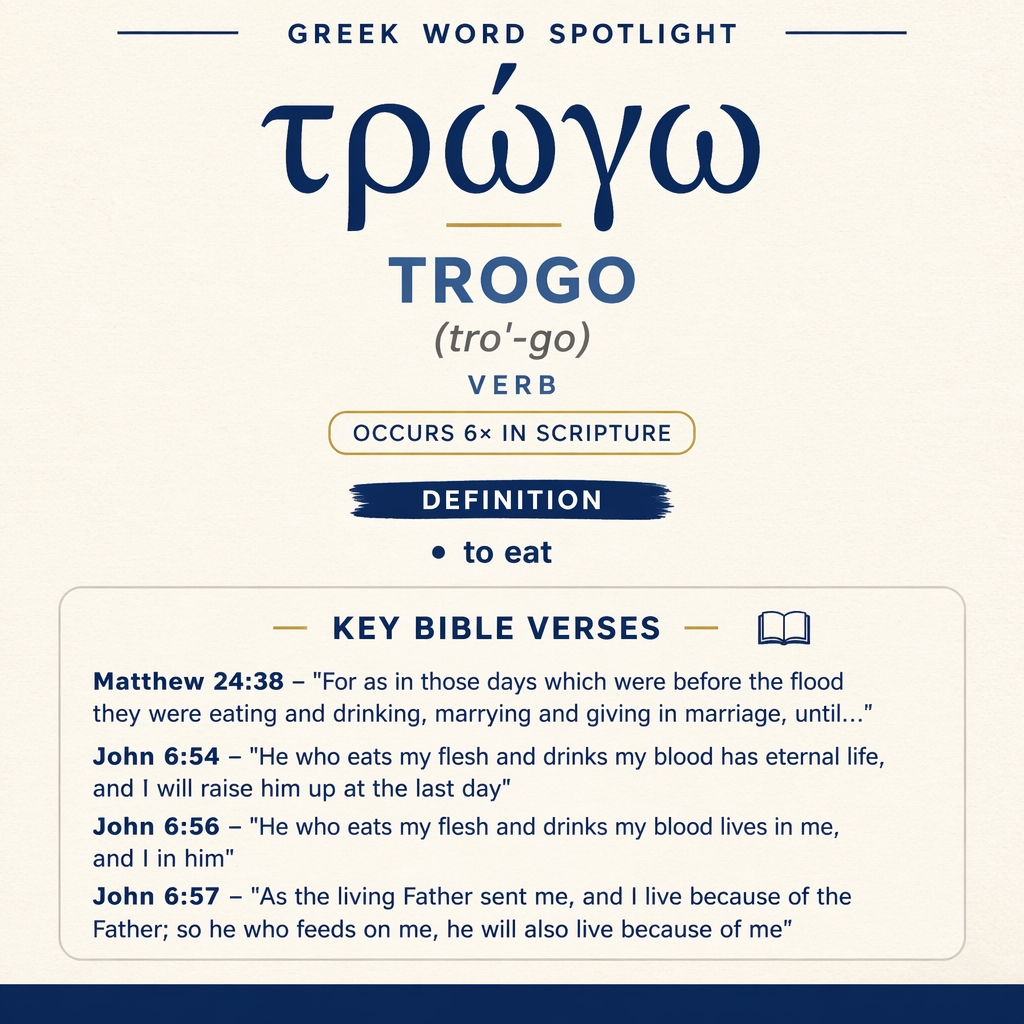
τρώγω means “to eat” and appears six times in Scripture: Matthew 24:38; John 6:54, 6:56–58; and John 13:18.
Core Meaning
τρώγω is defined as “to eat.” It is used for eating in both ordinary and figurative contexts.
Learn More →Where It Appears
This verb occurs 6 times in Scripture. It appears in Matthew 24:38; John 6:54, 6:56–58; and John 13:18.
Learn More →Key Contexts
In John 6:54–58 it is used in statements about eating Jesus’ flesh and eating the bread from heaven. In Matthew 24:38 it describes people eating and drinking before the flood.
Learn More →The verb τρώγω refers to the action of eating. In the passages where it appears, it ranges from ordinary, everyday eating to weighty metaphorical eating that is paired with drinking and tied to life, loyalty, and betrayal.
Occurrences
“For as in those days which were before the flood they were eating and drinking, marrying and giving in marriage, until the day that Noah entered into the ship,” (Matthew 24:38)
Here τρώγω belongs to a list of regular human activities: “eating and drinking, marrying and giving in marriage.” The force of the verb is its ordinariness. The scene is not about unusual food or ceremonial action; it portrays people continuing the normal patterns of life “until the day” a decisive event arrives. In the rhythm of the sentence, eating is paired with drinking as a basic marker of daily life, and its placement alongside family and social customs underscores how routine the moment feels right up to the turning point.
“He who eats my flesh and drinks my blood has eternal life, and I will raise him up at the last day.” (John 6:54)
In this saying, τρώγω is joined tightly to “drinks my blood,” so the act of eating is presented as a personal participation with a promised outcome: “has eternal life.” The clause “and I will raise him up at the last day” ties that participation to a future act of raising. The verb itself keeps its concrete action—eating—but in the sentence it functions as a gateway into the stated promise, putting the focus not on food as such but on the one who is eaten and drunk.
“He who eats my flesh and drinks my blood lives in me, and I in him.” (John 6:56)
This occurrence repeats the paired actions of eating and drinking, but the stated result is described in relational terms: “lives in me, and I in him.” τρώγω contributes the concrete, bodily verb that anchors the relational claim. Eating is not depicted as a detached act; it is the described means by which mutual indwelling is expressed. The sentence structure makes the eater the subject (“He who eats…”), and the consequence is a shared life defined by proximity and reciprocity (“in me… in him”).
“As the living Father sent me, and I live because of the Father; so he who feeds on me, he will also live because of me.” (John 6:57)
Here the act of eating is rendered as “feeds on me,” and τρώγω is placed within an analogy of life-giving dependence. The first half of the verse presents a relationship: the Father is “living,” the Son is “sent,” and the Son “live[s] because of the Father.” The second half mirrors it: “so he who feeds on me… will also live because of me.” τρώγω thus supports a comparison between two “because of” statements. Eating is the verb that describes the human side of the comparison, and its contribution is to frame life as received in a way analogous to nourishment.
“This is the bread which came down out of heaven—not as our fathers ate the manna, and died. He who eats this bread will live forever.” (John 6:58)
In this verse τρώγω appears twice: once in the contrast (“not as our fathers ate the manna, and died”) and once in the promise (“He who eats this bread will live forever”). The verb remains an act of eating, but the contrast makes two outcomes stand side by side: eating manna is followed by death, eating “this bread” is followed by enduring life. The repetition of the same action verb sharpens the point that the difference lies not in the act of eating but in what is eaten and in the stated result attached to it.
“I don’t speak concerning all of you. I know whom I have chosen. But that the Scripture may be fulfilled, ‘He who eats bread with me has lifted up his heel against me.’” (John 13:18)
Here τρώγω is embedded in a quotation about shared table fellowship: “He who eats bread with me.” The action of eating functions as the marker of closeness—someone who shares bread “with me”—and the shock comes from the reversal that follows: “has lifted up his heel against me.” In this context, eating is not about sustenance alone; it is the ordinary act that establishes a relationship in the scene, making the subsequent act of opposition stand out as a breach of that closeness.

Sense and Usage
Across these passages, τρώγω consistently names the physical action of eating, yet the surrounding words and outcomes give that action different weights. In Matthew 24:38, eating is presented as an everyday activity that can continue uninterrupted alongside other ordinary life events. The verb there helps paint a picture of normalcy—life proceeding with its routines—right up to a sudden threshold (“until the day”).
In John 6, the same basic act is drawn into a sustained set of statements where eating is paired with drinking and attached to strong promises. The repeated pattern “He who eats… and drinks…” makes the action personal and ongoing, and the results are expressed in several complementary ways: possession of “eternal life” (John 6:54), mutual indwelling (“lives in me, and I in him,” John 6:56), and derivative life (“will also live because of me,” John 6:57). John 6:58 adds a contrast that keeps the verb grounded in its ordinary meaning while insisting that outcomes differ sharply depending on the object of eating: the same action can be narrated with death on one side and enduring life on the other.
John 13:18 brings τρώγω into a social setting where eating is an act done “with” someone. The verb’s plain, domestic sense is crucial: a shared meal is a recognizable sign of association. Because the action is familiar, it can serve as the setting for a statement about betrayal without requiring a special ritual description. Eating bread together establishes an expectation of goodwill within the scene, and the verse’s force depends on that expectation being violated.
Taken together, these contexts show τρώγω working at two levels at once. It remains a straightforward verb for eating, suitable for describing normal life (Matthew 24:38) and a shared meal (John 13:18). At the same time, in John 6 it becomes the chosen concrete action for expressing participation, dependence, and promised life—still “eating,” but eating that is rhetorically loaded by the paired act of drinking and by the stated consequences that follow each occurrence.
Imagery in Context
The imagery carried by τρώγω in these passages is anchored in the table and in bread. Matthew 24:38 presents eating as part of the unremarkable flow of days; John 13:18 places it in the intimacy of eating “bread with me.” Between those two, John 6 repeatedly draws on the concreteness of eating and drinking to communicate life and belonging: “He who eats my flesh and drinks my blood,” “he who feeds on me,” and “He who eats this bread will live forever.” The verb’s strength in these texts lies in how a familiar bodily action can depict both ordinary normal life and the deepest relational and life-giving claims made in the discourse.
Sources: Lexical data from Strong’s Exhaustive Concordance and the Translators Brief Lexicon of Extended Strongs for Greek (STEPBible, CC BY). Occurrence data from the Translators Amalgamated Greek New Testament (STEPBible, CC BY). Scripture quotations from the World English Bible (public domain).




