
Exploring the Meaning of Trapeza in Greek
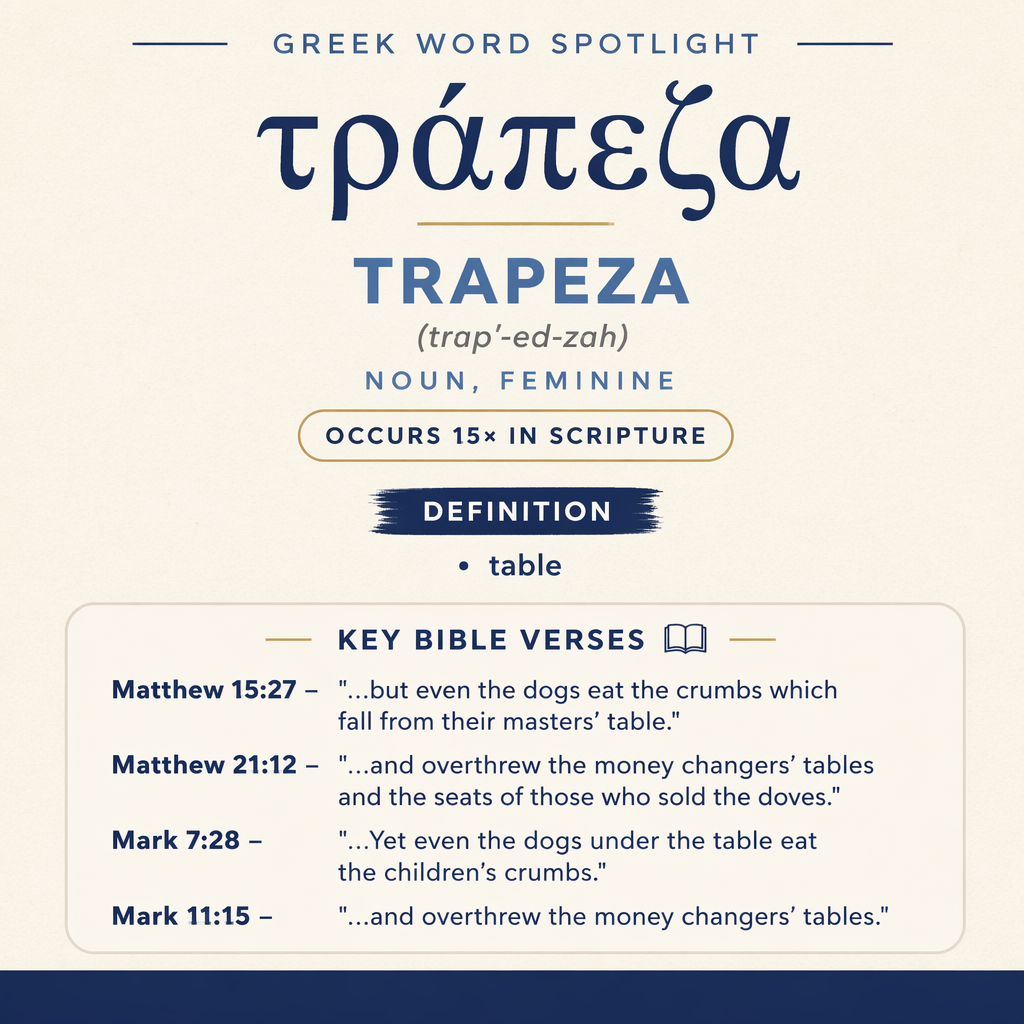
τράπεζα (Trapeza) means “table” and appears 15 times in Scripture, including Matthew 15:27; Mark 7:28; Luke 22:21, 30.
Core Meaning
τράπεζα means “table.” In the cited verses it refers to a masters’ table, a rich man’s table, and Jesus’ table.
Learn More →Gospel Scenes
In Matthew 15:27 and Mark 7:28, crumbs fall from the masters’ table. In Luke 16:21, crumbs fall from the rich man’s table.
Learn More →At the Table
In Luke 22:21, the betrayer’s hand is with Jesus on the table. In Luke 22:30, Jesus speaks of eating and drinking at His table in His Kingdom.
Learn More →τράπεζα refers to a “table,” appearing in scenes of household eating, temple commerce, financial exchange, and communal service. Across these passages it can be a simple surface for food, a working station for money, or a setting that signals relationship and belonging.
Occurrences
“But she said, “Yes, Lord, but even the dogs eat the crumbs which fall from their masters’ table.”” (Matthew 15:27)
Here τράπεζα anchors the image of a household meal. The “masters’ table” is the place from which “crumbs” fall; the table marks both provision and hierarchy—masters above, dogs below—yet still connects them through what falls from it.
“Jesus entered into the temple of God, and drove out all of those who sold and bought in the temple, and overthrew the money changers’ tables and the seats of those who sold the doves.” (Matthew 21:12)
In the temple, τράπεζα names the physical tables used by “money changers.” The action of “overthrew” makes the table a piece of equipment for commerce that can be upended, and its presence alongside “seats” shows a set-up for ongoing business activity within the temple precincts.
“But she answered him, “Yes, Lord. Yet even the dogs under the table eat the children’s crumbs.”” (Mark 7:28)
Mark’s wording places the dogs “under the table,” making τράπεζα the boundary between those at the meal (“the children”) and those beneath it. The table still functions as the source of “crumbs,” connecting what happens above with what is received below.
“They came to Jerusalem, and Jesus entered into the temple, and began to throw out those who sold and those who bought in the temple, and overthrew the money changers’ tables, and the seats of those who sold the doves.” (Mark 11:15)
As in Matthew’s temple scene, τράπεζα denotes the money changers’ work-tables. The repetition of “overthrew” emphasizes the tables as tangible fixtures of buying and selling—stations that enable exchange and therefore become targets of removal when the market activity is expelled.
“and desiring to be fed with the crumbs that fell from the rich man’s table. Yes, even the dogs came and licked his sores.” (Luke 16:21)
In this portrayal of a poor man longing for food, τράπεζα marks a rich man’s place of eating and abundance. The “crumbs that fell” establish the table as a point of overflow; the poor man is outside that table’s circle, hoping to live off what drops from it, while “the dogs” are present in the same space of deprivation.
“Then why didn’t you deposit my money in the bank, and at my coming, I might have earned interest on it?’” (Luke 19:23)
Although this verse speaks of depositing money “in the bank” and earning “interest,” τράπεζα contributes the concrete idea of a table as the locus of such financial transactions. The table is the sort of place where money can be handled, placed, and managed in a way that produces gain.
“But behold, the hand of him who betrays me is with me on the table.” (Luke 22:21)
At a shared meal, τράπεζα becomes the surface that visibly unites the group: a “hand” is “on the table” alongside the speaker. The table thus intensifies the tension of betrayal by placing the betrayer within the intimate setting of eating together.
“that you may eat and drink at my table in my Kingdom. You will sit on thrones, judging the twelve tribes of Israel.”” (Luke 22:30)
Here τράπεζα is the promised setting for “eat and drink” in the speaker’s “Kingdom.” The table functions as a sign of welcome and honor—belonging at “my table”—and it stands beside the language of enthronement, so that the table scene communicates privileged access within a larger picture of rule and judgment.
“He made a whip of cords, and threw all out of the temple, both the sheep and the oxen; and he poured out the changers’ money and overthrew their tables.” (John 2:15)
John’s temple action depicts τράπεζα as part of the money-changers’ apparatus: money is “poured out,” and the tables are “overthrew.” The table is the platform that had held the money in order, and its overturning dramatizes the disruption of the entire commercial operation.
“The twelve summoned the multitude of the disciples and said, “It is not appropriate for us to forsake the word of God and serve tables.”” (Acts 6:2)
In the community’s practical life, τράπεζα stands for the tables that are “served.” The expression “serve tables” presents the table as the focal point of material distribution and daily care, work that must be attended to even as the twelve prioritize “the word of God.”
“He brought them up into his house, and set food before them, and rejoiced greatly, with all his household, having believed in God.” (Acts 16:34)
With “food” set before guests in a household, τράπεζα naturally frames the implied table setting: the meal is arranged and offered. The table is the ordinary domestic place where hospitality and shared joy (“rejoiced greatly”) can be enacted with “all his household.”
“David says, “Let their table be made a snare, a trap, a stumbling block, and a retribution to them.”” (Romans 11:9)
In this citation, τράπεζα is “their table,” the place associated with their eating and security, but it is spoken of as something that can be “made” into danger: “a snare, a trap, a stumbling block.” The table, typically a place of provision, becomes the setting where reversal and judgment are experienced.
Sense and Usage
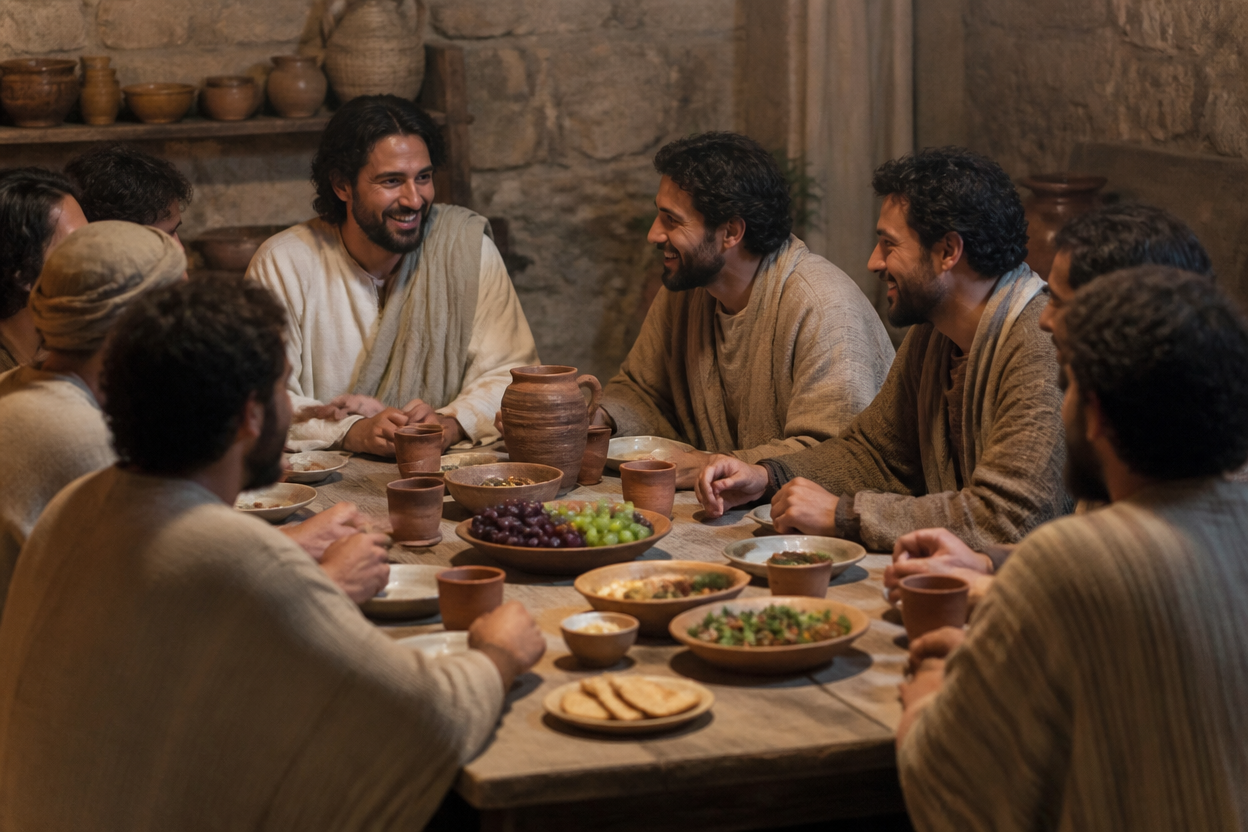
Across these texts τράπεζα consistently names a concrete table, but the table is shown doing different kinds of narrative work depending on the setting. In household scenes (Matthew 15:27; Mark 7:28; Luke 16:21; Acts 16:34), it is the everyday location of eating: crumbs fall from it, dogs gather beneath it, and the needy long for what comes from it. The table shapes social space—who sits at it, who remains under it, and who waits outside it—without ceasing to be the simple object from which food is served and by which a meal is organized.
In the temple scenes (Matthew 21:12; Mark 11:15; John 2:15), the table is recontextualized as commercial furniture: “money changers’ tables” are work surfaces that support exchange, cash-handling, and a settled rhythm of buying and selling (suggested by the presence of “seats”). The repeated act of overturning makes the table’s stability a visible sign of the enterprise’s establishment, and its toppling a visible sign of that enterprise being forcibly halted.
Other uses keep the same basic object but attach it to financial practice and communal organization. Luke 19:23 ties the idea of money being placed somewhere for gain (“deposit my money in the bank … earned interest”) to the kind of table where money is handled as an instrument of investment and return. Acts 6:2 uses the table as the center of practical service: “serve tables” frames the community’s material responsibilities in terms of attending to what happens at tables—distribution, provision, and the ordering of daily care. In Luke 22:21 and 22:30, the table is the scene of shared eating and drinking, but it becomes charged: it can be the place where betrayal sits in plain proximity (“the hand of him who betrays me is with me on the table”) and also the place of promised honor and fellowship (“eat and drink at my table in my Kingdom”). Romans 11:9 then takes the familiar object and speaks of it as a site of reversal: the table associated with normal sustenance becomes, in the language of the citation, an occasion of entanglement and recompense.
Imagery
These passages repeatedly frame the table as a boundary and a meeting point. Crumbs fall from it to those below (Matthew 15:27; Mark 7:28; Luke 16:21), hands rest on it in the midst of shared eating (Luke 22:21), and food is set before guests in a house (Acts 16:34). Yet the same object can also be the workbench of temple commerce that is dramatically overturned (Matthew 21:12; Mark 11:15; John 2:15). The result is a consistent, concrete image: a table is where provision is arranged and where relationships—welcome or exclusion, peace or betrayal, security or danger—become visible around an ordinary surface (Luke 22:30; Romans 11:9).
Sources: Lexical data from Strong’s Exhaustive Concordance and the Translators Brief Lexicon of Extended Strongs for Greek (STEPBible, CC BY). Occurrence data from the Translators Amalgamated Greek New Testament (STEPBible, CC BY). Scripture quotations from the World English Bible (public domain).




