
Exploring the Meaning of Trachus in Greek
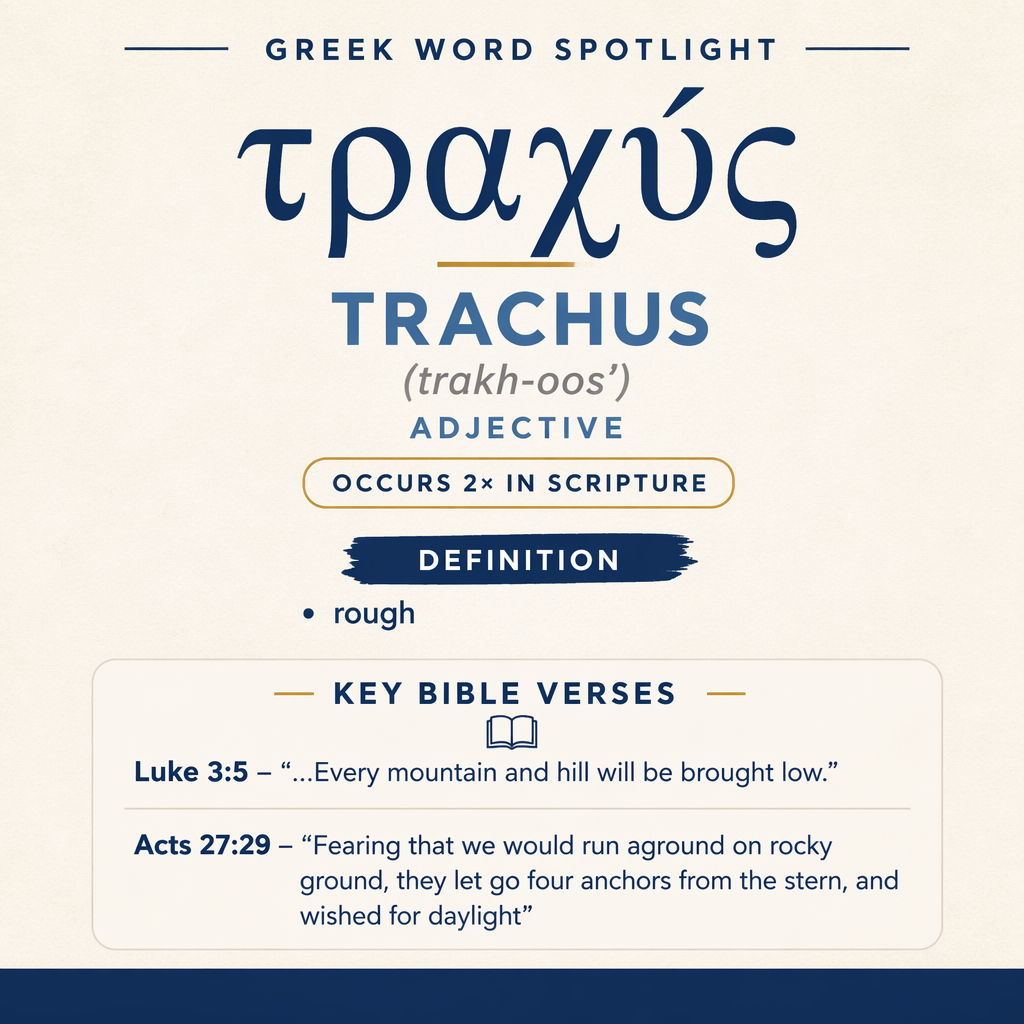
τραχύς means “rough” and appears twice in Scripture, in Luke 3:5 and Acts 27:29.
Verse Contexts
In Luke 3:5, it contrasts with straightening and leveling imagery. In Acts 27:29, it describes rocky ground feared during a voyage.
Learn More →τραχύς means “rough,” a concrete descriptor applied to a “way” and to threatening “rocky ground.” It appears in Luke’s portrayal of landscape-level change and in Luke’s narrative of a ship’s peril at sea.
Root and Related Words
τραχύς is connected with the verb rhegnymi (ῥήγνυμι), “to throw violently” (Strong’s G4486).

Occurrences
Luke 3:5 — “Every valley will be filled. Every mountain and hill will be brought low. The crooked will become straight, and the rough ways smooth.”
Here τραχύς qualifies “ways,” placing the word in the stream of paired contrasts that run through the verse. Valleys are “filled” and heights are “brought low,” so that extremes of terrain no longer hinder travel. In the same pattern, what is “crooked” becomes “straight,” and what is “rough” becomes “smooth.” Within the sentence, “rough” is not presented as a mere texture but as a condition of a “way” that obstructs or complicates passage; it belongs to the same landscape imagery that imagines hollows leveled and ridges reduced. The transformation is comprehensive: not only the grand features of geography (valleys, mountains, hills) but also the smaller, path-level experience of movement (“ways”) is altered. The word therefore contributes a tactile and practical dimension to the picture—roughness is what makes a road hard going, and the promised result is a way experienced as “smooth.”
Acts 27:29 — “Fearing that we would run aground on rocky ground, they let go four anchors from the stern, and wished for daylight.”
In this sea scene, τραχύς is bound to a moment of urgent caution. The crew fears running aground, and the danger is located in “rocky ground,” a phrasing that evokes an uneven, hazardous seabed or nearshore shallows where a ship can be caught and damaged. The response—dropping “four anchors from the stern”—shows that the threat is immediate and that the ship’s position must be held rather than pressed forward blindly. “Wished for daylight” underscores how perilous the conditions are: darkness hides what would otherwise be read and avoided. Within this verse, roughness is not the feel of a path underfoot but the character of the ground that threatens to tear, jar, or immobilize the vessel. The adjective sharpens the reason for fear: it is not merely “ground” but ground whose rough, rock-strewn character makes grounding disastrous.
Sense and Usage
Across these two passages, “rough” functions as a situational adjective that marks difficulty created by unevenness in the physical environment. In Luke 3:5 it belongs to a series of opposites, where roughness is paired with the resulting condition of being made “smooth.” The verse frames roughness as something that can be removed when larger barriers are also removed—valleys filled, mountains lowered, crookedness straightened—so that the total travel experience changes from obstructed to passable. The word’s force there is experiential: roughness is what a traveler encounters along “ways,” and the promised change is a road no longer felt as harsh or irregular.
In Acts 27:29 the word is not contrasted with its opposite, but it is embedded in a response of restraint and waiting. Roughness is tied to “rocky ground,” and the sailors’ fear is a rational appraisal of terrain they cannot see. The same basic notion—roughness as a dangerous irregularity—appears in a different domain: not a public road altered for passage, but a maritime hazard that must be avoided. In both uses, roughness is not an abstract quality but a concrete feature of a setting that shapes what people can safely do: the ease of traveling a “way” and the safety of holding a ship off a rough seabed.
The connection with rhegnymi (ῥήγνυμι), “to throw violently,” sits naturally beside these scenes. Luke’s image involves dramatic leveling—mountains and hills “brought low”—and Acts portrays violent forces implicit in a storm-driven voyage, where contact with rocks would be catastrophic. Without expanding the definition, the association highlights how “rough” fits settings marked by forceful movement and the risk of damage: rough ground makes the impact of travel or contact harsher, while smoothness implies the removal of what would jolt, impede, or endanger.
Imagery
Luke 3:5 places roughness within a sweeping picture of a landscape reshaped for unobstructed movement: valleys raised, elevations lowered, crookedness straightened, and rough ways made smooth. Acts 27:29 places roughness under the surface, sensed through fear and precaution rather than sight—anchors dropped from the stern and a longing for daylight—so that the word carries the feel of hidden irregular hazards that must be respected.
Sources: Lexical data from Strong’s Exhaustive Concordance and the Translators Brief Lexicon of Extended Strongs for Greek (STEPBible, CC BY). Occurrence data from the Translators Amalgamated Greek New Testament (STEPBible, CC BY). Scripture quotations from the World English Bible (public domain).




