Exploring the Meaning of Trauma in Greek
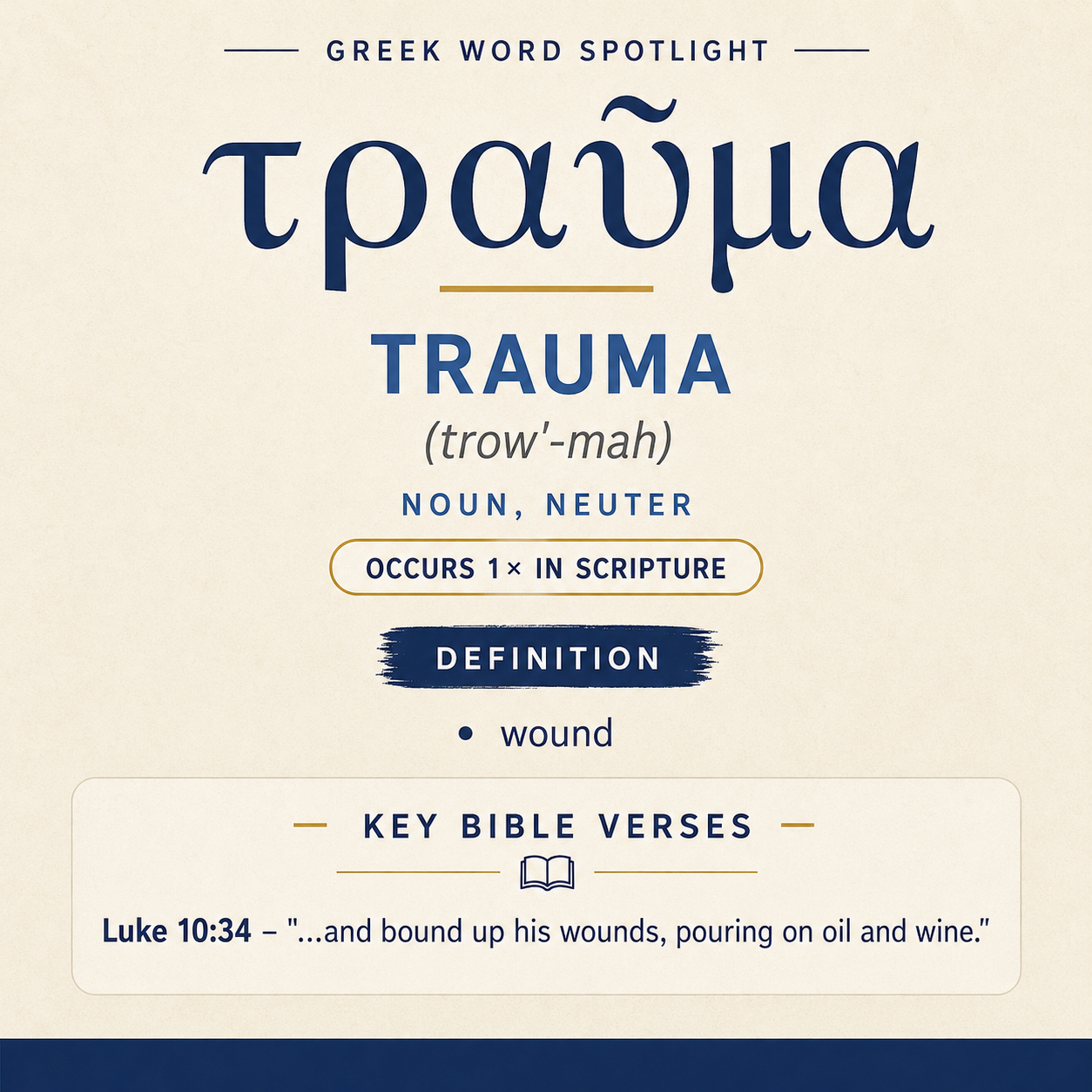
τραῦμα means “wound” and appears once in Scripture, in Luke 10:34.
τραῦμα means “wound” and appears in Luke 10:34. In its lone New Testament setting, the word belongs to a scene of hands-on care where injury is treated with deliberate, practical action.
Occurrences
“came to him, and bound up his wounds, pouring on oil and wine. He set him on his own animal, brought him to an inn, and took care of him.” (Luke 10:34)
Here τραῦμα names the concrete injuries that require immediate attention. The wording places the wounds at the center of a chain of remedial actions: the helper “came to him,” then “bound up his wounds,” then applied substances (“pouring on oil and wine”), then arranged transport (“He set him on his own animal”), then provided ongoing support (“brought him to an inn, and took care of him”). τραῦμα therefore functions as the medical and moral pivot of the sentence: the reason bandaging is needed, the reason oil and wine are used, the reason the injured man is moved from the roadside to a place where care can continue.

The phrase “bound up his wounds” frames the wounds as something that can be gathered, secured, and stabilized—injuries with boundaries that can be addressed by wrapping and dressing. The subsequent phrase “pouring on oil and wine” does not replace the bandaging but accompanies it, suggesting a careful sequence in which the wounds are treated, not merely noticed. In this context τραῦμα is neither abstract nor symbolic; it is bodily harm that dictates a hands-on response and justifies the costliness of the aid that follows (using one’s own supplies, one’s own animal, and one’s own time at an inn).

Sense and Usage
Because τραῦμα is used only once, its sense is established entirely by this narrative context: it denotes harm serious enough to demand first aid and continued assistance. The wounds are multiple (“wounds,” plural), which presents the injured man’s condition as extensive rather than minor. This plurality also shapes the scene’s realism: multiple injuries require a sustained, careful procedure—coming close, binding up, applying oil and wine, arranging transport, and supervising recovery. τραῦμα is thus a word of physical vulnerability, naming what has been done to the victim and what must now be addressed if life and safety are to be restored.
The immediate collocation with “bound up” makes τραῦμα a term that invites practical, bodily engagement. A wound is not handled at a distance. It calls for nearness (“came to him”), touch and technique (“bound up”), and resources (“oil and wine”). The narrative does not describe the wounds in detail, yet the very mention of them establishes the urgency of intervention; the wounds are the implicit reason the man cannot simply continue on his way. By naming the injuries, τραῦμα anchors the compassion of the helper in a specific, material need.
τραῦμα also shapes the story’s movement from danger to refuge. The wounds belong to the roadside moment of crisis; the care that addresses them moves the injured man toward shelter and ongoing support. The progression “set him on his own animal” and “brought him to an inn” makes the wounds the motivating condition for relocation. The word therefore operates as a hinge between suffering and restoration: what is bound up and treated is also what necessitates carrying, lodging, and continued care.
Even within a single occurrence, the word’s usage displays a full picture of what a wound entails in lived experience. A wound is not only an injury; it is an injury that must be managed. It requires cleaning or treatment (“pouring on oil and wine”), protection (“bound up”), and follow-through (“took care of him”). τραῦμα stands at the point where compassion becomes concrete in actions that address the body.
Imagery
Luke 10:34 gives τραῦμα a vivid, tactile setting: bandages being wrapped, oil and wine being poured, and an injured person being lifted onto an animal and brought to shelter. The word carries the imagery of exposed harm met by careful hands—injury that is neither ignored nor merely pitied, but attended with the steady work of healing care.
Sources: Lexical data from Strong’s Exhaustive Concordance and the Translators Brief Lexicon of Extended Strongs for Greek (STEPBible, CC BY). Occurrence data from the Translators Amalgamated Greek New Testament (STEPBible, CC BY). Scripture quotations from the World English Bible (public domain).