Exploring the Meaning of Koite in Greek
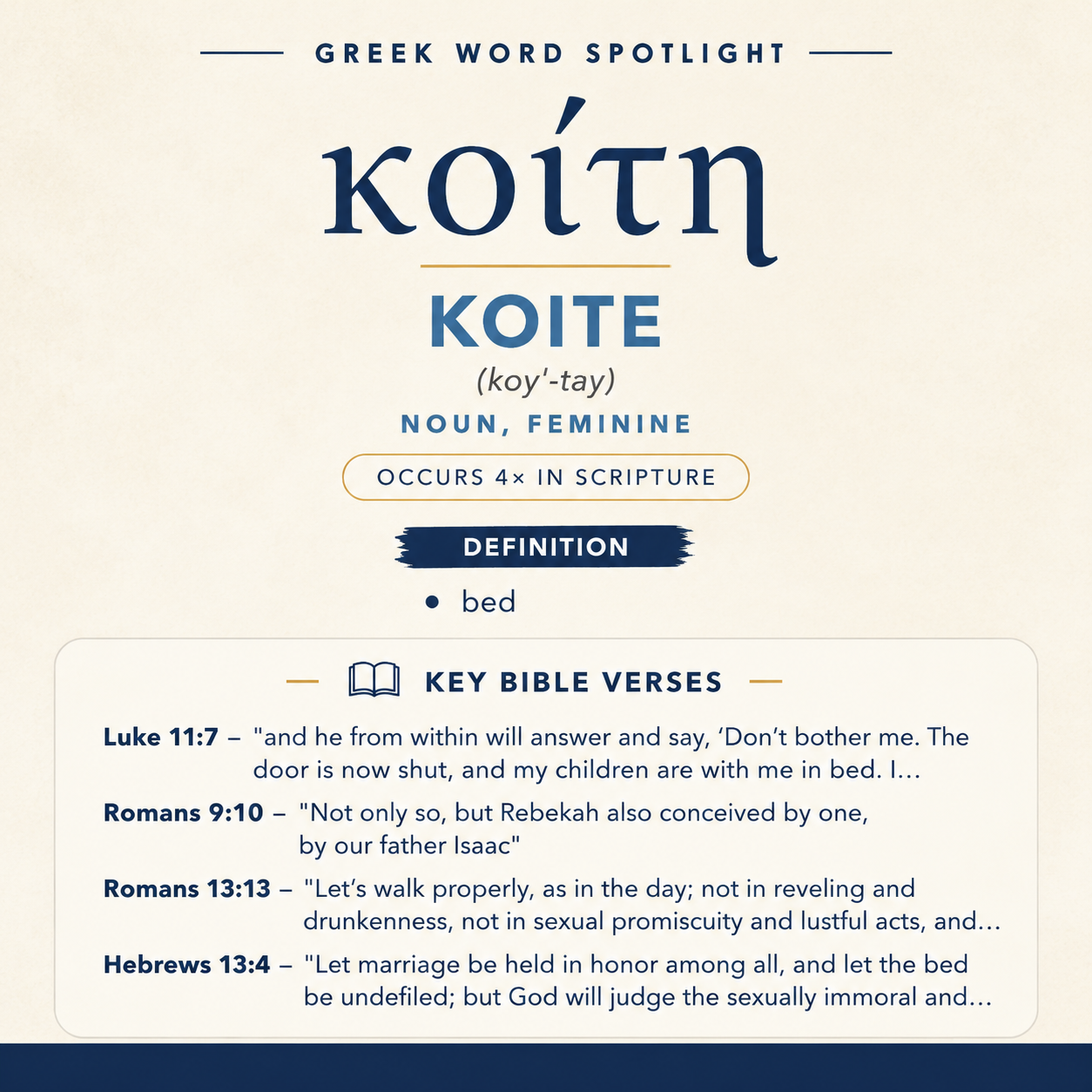
κοίτη means “bed” and appears four times in Scripture: Luke 11:7; Romans 9:10; Romans 13:13; Hebrews 13:4.
Scripture Occurrences
It occurs 4 times in Scripture: Luke 11:7; Romans 9:10; Romans 13:13; Hebrews 13:4.
Learn More →Context Snapshots
Luke 11:7 describes children being “with me in bed,” and Hebrews 13:4 says, “let the bed be undefiled.”
Learn More →κοίτη appears in four New Testament passages with the concrete sense of a “bed.” Across its occurrences it can point to an ordinary sleeping place within a home, and it can also function in moral exhortation where the bed stands for the sphere that ought to remain protected and unpolluted.
Root and Related Words
κοίτη is related to the verb keimai (κεῖμαι), “to lay/be appointed” (Strong’s G2749). The link to “laying” language fits a term that naturally denotes a place where someone is laid down.

Occurrences
Luke 11:7: “and he from within will answer and say, ‘Don’t bother me. The door is now shut, and my children are with me in bed. I can’t get up and give it to you’?”
Here κοίτη belongs to a domestic, nighttime setting. The speaker’s refusal turns on the practical reality that the household is already settled: “The door is now shut,” and “my children are with me in bed.” The bed is presented as a shared sleeping arrangement that makes rising and moving about disruptive. In this scene, κοίτη contributes a vivid detail of closeness and rest—everyone is already down for the night—so the request at the door comes at the worst possible time.
Romans 9:10: “Not only so, but Rebekah also conceived by one, by our father Isaac.”
In this brief statement, κοίτη is tied to conception within a specific union: Rebekah “conceived by one.” The word’s force lies in connecting the ordinary physical setting of a bed to the reality of begetting a child. The emphasis in the sentence is not on furniture or sleeping, but on a single, identifiable source (“by one”) in connection with Isaac; κοίτη serves that point by anchoring conception in a concrete, embodied context.
Romans 13:13: “Let’s walk properly, as in the day; not in reveling and drunkenness, not in sexual promiscuity and lustful acts, and not in strife and jealousy.”
In this exhortation, κοίτη occurs in a list contrasting conduct that fits “the day” with conduct that does not. The verse groups behaviors into pairs: “reveling and drunkenness,” “sexual promiscuity and lustful acts,” and “strife and jealousy.” Within that structure, κοίτη functions as part of the sexual pair, bringing the bed into view as the locale associated with illicit behavior being rejected. The word draws attention to the bodily sphere of life—what people do in private as much as in public—and places it under the call to “walk properly.” The bed is not treated as neutral space here; it becomes a moral marker in a life meant to match the light of “the day.”
Hebrews 13:4: “Let marriage be held in honor among all, and let the bed be undefiled; but God will judge the sexually immoral and adulterers.”
This occurrence explicitly names the bed and sets it within the honor of marriage: “Let marriage be held in honor among all, and let the bed be undefiled.” The clause makes the bed a focal point for guarding what belongs to marriage, and it places that safeguard under divine scrutiny: “God will judge the sexually immoral and adulterers.” κοίτη carries the weight of a tangible image—something that can be kept “undefiled”—and the verse uses that image to speak plainly about fidelity. The bed stands for the intimate domain where honor or dishonor becomes concrete, not merely theoretical.
Sense and Usage
Across these passages, κοίτη retains its basic reference to a bed, but the contexts show how that simple object can bear different kinds of emphasis.
In Luke 11:7, the bed is part of everyday household life: it is where parents and children are already resting together. The word contributes realism—closed door, settled family, a reluctant response from within. Nothing in the scene is abstract; the bed underscores inconvenience and the disruption of waking a whole household.
Romans 9:10 shows the bed’s connection to family origins. Even with minimal wording, the verse ties conception to a concrete human setting. The term fits naturally alongside the verb “conceived,” locating the beginning of life in the physical intimacy that belongs to a particular union (“by one, by our father Isaac”). κοίτη does not need elaboration to do its work; the sentence assumes the reader understands the bed as the ordinary place associated with conception.
Romans 13:13 and Hebrews 13:4 move from description to moral direction. In Romans 13:13, κοίτη is placed among vices, so the bed becomes shorthand for activities that violate the call to live “properly.” The verse’s rhythm—three “not” clauses—pushes the reader to think of the bed as one of the private arenas where a person’s walk can turn disordered. The bed, a common part of life, becomes a point where self-control and purity are tested.
Hebrews 13:4, by contrast, does not treat the bed as inherently suspect; it treats it as something that can and must be kept clean. The bed is joined to marriage honor: the relationship is to be “held in honor,” and the bed is to remain “undefiled.” The coupling of these commands shows how bodily intimacy belongs within a publicly honored covenant. The final clause (“God will judge the sexually immoral and adulterers”) reinforces that what happens in the bed is not hidden from moral evaluation; it matters at the level of divine judgment.
Read together, these uses show a movement from the bed as a simple domestic reality (resting children, a closed house) to the bed as a location bound up with generative intimacy (conception), and then to the bed as a morally charged space either associated with sexual wrongdoing or guarded within honored marriage. In each case, the bed remains a concrete point of reference; the surrounding context supplies whether it functions primarily as a scene-setting detail, a link to conception, or a boundary marker in ethical instruction.
Imagery
The imagery of κοίτη is intentionally plain: it evokes the ordinary place where people lie down. Luke 11:7 pictures a crowded, settled nighttime bed that makes interruption costly. Hebrews 13:4 turns the same ordinary object into a vivid symbol of purity within marriage—something that can be kept “undefiled”—and sets that image against the seriousness of judgment on sexual sin. Romans 13:13 places the bed within a call to daylight integrity, pressing the idea that what occurs in private spaces belongs under the same “walk properly” demanded in public.
Sources: Lexical data from Strong’s Exhaustive Concordance and the Translators Brief Lexicon of Extended Strongs for Greek (STEPBible, CC BY). Occurrence data from the Translators Amalgamated Greek New Testament (STEPBible, CC BY). Scripture quotations from the World English Bible (public domain).