
Exploring the Meaning of Keimai in Greek
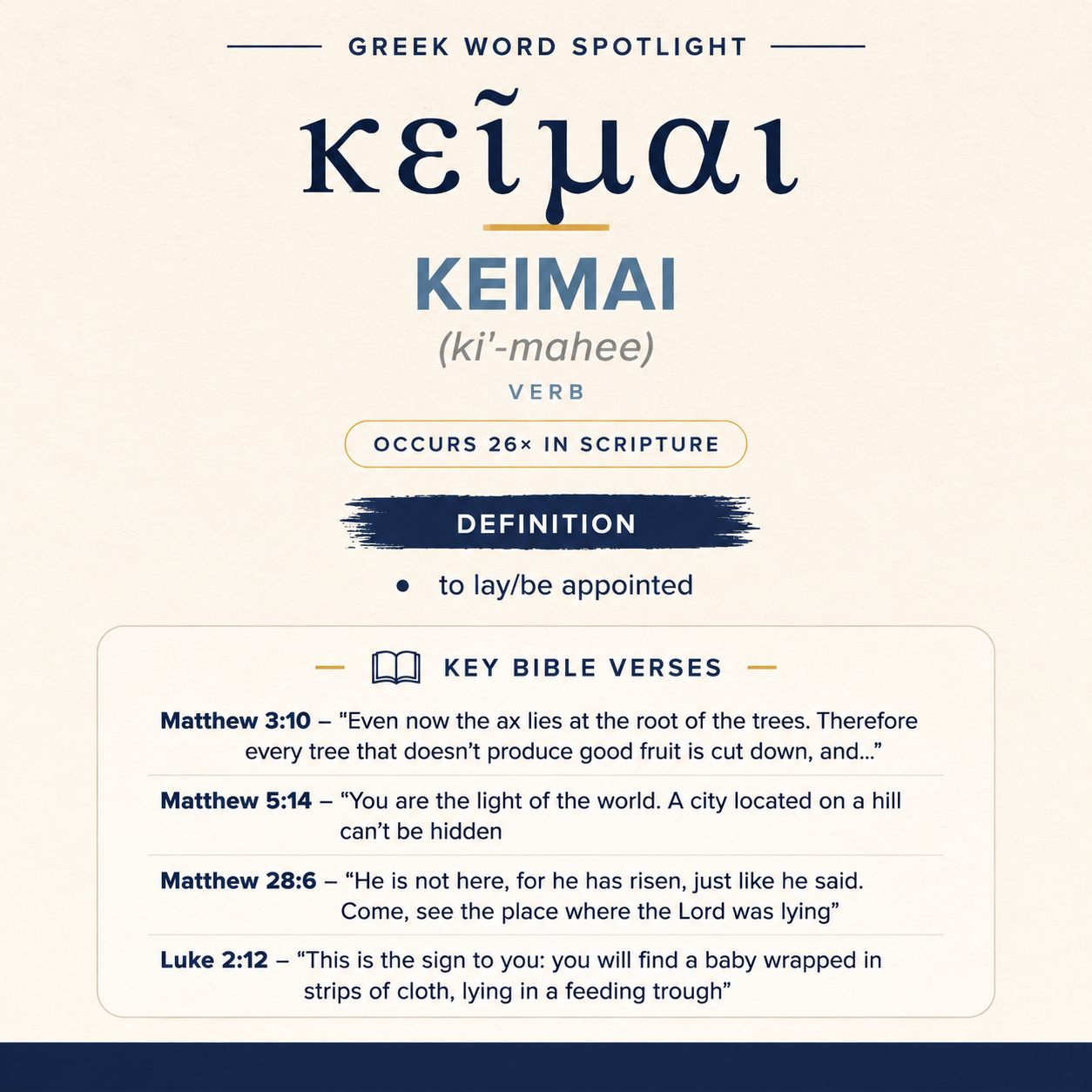
κεῖμαι (Keimai) means “to lay/be appointed” and occurs 26 times in Scripture, including Matthew, Luke, and Matthew 28:6.
Core Meaning
κεῖμαι means “to lay/be appointed.” In Matthew 28:6 it describes the place where the Lord was lying.
Learn More →Gospel Scenes
In Luke 2:12 and 2:16, it describes the baby lying in a feeding trough. In Matthew 3:10 and Luke 3:9, it describes the ax lying at the root of the trees.
Learn More →Set or Laid
In Luke 2:34, Simeon says the child is set for the falling and rising of many. In Luke 12:19, it describes goods laid up for many years.
Learn More →κεῖμαι expresses being laid or set in place, whether of objects, a person’s body, or a destiny that stands appointed. In the passages below it appears in scenes ranging from an ax at a tree’s root, to a baby in a feeding trough, to a tomb and graveclothes, and also in statements about what is “set” for people.
Occurrences
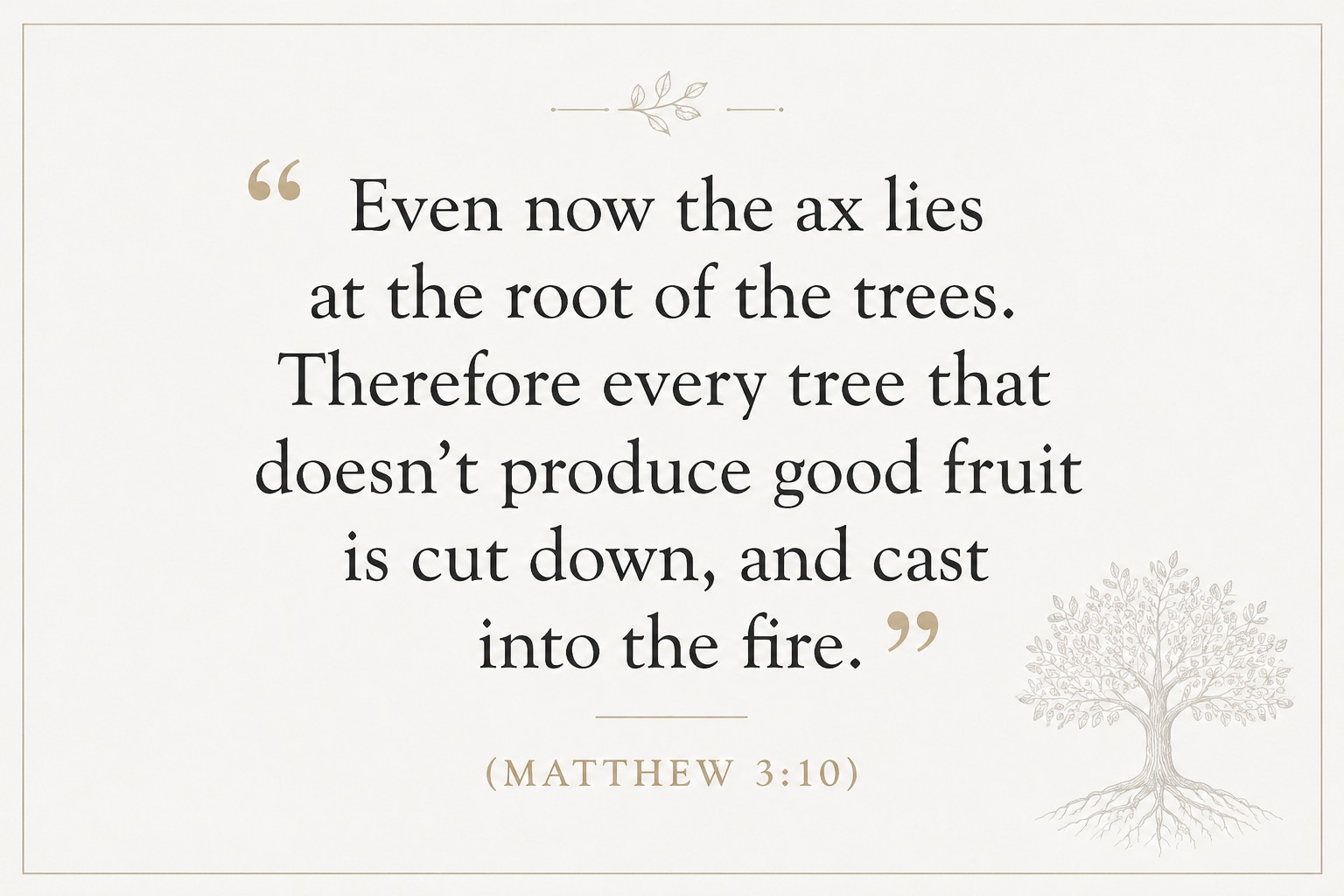
“Even now the ax lies at the root of the trees. Therefore every tree that doesn’t produce good fruit is cut down, and cast into the fire.” (Matthew 3:10)
Here κεῖμαι portrays the ax as already placed at the decisive point: “at the root.” The verb makes the warning immediate—judgment is not merely threatened in the future; the instrument is lying there in readiness. The image depends on location: the ax is set where it can do its work.
You are the light of the world. A city located on a hill can’t be hidden. (Matthew 5:14)
In this saying, κεῖμαι frames a city’s visibility as a matter of placement: it is “located on a hill.” The verb supports the point that the city’s position determines what can or cannot be concealed. The emphasis falls on an established setting rather than a momentary action.
He is not here, for he has risen, just like he said. Come, see the place where the Lord was lying. (Matthew 28:6)
κεῖμαι is used of the Lord’s body as it had been laid in the tomb. The invitation focuses attention on “the place” associated with his prior location: the spot where he had been lying is now empty, and the verb helps the reader register that absence by recalling the earlier state of being laid there.
This is the sign to you: you will find a baby wrapped in strips of cloth, lying in a feeding trough.” (Luke 2:12)
The angel’s “sign” is identifiable by concrete arrangement: the baby is wrapped and lying in a feeding trough. κεῖμαι ties the sign to a recognizable placement—where the child is situated. The verb functions almost like a locator, specifying the baby’s position as the confirming mark.
They came with haste, and found both Mary and Joseph, and the baby was lying in the feeding trough. (Luke 2:16)
This narrative fulfillment repeats the same placedness. The shepherds “found” the family and observe the baby’s location as described: “was lying in the feeding trough.” κεῖμαι underlines that the earlier announcement corresponds to a real, visible arrangement on arrival.
and Simeon blessed them, and said to Mary, his mother, “Behold, this child is set for the falling and the rising of many in Israel, and for a sign which is spoken against. (Luke 2:34)
κεῖμαι shifts from physical location to appointment: “this child is set for the falling and the rising of many.” The verb conveys that the child stands placed within Israel’s life with a determined role, and the following phrase (“for a sign which is spoken against”) continues the idea of an appointed function that will elicit response.
Even now the ax also lies at the root of the trees. Every tree therefore that doesn’t produce good fruit is cut down, and thrown into the fire.” (Luke 3:9)
As in Matthew’s parallel, κεῖμαι depicts the ax as already stationed at the root. The added “also” reinforces the immediacy: the ax is not being fetched or prepared; it is lying there now. The verb makes the warning press upon the present moment.
I will tell my soul, “Soul, you have many goods laid up for many years. Take your ease, eat, drink, and be merry.” ’ (Luke 12:19)
In the rich man’s self-talk, κεῖμαι describes “many goods laid up for many years.” The idea is not simply possession but placement and storage: the goods are set aside, positioned for long-term security. The verb helps convey his sense of stability—his life is arranged around what has been laid away.
He took it down, and wrapped it in a linen cloth, and laid him in a tomb that was cut in stone, where no one had ever been laid. (Luke 23:53)
This burial account uses laying language in a concrete, physical sense. The body is wrapped and placed in a rock-cut tomb, and the note “where no one had ever been laid” highlights the tomb’s unused status by reference to whether a body has previously been set there. κεῖμαι contributes to the careful description of placement, emphasizing the tomb as a specific resting location.
But Peter got up and ran to the tomb. Stooping and looking in, he saw the strips of linen lying by themselves, and he departed to his home, wondering what had happened. (Luke 24:12)
Here κεῖμαι describes not a person but “the strips of linen lying by themselves.” The verb presents the linen as remaining in place, visible as an observed detail inside the tomb. The phrase “by themselves” draws attention to their solitary position, and κεῖμαι anchors that observation in the physical scene Peter inspects.
Now there were six water pots of stone set there after the Jews’ way of purifying, containing two or three metretes apiece. (John 2:6)
At the setting of the waterpots, κεῖμαι highlights their being “set there” in connection with purification practice. The verb gives a sense of arrangement: the pots stand placed in a certain location for a known use, and their capacity is noted as part of that practical setup.
So they took away the stone from the place where the dead man was lying. Jesus lifted up his eyes, and said, “Father, I thank you that you listened to me.” (John 11:41)
κεῖμαι is used of the dead man’s body, identifying the exact “place” from which the stone is removed. The verb locates the scene: the stone blocks access to the place where he is lying. This prepares for Jesus’ prayer by fixing attention on the sealed site associated with death and confinement.

Sense and Usage
Across these passages, κεῖμαι consistently presents a state of being laid or set, and that state often carries the weight of the moment. With the ax “at the root of the trees” (Matthew 3:10; Luke 3:9), the verb does more than indicate where the ax is; it frames judgment as already positioned to fall. The trees stand within reach of an instrument already placed at the decisive point, so the call to bear good fruit arrives with urgency.
In Matthew 5:14, the focus is not urgency but inevitability. A city “located on a hill can’t be hidden.” The verb’s contribution is spatial and enduring: the city is set where it is, so concealment is not realistically possible. The saying rests on the simple logic of placedness—what is set high is exposed.
Luke’s infancy scenes (Luke 2:12, 2:16) show κεῖμαι functioning as a marker of recognition. The “sign” is a particular arrangement in space: a baby wrapped and lying in a feeding trough. The narrative then confirms that the baby “was lying” there when found. In this way the verb supports the link between announcement and discovery; the child’s location is not incidental but integral to identification.
Luke 2:34 demonstrates that κεῖμαι can speak of appointment rather than physical placement. Simeon’s “this child is set for the falling and the rising of many in Israel” treats the child’s role as established—set in relation to the destinies of “many.” The same line adds “for a sign which is spoken against,” keeping the notion of appointment: the child stands placed as a point of contention and response.
In Luke 12:19, the verb describes goods “laid up for many years.” The goods are portrayed as set aside and stored; κεῖμαι thus supports the rich man’s confidence that his future is secured by what has been positioned in reserve. The placement is oriented toward time (“for many years”), but the verb itself keeps the image grounded in the condition of being laid away.
The burial and tomb scenes (Luke 23:53; Matthew 28:6; Luke 24:12; John 11:41) draw heavily on κεῖμαι’s concrete sense. Bodies are laid in places, and places are identified by who has been lying there. In Luke 23:53, “where no one had ever been laid” uses the verb to mark the tomb as new and unused. In Matthew 28:6, the “place where the Lord was lying” becomes a crucial reference point: what had been a site of a laid body is now defined by his absence. Luke 24:12 then turns to objects—the linen strips—“lying by themselves,” a detail that remains when the body is no longer in that place. John 11:41 similarly anchors the scene to “the place where the dead man was lying,” so that removing the stone is described as opening access to that specific location.
John 2:6 extends the verb’s range to ordinary objects arranged for customary practice: stone waterpots “set there” for purification. κεῖμαι here gives the scene a sense of ordered readiness—items already positioned for use, like the ax in the preaching warnings, though in an everyday, non-threatening setting.
Imagery
The passages cluster around vivid locations: a root, a hill, a feeding trough, a stone-cut tomb, and a place sealed by a stone. κεῖμαι ties meaning to where something is set. Whether it is an ax poised at the root, a city fixed on a hill, goods stored away for years, or linen strips lying in an emptied tomb, the verb repeatedly makes the reader attend to what has been placed—and what follows because it is placed there.
Sources: Lexical data from Strong’s Exhaustive Concordance and the Translators Brief Lexicon of Extended Strongs for Greek (STEPBible, CC BY). Occurrence data from the Translators Amalgamated Greek New Testament (STEPBible, CC BY). Scripture quotations from the World English Bible (public domain).




