
Exploring the Meaning of Koimao in Greek
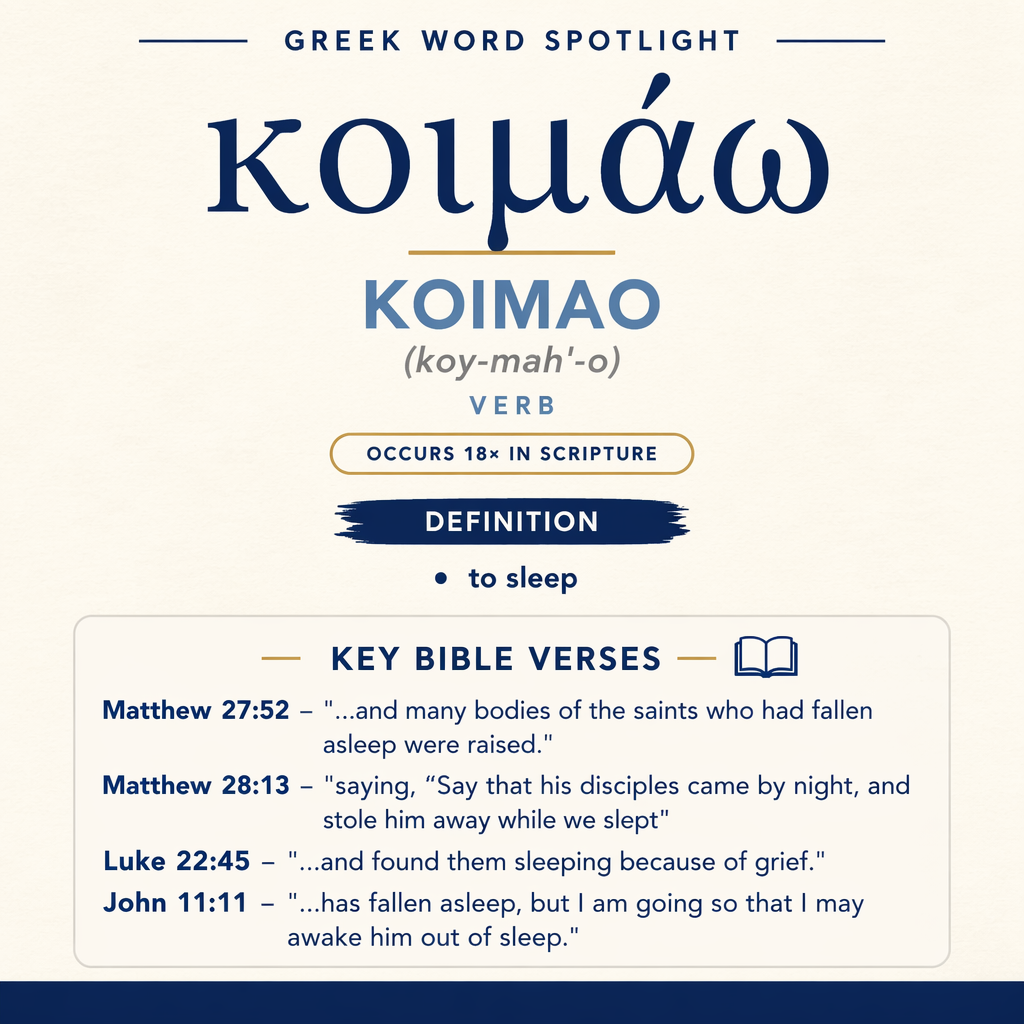
κοιμάω means “to sleep” and occurs 18 times in Scripture, including Matthew 27:52; 28:13; Luke 22:45; John 11:11–12; Acts 7:60; 12:6; 13:36.
Core Meaning
κοιμάω is defined as “to sleep.” In several passages it describes people who “had fallen asleep.”
Learn More →Gospel Examples
In Matthew 28:13 it is used of sleeping at night. In John 11:11–12 it is used of Lazarus having “fallen asleep.”
Learn More →Acts Examples
In Acts 12:6 it describes Peter sleeping between two soldiers. In Acts 13:36 it describes David who “fell asleep” and was laid with his fathers.
Learn More →κοιμάω means “to sleep,” and in the passages where it appears it speaks either of ordinary sleeping or of “falling asleep” as a way of speaking about death. The word is used in narrative scenes (guards, disciples, a prisoner) and in apostolic preaching and teaching about the dead.
Occurrences
“The tombs were opened, and many bodies of the saints who had fallen asleep were raised;” (Matthew 27:52)
Here “had fallen asleep” characterizes the saints whose bodies are in tombs; the wording connects their present state with being raised. Within the sentence, “sleep” functions as the condition from which these “bodies” are brought out when “the tombs were opened.”
“saying, “Say that his disciples came by night, and stole him away while we slept.” (Matthew 28:13)
“While we slept” is part of a proposed explanation offered by guards: the theft is imagined as happening during their sleep. The verb supplies the vulnerability and timing that make the story plausible within the scene’s logic—events occur “by night” and during the guards’ sleeping.
“When he rose up from his prayer, he came to the disciples, and found them sleeping because of grief,” (Luke 22:45)
The disciples are discovered “sleeping because of grief,” so sleep is portrayed as the bodily effect of intense sorrow. The clause links the act of sleeping with an emotional cause, sharpening the contrast between Jesus’ prayer and their exhaustion.
“He said these things, and after that, he said to them, “Our friend, Lazarus, has fallen asleep, but I am going so that I may awake him out of sleep.”” (John 11:11)
Jesus describes Lazarus as having “fallen asleep” and immediately frames his own action as awakening him “out of sleep.” The paired expressions (“fallen asleep” / “awake him out of sleep”) present sleep as a state from which one can be roused, and the sentence’s purpose clause (“so that I may awake him”) gives the word a forward-driving role in the narrative.
“The disciples therefore said, “Lord, if he has fallen asleep, he will recover.”” (John 11:12)
The disciples treat “fallen asleep” as a positive sign: sleep suggests rest that leads to recovery. In this response, the verb supports an inference about health (“he will recover”) drawn from the fact of sleeping.
“He kneeled down, and cried with a loud voice, “Lord, don’t hold this sin against them!” When he had said this, he fell asleep.” (Acts 7:60)
Stephen’s final words are followed by “he fell asleep,” closing the scene with a calm, settled description after a loud cry and prayer. The verb functions as the narrative’s concluding action, marking the end of his speech and the end of his earthly struggle in the moment described.
“The same night when Herod was about to bring him out, Peter was sleeping between two soldiers, bound with two chains. Guards in front of the door kept the prison.” (Acts 12:6)
“Peter was sleeping” sets a striking scene of rest in confinement: he is “between two soldiers,” “bound with two chains,” with guards at the door. The word highlights his state at a tense moment (“about to bring him out”), contrasting physical restraint and heavy security with the simplicity of sleep.
“For David, after he had in his own generation served the counsel of God, fell asleep, was laid with his fathers, and saw decay.” (Acts 13:36)
“Fell asleep” stands among a sequence of clauses describing David’s end: service, sleep, burial (“was laid with his fathers”), and decay. In this chain, sleep functions as the transition from a life of service to burial and the natural course of the body afterward.
“A wife is bound by law for as long as her husband lives; but if the husband is dead, she is free to be married to whomever she desires, only in the Lord.” (1 Corinthians 7:39)
This verse addresses the condition of being “dead” in a legal and relational context: a husband’s death changes a wife’s status. In the larger set of κοιμάω occurrences, it provides a plain reference point for death as an objective state that ends a bond “for as long as her husband lives,” even though the verse itself speaks of “dead” rather than describing the state as sleep.
“For this cause many among you are weak and sickly, and not a few sleep.” (1 Corinthians 11:30)
“Not a few sleep” is placed alongside “weak” and “sickly” as part of a sobering diagnosis of the community. The wording treats “sleep” as the most severe outcome in the sequence, functioning as a blunt summary of those who have entered that state.
“Then he appeared to over five hundred brothers at once, most of whom remain until now, but some have also fallen asleep.” (1 Corinthians 15:6)
“Some have also fallen asleep” distinguishes between those “who remain until now” and those who no longer do. The verb supplies a gentle way to acknowledge that a portion of this large group has died, while the sentence maintains the contrast between present witnesses and those who have passed from the scene.
“Then they also who are fallen asleep in Christ have perished.” (1 Corinthians 15:18)
The phrase “fallen asleep in Christ” identifies a group defined by their death and their relation “in Christ.” The verb’s imagery of sleep is pressed into a theological argument: it is these sleepers whose fate is being discussed (“have perished”), making the term central to the verse’s concern for the dead.
Sense and Usage
Across these passages, κοιμάω consistently presents “sleep” as a recognizable human condition, but the settings show two distinct ways that condition is spoken of. In straightforward narrative moments, it is literal sleeping: guards give an account framed by “while we slept” (Matthew 28:13), disciples are found “sleeping because of grief” (Luke 22:45), and Peter is “sleeping between two soldiers” despite chains and guards (Acts 12:6). In each case, sleep is not merely a background detail; it shapes the scene’s meaning—either exposing vulnerability (guards), revealing weakness under sorrow (disciples), or heightening the tension of an impending ordeal (Peter).
In other contexts, the same verb describes death as “falling asleep.” This phrasing appears with the saints in opened tombs (Matthew 27:52), with Lazarus in a conversation that introduces the idea of being “awake[n] … out of sleep” (John 11:11–12), with Stephen at the close of his final prayer (Acts 7:60), with David in a summary of his end (Acts 13:36), and with members of the Christian community in the midst of pastoral warning and resurrection teaching (1 Corinthians 11:30; 15:6, 15:18). Used this way, “sleep” provides language for death that can be placed naturally into narratives and arguments without changing the basic meaning of the word: it still names a state of “sleep,” but it is applied to those whose bodies are in tombs (Matthew 27:52) or who have reached the end of life’s course (Acts 13:36).
Several passages show how flexible the imagery can be while remaining anchored in “sleep.” In John 11:11, Jesus pairs “has fallen asleep” with “awake him out of sleep,” presenting sleep as a state that can be ended by awakening; the disciples’ response (“if he has fallen asleep, he will recover,” John 11:12) shows how easily hearers can take the word in its ordinary sense and reason from it. In 1 Corinthians 15:6, “fallen asleep” functions in a factual register—some witnesses remain, others have died—whereas in 1 Corinthians 15:18 the phrase “fallen asleep in Christ” places sleepers within a defined group whose destiny is being debated. In 1 Corinthians 11:30, “sleep” stands as a stark communal reality alongside weakness and sickness, turning the vocabulary of sleep into a warning-laden assessment.
Imagery
The passages gather a set of concrete images around κοιμάω: sleeping guards at night (Matthew 28:13), grieving disciples overcome by sleep (Luke 22:45), a chained prisoner asleep under guard (Acts 12:6), and tombs opened where those who “had fallen asleep” are raised (Matthew 27:52). When used of death, the imagery remains bodily and grounded—sleepers are connected with tombs and decay (Matthew 27:52; Acts 13:36)—yet it also serves as a way to speak of the dead within communities that remember them (“some have also fallen asleep,” 1 Corinthians 15:6) and within arguments that weigh what their end would mean (“fallen asleep in Christ,” 1 Corinthians 15:18).
Sources: Lexical data from Strong’s Exhaustive Concordance and the Translators Brief Lexicon of Extended Strongs for Greek (STEPBible, CC BY). Occurrence data from the Translators Amalgamated Greek New Testament (STEPBible, CC BY). Scripture quotations from the World English Bible (public domain).




