
Exploring the Meaning of Koilia in Greek
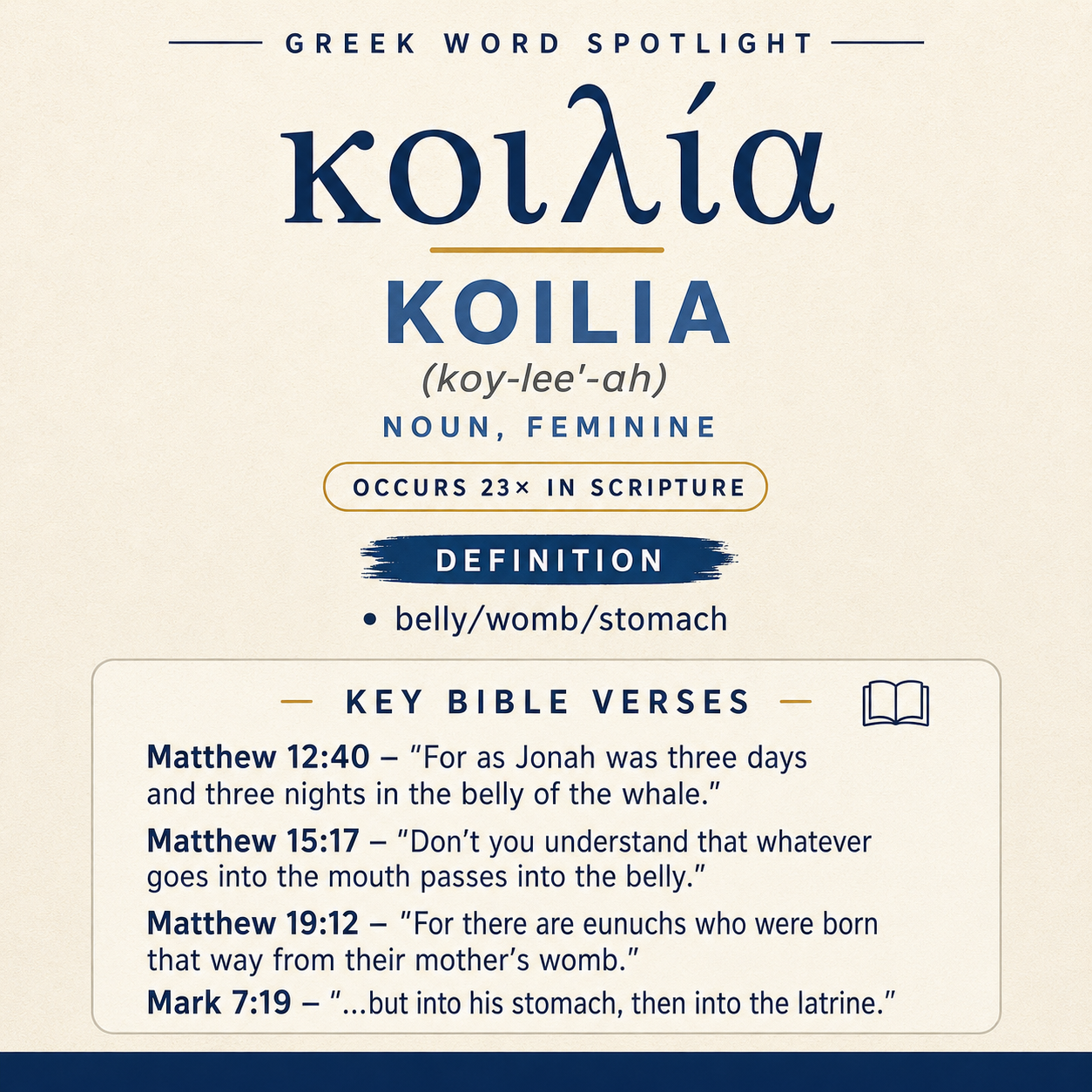
κοιλία means belly/womb/stomach and occurs 23 times in Scripture, including Matthew 12:40; Matthew 15:17; Matthew 19:12; Mark 7:19; and Luke 1:15,41-42,44.
Matthew & Mark
It describes Jonah being in the whale’s belly (Matthew 12:40) and food passing into the belly/stomach (Matthew 15:17; Mark 7:19).
Learn More →Luke’s Womb
In Luke 1, κοιλία refers to the womb, including the baby leaping in Elizabeth’s womb (Luke 1:41,44) and “fruit of your womb” (Luke 1:42).
Learn More →κοιλία names the body’s interior in concrete terms, ranging from digestive space to the place where a child is conceived and carried. In the passages below it anchors Jesus’ teaching in ordinary anatomy and also supplies vivid imagery for confinement, hunger, and prenatal life.
Occurrences
Matthew 12:40 — “For as Jonah was three days and three nights in the belly of the whale, so will the Son of Man be three days and three nights in the heart of the earth.”
Here κοιλία marks an enclosed interior space: Jonah is described as being “in the belly,” which frames the comparison as one of being held within something larger than oneself. The word contributes a spatial, bodily image—an “inside”—that supports the stated time period (“three days and three nights”) and prepares the parallel “in the heart of the earth.”
Matthew 15:17 — “Don’t you understand that whatever goes into the mouth passes into the belly, and then out of the body?”
In this saying, κοιλία is the bodily destination of what enters “the mouth.” The sequence “into the mouth … into the belly … out of the body” uses the stomach as a midpoint in a plain description of digestion, emphasizing where food goes and how it exits rather than treating ingestion as something that remains within a person.
Matthew 19:12 — “For there are eunuchs who were born that way from their mother’s womb, and there are eunuchs who were made eunuchs by men; and there are eunuchs who made themselves eunuchs for the Kingdom of Heaven’s sake. He who is able to receive it, let him receive it.”
Here κοιλία is “their mother’s womb,” the bodily origin point of one category (“born that way”). The word grounds the discussion of different life situations in physical beginnings: the distinction starts at gestation and birth (“from their mother’s womb”) before moving to human action (“made … by men”) and chosen renunciation (“made themselves”).
Mark 7:19 — “because it doesn’t go into his heart, but into his stomach, then into the latrine, making all foods clean?”
In this explanation, κοιλία is “his stomach,” contrasted with “his heart.” The word supports an argument by mapping a path: what is eaten does not enter the moral center (“heart”) but the digestive interior (“stomach”), and then proceeds “into the latrine.” The realism of the bodily route is what gives the contrast its force.
Luke 1:15 — “For he will be great in the sight of the Lord, and he will drink no wine nor strong drink. He will be filled with the Holy Spirit, even from his mother’s womb.”
Here κοιλία, “his mother’s womb,” identifies the earliest stage of life as the starting point for what is said about John. The phrase “even from” ties the womb to an origin of experience, indicating a beginning before birth for what follows in the sentence.
Luke 1:41 — “When Elizabeth heard Mary’s greeting, the baby leaped in her womb; and Elizabeth was filled with the Holy Spirit.”
In this narrative moment, κοιλία is the location of the baby’s movement: “the baby leaped in her womb.” The word provides a concrete setting for an unseen action—movement within the mother—and links it temporally to the heard greeting (“When Elizabeth heard…”), showing an immediate bodily response.
Luke 1:42 — “She called out with a loud voice and said, “Blessed are you among women, and blessed is the fruit of your womb!”
Here κοιλία appears in a blessing: “the fruit of your womb.” The word frames pregnancy in terms of bodily place and outcome, where “fruit” names the child as what the womb contains and brings forth. It also keeps the blessing tightly connected to Mary’s physical motherhood (“among women”).
Luke 1:44 — “For behold, when the voice of your greeting came into my ears, the baby leaped in my womb for joy!”
In this further explanation, κοιλία again locates the baby (“in my womb”), but now the leaping is qualified: “for joy.” The word supplies the bodily container in which an emotional response is expressed through movement, binding together hearing (“came into my ears”) and an interior bodily event.
Luke 2:21 — “When eight days were fulfilled for the circumcision of the child, his name was called Jesus, which was given by the angel before he was conceived in the womb.”
Here κοιλία is used with conception: “conceived in the womb.” The word anchors the time reference “before” in a bodily milestone, setting the naming (“his name was called Jesus”) against the earlier moment of conception. The womb functions as the locus where conception occurs, marking a point in the child’s existence.
Luke 11:27 — “It came to pass, as he said these things, a certain woman out of the multitude lifted up her voice, and said to him, “Blessed is the womb that bore you, and the breasts which nursed you!””
In this exclamation from the crowd, κοιλία is “the womb that bore you.” The word highlights Jesus’ physical gestation and birth as grounds for praise, paired with “the breasts which nursed you.” Together they form a maternal picture in which the womb is the place of bearing and the breasts the means of nourishment after birth.
Luke 15:16 — “He wanted to fill his belly with the husks that the pigs ate, but no one gave him any.”
In the parable’s low point, κοιλία is “his belly,” presented as empty and craving to be filled. The word sharpens the desperation: the hunger is not abstract but located in the body’s need, and the desired food (“husks that the pigs ate”) underscores the degradation of the situation, reinforced by the final clause, “but no one gave him any.”
Luke 23:29 — “For behold, the days are coming in which they will say, ‘Blessed are the barren, the wombs that never bore, and the breasts that never nursed.’”
Here κοιλία appears in a stark reversal: “the wombs that never bore.” The word remains bodily and concrete, but now it is used in a pronouncement about coming days, where the absence of childbearing (“barren … never bore … never nursed”) is spoken of as “blessed.” The womb is the central image for bearing, paired again with breasts for nursing.

Sense and Usage
Across these passages, κοιλία consistently points to an interior bodily space, and the contexts cluster around two main domains: digestion and gestation. In the digestive sayings (Matthew 15:17; Mark 7:19), the word helps trace a physical route—mouth to stomach and onward—so that the argument is grounded in what happens to food in ordinary human bodies. In Luke 15:16, the same bodily interior becomes the seat of urgent hunger: the “belly” is something that can be “fill[ed],” and the scene’s harshness is expressed by the kind of fill sought and the refusal of provision.
In the birth-and-pregnancy texts (Matthew 19:12; Luke 1:15, 1:41–42, 1:44; Luke 2:21; Luke 11:27; Luke 23:29), κοιλία functions as the place of origin and nurture before birth. It can mark the beginning point of a life situation (“from their mother’s womb”), the setting of prenatal action (“the baby leaped in her womb”), and the locus of conception (“conceived in the womb”). Several of these occurrences place the womb alongside other bodily realities—ears that hear, a voice that greets, breasts that nurse—so that the narratives and sayings remain grounded in embodied life. The repeated pairing of womb and breasts (Luke 11:27; Luke 23:29) treats motherhood as a whole sequence: bearing and then feeding, with κοιλία naming the first stage of that sequence.
Matthew 12:40 stands somewhat apart by applying κοιλία to Jonah’s confinement “in the belly of the whale.” Even there, the word retains its core idea of an interior space; it is simply extended from human anatomy to the inside of a great creature. The imagery of being within—hidden, enclosed, and held for a set time—makes the comparison memorable and concrete.
Imagery
κοιλία carries strong interior imagery in these texts: the inside where food goes, the inside where a child is conceived and moves, and the inside where someone can be enclosed. Whether the scene is a teaching about what enters and exits the body, a blessing focused on pregnancy and birth, or a parable of hunger so intense it longs to be “fill[ed],” the word consistently draws attention to what is happening within the body (or within a creature) and uses that inner space to sharpen what is being said.
Sources: Lexical data from Strong’s Exhaustive Concordance and the Translators Brief Lexicon of Extended Strongs for Greek (STEPBible, CC BY). Occurrence data from the Translators Amalgamated Greek New Testament (STEPBible, CC BY). Scripture quotations from the World English Bible (public domain).




