
Exploring the Meaning of Koiton in Greek
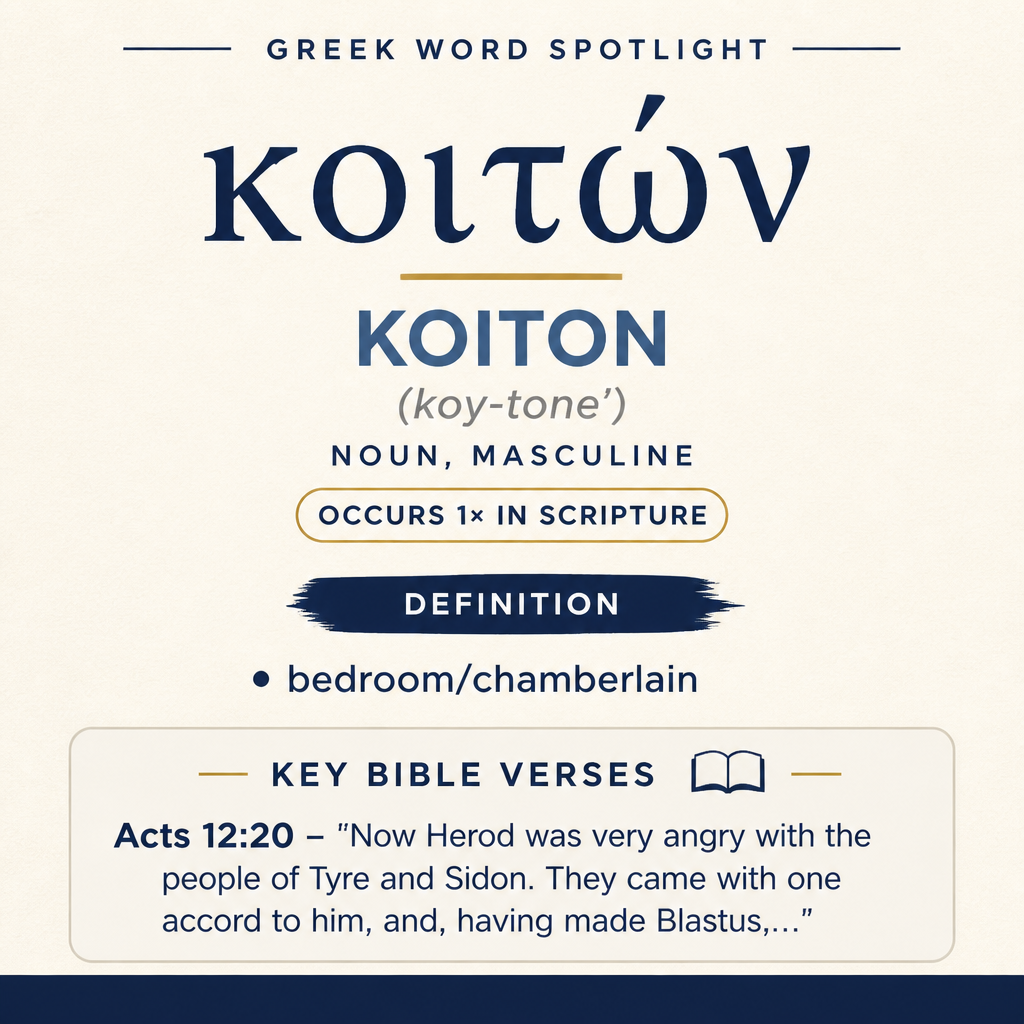
κοιτών (Koiton) means “bedroom/chamberlain” and appears once in Scripture, in Acts 12:20.
Scripture Occurrence
This word occurs 1 time in Scripture. Its single reference is Acts 12:20.
Learn More →Acts Context
In Acts 12:20, the narrative mentions Blastus in relation to Herod. κοιτών appears in this verse.
Learn More →Koitōn refers to a “bedroom/chamberlain,” and it appears once in the New Testament, in the narrative of Herod and the delegation from Tyre and Sidon. In that setting, it identifies a royal household role connected to access and mediation.
Root and Related Words
Koitōn is derived from koitē (κοίτη), “bed” (Strong’s G2845). The relationship ties the term to the sphere of the bedchamber and the personnel associated with it, framing the word within the vocabulary of intimate household space and service.

Occurrences
Acts 12:20 Now Herod was very angry with the people of Tyre and Sidon. They came with one accord to him, and, having made Blastus, the king’s personal aide, their friend, they asked for peace, because their country depended on the king’s country for food.
In Acts 12:20, koitōn stands behind the description “the king’s personal aide,” naming Blastus as a figure situated within the king’s immediate circle. The verse describes a tense political moment: Herod is “very angry,” and the people of Tyre and Sidon respond not with a public appeal but by coordinated approach—“They came with one accord to him.” Their strategy centers on relationship and access: “having made Blastus … their friend, they asked for peace.” Within that sentence, the function of koitōn is to mark the kind of aide Blastus is—someone positioned close enough to the king that his goodwill matters for petitioners seeking an audience and a favorable outcome.
The word’s force in the scene is therefore relational and procedural. The delegation’s request—“they asked for peace”—is not presented as an abstract negotiation; it is mediated through a royal household officer. The narrative highlights the practical stakes: “their country depended on the king’s country for food.” Against that urgency, the mention of Blastus with koitōn clarifies why winning his friendship is an effective step. He is not merely a messenger at the edge of court life but a household insider associated with the king’s personal domain, the kind of role that can smooth access, convey petitions, and influence timing and reception. Even without describing his actions directly, the text assigns him narrative weight by placing him between the dependent cities and the angry monarch.
Sense and Usage
The paired definition “bedroom/chamberlain” gathers two closely linked ideas: a space (the bedroom) and a person (the chamberlain) associated with that space. In Acts 12:20, the personal dimension is foregrounded: Blastus is a “personal aide,” and the story turns on the delegation’s ability to secure his friendship. In royal contexts, a “bedroom” is not simply a sleeping area; it represents the most private segment of a ruler’s household, where access is restricted and controlled. A term connected to that sphere naturally suggests proximity, trust, and gatekeeping—features that make such an officer valuable to outsiders seeking influence.
Within the verse, koitōn contributes to the portrayal of power as something managed through layers. Herod’s anger sets a hostile backdrop; the need of Tyre and Sidon sets the pressure point; and Blastus, identified by koitōn, embodies the mechanism by which petitioners attempt to move from vulnerability toward safety. The narrative does not depict them confronting Herod’s anger head-on; instead, it shows them making a calculated approach that begins inside the king’s household structure. The word thus functions as a compact social description: it tells the reader what kind of connection Blastus represents and why his friendship is an instrument for achieving “peace.”
The definition’s two-part range also helps explain the English rendering in Acts 12:20. The verse translates the idea with a courtly job description (“personal aide”) rather than naming the room itself (“bedroom”), because the scene is about negotiation and access rather than about physical furnishings. Still, the “bedroom” side of the definition remains relevant at the level of connotation: it locates the office in the inner household, where personal service overlaps with political influence. In a story where supply (“food”) and diplomacy (“peace”) hinge on a ruler’s disposition, the presence of a chamber-related aide underscores how decisions and relationships can be shaped from within the private infrastructure of power.
Because koitōn appears here in a sentence focused on friendship, petition, and dependence, its usage is tightly bound to mediation. The word does not name the king, the petitioners, or the requested outcome; it names the connecting figure whose position makes him worth winning over. That is how koitōn works in this passage: it identifies a household officer whose closeness to the king makes him a strategic point of contact for those who need something from the throne.
Imagery
The imagery attached to koitōn in Acts 12:20 is the imagery of the inner chambers of rule: not the public square, but the private corridor where access is controlled. The verse’s brief mention of Blastus places the reader at the threshold between an angry king and anxious petitioners, where “peace” is sought through the friendship of a personal aide whose role is defined by proximity to the royal bedchamber.
Sources: Lexical data from Strong’s Exhaustive Concordance and the Translators Brief Lexicon of Extended Strongs for Greek (STEPBible, CC BY). Occurrence data from the Translators Amalgamated Greek New Testament (STEPBible, CC BY). Scripture quotations from the World English Bible (public domain).




