Exploring the Meaning of Xeros in Greek
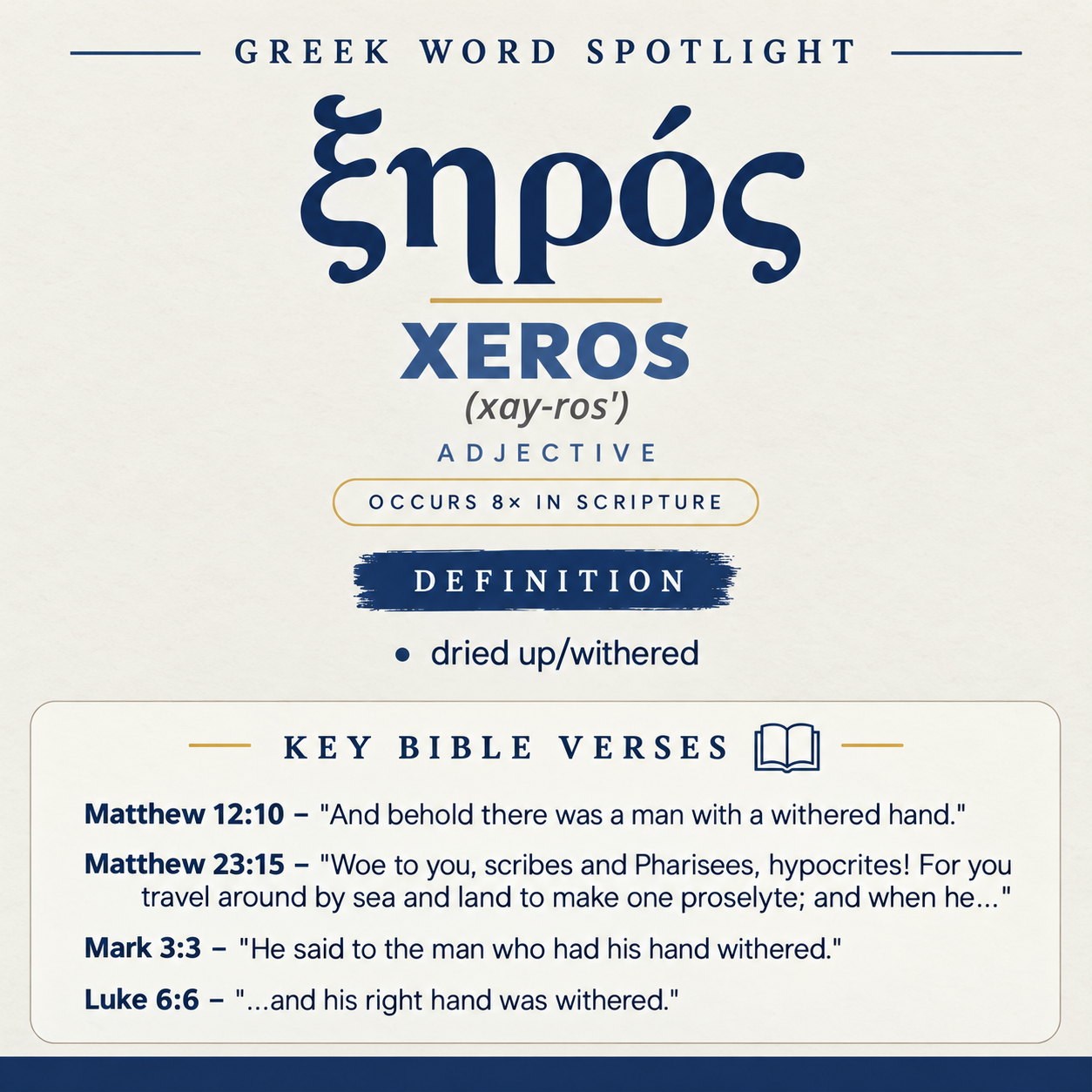
ξηρός (Xeros) means “dried up/withered” and occurs 8 times in Scripture, including Matthew, Mark, Luke, John, and Hebrews.
Gospel Usage
It describes a “withered hand” in Matthew 12:10; Mark 3:3; Luke 6:6, 6:8. Luke 23:31 contrasts the “green tree” with the “dry” one.
Learn More →Other Occurrences
Hebrews 11:29 uses it for “dry land” in Israel’s passage through the Red Sea. John 5:3 lists many sick people, including “paralyzed.”
Learn More →ξηρός describes something “dried up/withered,” a condition pictured both in the body and in the natural world. In the New Testament it appears in scenes of Sabbath controversy and healing, in a warning framed with tree imagery, and in a recollection of Israel crossing the sea on “dry land.”
Occurrences
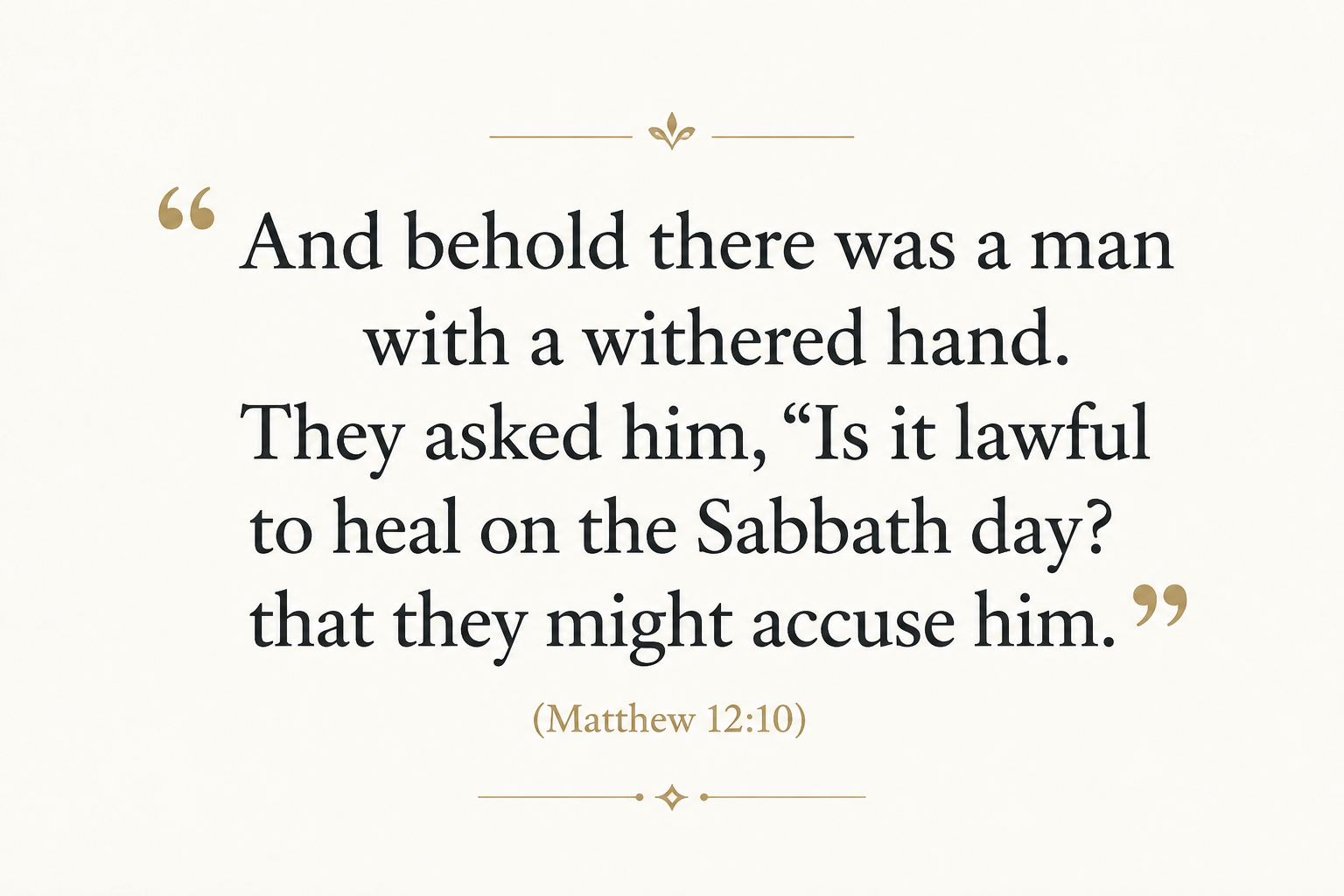
“And behold there was a man with a withered hand. They asked him, “Is it lawful to heal on the Sabbath day?” that they might accuse him.” (Matthew 12:10)
Here ξηρός marks a visible, physical impairment: the man’s hand is described as “withered,” setting the scene for a test question about Sabbath healing. The adjective’s concrete force helps explain why the question carries immediate weight: the condition is not abstract but embodied, and its presence becomes the occasion for an accusation.
“Woe to you, scribes and Pharisees, hypocrites! For you travel around by sea and land to make one proselyte; and when he becomes one, you make him twice as much a son of Gehenna as yourselves.” (Matthew 23:15)
This verse is part of a denunciation that uses travel “by sea and land” to stress effort and reach. In this setting, ξηρός contributes the sense of “dried up/withered” by lending itself to the land imagery: the language contrasts modes and terrains, so the adjective’s natural association with dryness fits the scene’s geographic vocabulary and sharpens the picture of strenuous movement across different environments.
“He said to the man who had his hand withered, “Stand up.”” (Mark 3:3)
Mark’s brief command is anchored by the description “hand withered,” which identifies the man without naming him and places his condition at the center of the confrontation. ξηρός functions almost like a spotlight: it focuses attention on the withered limb as the immediate object around which Jesus’ directive and the public moment (“Stand up.”) are arranged.
“It also happened on another Sabbath that he entered into the synagogue and taught. There was a man there, and his right hand was withered.” (Luke 6:6)
Luke situates the episode within synagogue teaching on the Sabbath and specifies “his right hand,” making the impairment more particular and concrete. ξηρός here conveys a withering that is localized and observable; it frames the narrative as a case of bodily diminishment set directly in a communal, watchful setting where teaching and healing will intersect.
“But he knew their thoughts; and he said to the man who had the withered hand, “Rise up, and stand in the middle.” He arose and stood.” (Luke 6:8)
The adjective remains attached to the man as he is brought “in the middle,” turning a private affliction into a public focal point. ξηρός contributes to the tension of the scene: the withered condition is the reason the man is summoned forward, and the narrative places that withering under communal scrutiny—precisely where motives (“he knew their thoughts”) are also being tested.
“For if they do these things in the green tree, what will be done in the dry?” (Luke 23:31)
Here ξηρός shifts from the human body to the natural world: the contrast is between “the green tree” and “the dry.” The adjective supplies the image of something dried out, set against what is living and moist (“green”). The force of the saying depends on the starkness of that contrast: dryness is a condition that evokes vulnerability and exposure, and it serves as a vivid counterpart to the “green tree.”
“In these lay a great multitude of those who were sick, blind, lame, or paralyzed, waiting for the moving of the water;” (John 5:3)
This description of the poolside crowd lists conditions of weakness and disability. In such a setting, ξηρός contributes the notion of “dried up/withered” as one recognizable kind of bodily affliction among others, fitting naturally into a catalog of impairments. The emphasis falls on sheer number (“a great multitude”) and on waiting, so the adjective’s descriptive sharpness supports the picture of long-standing, visible need gathered at the water’s edge.
“By faith, they passed through the Red Sea as on dry land. When the Egyptians tried to do so, they were swallowed up.” (Hebrews 11:29)
In Hebrews, ξηρός belongs to the terrain underfoot: “dry land” in the middle of the sea. The adjective’s sense of dryness intensifies the marvel implied by the comparison “as on dry land”: the path is pictured not as muddy or precarious but as genuinely dry. The phrase provides a stable-sounding surface for the crossing, which heightens the contrast with the Egyptians’ attempt and sudden reversal (“they were swallowed up”).

Sense and Usage
Across these passages, ξηρός consistently depicts a state of dryness or withering, but it does so in distinct domains that shape how the reader imagines the condition.
In the healing narratives (Matthew 12:10; Mark 3:3; Luke 6:6; Luke 6:8), ξηρός is bodily and specific: a “hand” is withered, and Luke narrows it further to “his right hand.” The adjective does more than label a medical condition; it provides a visible marker that makes the person’s need legible to the crowd and immediately relevant to the controversy about what may be done “on the Sabbath day” (Matthew 12:10) and in the synagogue (Luke 6:6). The repeated pairing with public commands—“Stand up,” “Rise up,” “stand in the middle”—shows how the withered state becomes the narrative hinge for a public action that will be judged and interpreted by observers.
In Luke 23:31, ξηρός functions metaphorically through tree imagery without leaving its concrete sense. “Dry” is not an inward feeling but the outward condition of a tree contrasted with “green.” The expression works because dryness and greenness are readily pictured conditions: the adjective supplies an immediate sensory contrast, allowing the saying to move quickly from image to implication.
In Hebrews 11:29, the adjective is applied to the ground itself: “dry land” provides a physical setting for movement through water. Here ξηρός supports the logic of the comparison: the crossing is described in terms of an ordinary experience—walking on dry ground—even as the surrounding reality (“through the Red Sea”) makes the ordinary description striking. Dryness becomes a sign of stability and passability, not merely the absence of moisture.
John 5:3 places ξηρός within a larger field of affliction—“sick, blind, lame, or paralyzed”—all gathered in a posture of waiting. In that list-shaped description, the adjective’s role is classificatory: it helps populate the scene with recognizable kinds of suffering. The pool setting and the phrase “waiting for the moving of the water” make dryness/withering particularly poignant as one mode of bodily need present at a place associated with water.
Matthew 23:15, with its movement “by sea and land,” uses environmental language that readily accommodates dryness as a descriptor of land. In that denunciation, the vocabulary of travel and terrain serves the rhetorical point about effort and outcome, and ξηρός contributes to the concreteness of the land-side picture as part of that travel contrast.
Imagery
ξηρός carries a consistent visual profile in these texts: a hand that is visibly diminished, a tree set in contrast to what is “green,” and ground described as “dry” even when surrounded by sea. Whether on a Sabbath in a synagogue, on a road framed by proverbial tree imagery, or in the remembered crossing of the sea, the adjective supplies a tactile, observable condition—something the eye can register and the mind can picture as either withered flesh, parched wood, or firm earth.
Sources: Lexical data from Strong’s Exhaustive Concordance and the Translators Brief Lexicon of Extended Strongs for Greek (STEPBible, CC BY). Occurrence data from the Translators Amalgamated Greek New Testament (STEPBible, CC BY). Scripture quotations from the World English Bible (public domain).