
Who was Pharaoh in the bible?
Pharaoh is named as “king of Egypt” in Acts 7 and is also addressed in Romans 9:17, appearing in Acts, Romans, and Hebrews.

Joseph Before Pharaoh
God “gave him favor and wisdom before Pharaoh, king of Egypt” (Acts 7:10). “Joseph’s race was revealed to Pharaoh” (Acts 7:13).
Learn More →Moses and Pharaoh
“Pharaoh’s daughter took him up and reared him as her own son” (Acts 7:21). Moses “refused to be called the son of Pharaoh’s daughter” (Hebrews 11:24).
Learn More →In the New Testament passages provided, Pharaoh is presented as “Pharaoh, king of Egypt” and as a royal figure addressed by Scripture. The name is a title of foreign origin, used for Egyptian kings, and it also appears in reference to “Pharaoh’s daughter.”
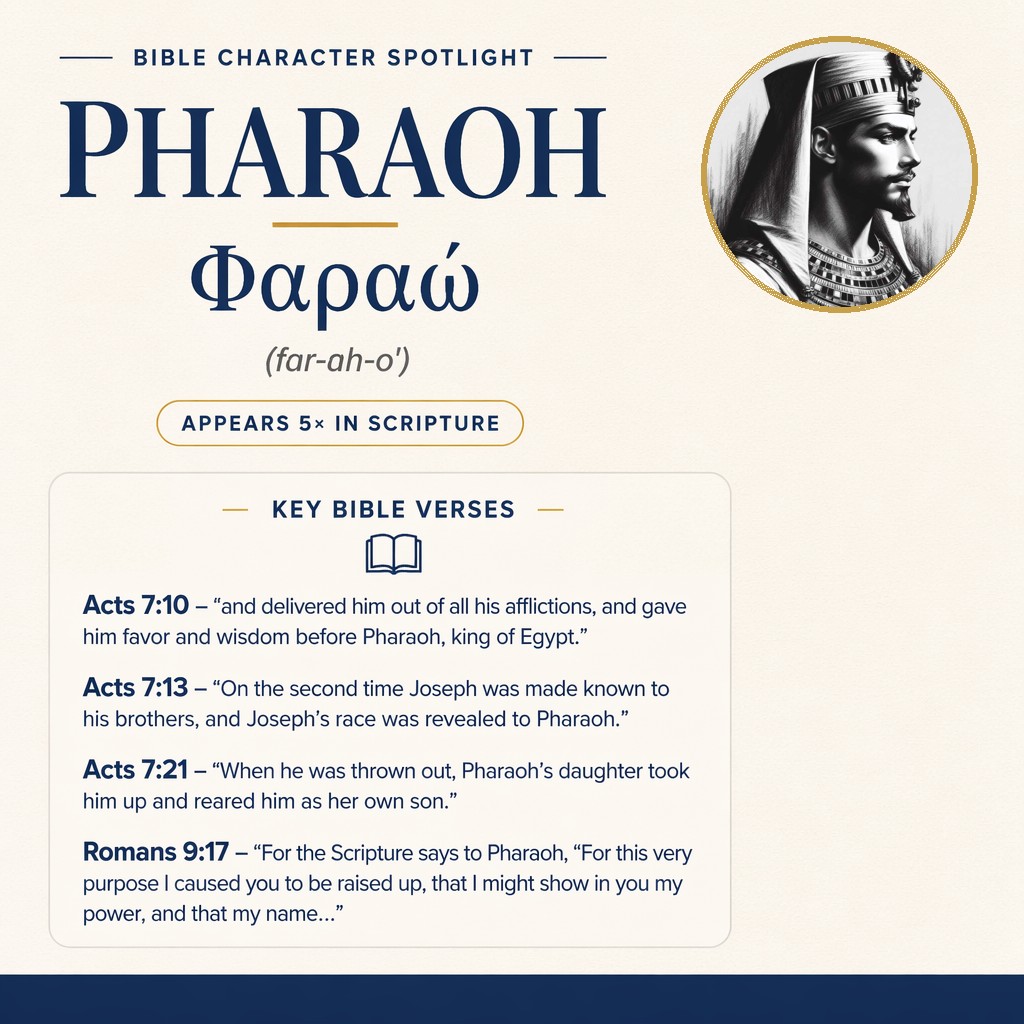
Pharaoh in Scripture
Pharaoh appears most fully within Stephen’s speech in Acts 7, where Stephen recounts the history of Israel’s ancestors and God’s dealings with them. The narrative begins broadly with God’s call to Abraham (Acts 7:2–8), then turns to Joseph’s being sold into Egypt and God’s presence with him there (Acts 7:9–16). Within that setting, Pharaoh enters the account as the Egyptian king before whom Joseph found favor.
“and delivered him out of all his afflictions, and gave him favor and wisdom before Pharaoh, king of Egypt. He made him governor over Egypt and all his house.” (Acts 7:10)
This verse frames Pharaoh as the reigning “king of Egypt” during Joseph’s rise: Joseph’s deliverance and advancement are attributed to God’s action, and Joseph is described as receiving “favor and wisdom” before Pharaoh. Stephen then continues the story with the famine affecting Egypt and Canaan (Acts 7:11) and Jacob’s sending the patriarchs to Egypt for grain (Acts 7:12). On their second visit Joseph is revealed, and Pharaoh is again mentioned as the one to whom Joseph’s family line became known.
“On the second time Joseph was made known to his brothers, and Joseph’s race was revealed to Pharaoh.” (Acts 7:13)
Stephen’s speech continues with Joseph summoning Jacob and relatives, “seventy-five souls” (Acts 7:14), and Jacob’s move to Egypt and death there (Acts 7:15), with the later return of their bodies to Shechem (Acts 7:16). The speech then describes Israel’s multiplication in Egypt as the “time of the promise” drew near (Acts 7:17) and introduces oppression under a new ruler.
“until there arose a different king, who didn’t know Joseph.” (Acts 7:18)
Stephen describes that king’s mistreatment: “The same took advantage of our race, and mistreated our fathers, and forced them to throw out their babies, so that they wouldn’t stay alive.” (Acts 7:19). Within that context, Moses is born and hidden for a time (Acts 7:20). Pharaoh appears again, not directly as an actor in Moses’ rescue, but through reference to his daughter, who takes Moses in.
“When he was thrown out, Pharaoh’s daughter took him up and reared him as her own son.” (Acts 7:21)
Stephen adds that Moses “was instructed in all the wisdom of the Egyptians” and became “mighty in his words and works” (Acts 7:22). The speech then narrates Moses’ desire to visit “his brothers, the children of Israel” (Acts 7:23), his defense of an oppressed Israelite and striking of an Egyptian (Acts 7:24), and his assumption that his people would recognize that God was giving deliverance by his hand (Acts 7:25). When conflict arises and Moses’ deed becomes known, Moses flees and becomes “a stranger in the land of Midian” (Acts 7:29). After “forty years were fulfilled,” an angel appears to him (Acts 7:30–34), and God commissions Moses to return to Egypt: “Now come, I will send you into Egypt.” (Acts 7:34). Stephen emphasizes that the Moses whom they rejected was the one God sent “as both a ruler and a deliverer” (Acts 7:35), and he summarizes Moses’ works and leadership.
“This man led them out, having worked wonders and signs in Egypt, in the Red Sea, and in the wilderness for forty years.” (Acts 7:36)
In Stephen’s telling, Pharaoh is not named within the later portion of the speech, but Egypt remains central as the place of Israel’s affliction and from which God brings deliverance. Stephen’s speech proceeds through the wilderness period (Acts 7:37–44), Israel’s later history (Acts 7:45–50), and Stephen’s prophetic accusation against his hearers (Acts 7:51–53), culminating in his martyrdom (Acts 7:54–60).
Outside Acts 7, Pharaoh appears in Romans as the figure to whom Scripture speaks concerning God’s purpose in displaying power. The verse does not narrate the surrounding events, but it quotes Scripture’s address to Pharaoh in theological terms.
“For the Scripture says to Pharaoh, “For this very purpose I caused you to be raised up, that I might show in you my power, and that my name might be proclaimed in all the earth.”” (Romans 9:17)
Pharaoh is also referenced in Hebrews 11 within the account of Moses’ faith. In this passage, Pharaoh appears again indirectly through “Pharaoh’s daughter,” with the emphasis on Moses’ refusal of an Egyptian royal identification.
“By faith, Moses, when he had grown up, refused to be called the son of Pharaoh’s daughter,” (Hebrews 11:24)
Multiple bearers
The title Pharaoh is used in the provided verses for more than one Egyptian king. In Acts 7:10 and Acts 7:13, Pharaoh is “king of Egypt” in the days of Joseph, before whom Joseph received “favor and wisdom” and to whom “Joseph’s race was revealed.” In Acts 7:18–21, Stephen describes a later period: “there arose a different king, who didn’t know Joseph” (Acts 7:18), and the narrative of Moses’ infancy involves “Pharaoh’s daughter” (Acts 7:21). The passages do not specify whether “Pharaoh’s daughter” belongs to the “different king” of Acts 7:18, but they place Moses’ upbringing within an Egyptian royal household associated with Pharaoh.
Name and Meaning
In the Greek text, the name appears as Φαραώ, transliterated Pharao and pronounced “far-ah-o’.” The lexicon information supplied describes it as a title of foreign origin connected with the Hebrew form (H06547) and used as the designation “Pharaoh.”
Observation
Across these passages, Pharaoh functions as a marker of Egyptian royal power: Joseph receives “favor and wisdom before Pharaoh, king of Egypt” (Acts 7:10), Moses is raised within Pharaoh’s household through “Pharaoh’s daughter” (Acts 7:21), and Romans presents Pharaoh as one through whom God’s power and name are proclaimed “in all the earth” (Romans 9:17).
Frequently Asked Questions
What does the name Pharaoh mean?
Pharaoh means “Pharaoh.”
How many times does Pharaoh appear in the Bible?
Pharaoh appears 5 times.
Who was Pharaoh in the Bible?
Pharaoh is identified as the king of Egypt (Acts 7:10). Pharaoh is also connected to Pharaoh’s daughter (Acts 7:21; Hebrews 11:24).
What does Acts say about Pharaoh and Joseph?
Acts says Joseph received favor and wisdom before Pharaoh, king of Egypt, and Pharaoh made him governor over Egypt and all his house (Acts 7:10). It also says Joseph’s race was revealed to Pharaoh (Acts 7:13).
Explore Further
If you found this page about Pharaoh interesting and would like to discover more about other biblical characters, explore our comprehensive Encyclopedia of Biblical Characters. For those looking to delve deeper into the Greek origins of these names and terms, our Greek Lexicon is an invaluable resource.
Sources: Name and occurrence data from Strong’s Exhaustive Concordance and STEPBible reference data (CC BY). Scripture quotations from the World English Bible (public domain).





