
Who was Jacob in the bible?
Jacob (Ya'aqob) is the Israelitish patriarch mentioned across Scripture in covenant language and in references to “the children of Jacob,” including 1 Chronicles 16 and Amos.

Covenant References
David’s song says of Yahweh: “He confirmed it to Jacob for a statute, and to Israel for an everlasting covenant” (1 Chronicles 16:17). Yahweh showed compassion “because of his covenant with Abraham, Isaac, and Jacob” (2 Kings 13:23).
Learn More →Israel Named
Elijah used stones for “the tribes of the sons of Jacob, to whom Yahweh’s word came, saying, ‘Israel shall be your name’” (1 Kings 18:31). Another passage speaks of “the children of Jacob, whom he named Israel” (2 Kings 17:34).
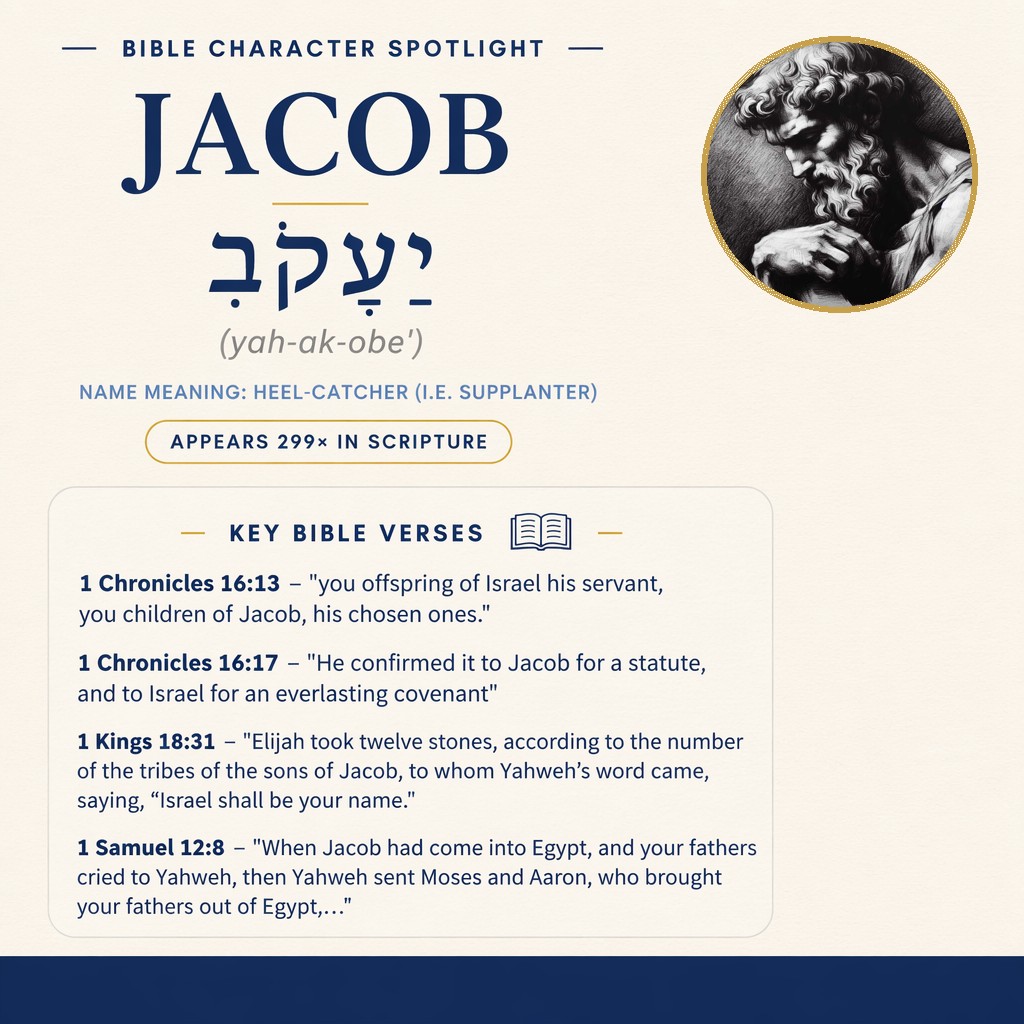
Learn More →Jacob (יַעֲקֹב, Ya’aqob) is presented as the Israelitish patriarch. The name is explained in lexicon paraphrase as meaning “heel-catcher,” that is, a “supplanter,” derived from a Hebrew root connected with seizing by the heel.
Jacob in Scripture
In a liturgical scene connected with David’s ordering of worship before the ark, Jacob is invoked as an ancestor-name for the covenant people. The address to the assembled worshipers includes a direct identification of the community as Jacob’s descendants:
“you offspring of Israel his servant, you children of Jacob, his chosen ones.” (1 Chronicles 16:13)
Within the same setting, the remembered covenant is traced through Abraham and Isaac and then expressly confirmed to Jacob. The narrative frames this remembrance with calls to thanksgiving and proclamation—“Oh give thanks to Yahweh. Call on his name. Make what he has done known among the peoples.” (1 Chronicles 16:8)—and then anchors the covenant in a statement about Jacob and Israel:
“He confirmed it to Jacob for a statute, and to Israel for an everlasting covenant,” (1 Chronicles 16:17)
The chapter continues by quoting the covenant promise—“I will give you the land of Canaan, The lot of your inheritance,” (1 Chronicles 16:18)—and culminates in the people’s worship response: “Blessed be Yahweh, the God of Israel, from everlasting even to everlasting. All the people said, “Amen,” and praised Yahweh.” (1 Chronicles 16:36). In this narrative, Jacob functions as a key covenant reference point: the people’s identity (“children of Jacob”) and the covenant’s confirmation (“confirmed it to Jacob”) are placed in the middle of communal praise, remembrance, and instruction.
Elsewhere, Jacob appears as a named figure in Israel’s national memory, particularly in recounting events connected with Egypt. Samuel’s speech recalls a sequence that begins with Jacob’s arrival in Egypt and continues with Israel’s cry and Yahweh’s sending of leaders:
“When Jacob had come into Egypt, and your fathers cried to Yahweh, then Yahweh sent Moses and Aaron, who brought your fathers out of Egypt, and made them to dwell in this place.” (1 Samuel 12:8)
Jacob is also cited within the language of covenant continuity and divine compassion. A historical notice about Yahweh’s dealings with Israel links mercy to a covenant remembered with three named patriarchs:
“But Yahweh was gracious to them, and had compassion on them, and had respect for them, because of his covenant with Abraham, Isaac, and Jacob, and would not destroy them, and he didn’t cast them from his presence as yet.” (2 Kings 13:23)
In another historical context, “the children of Jacob” are identified as those to whom Yahweh gave “the statutes, or the ordinances, or the law, or the commandment,” and the verse explicitly connects Jacob with the name Israel:
“To this day they do what they did before. They don’t fear Yahweh, and they do not follow the statutes, or the ordinances, or the law, or the commandment which Yahweh commanded the children of Jacob, whom he named Israel;” (2 Kings 17:34)
The name Jacob also marks the origin of Israel’s tribal structure in a symbolic prophetic action. Elijah’s choice of stones is explicitly tied to “the tribes of the sons of Jacob” and to a word from Yahweh about the name Israel:
“Elijah took twelve stones, according to the number of the tribes of the sons of Jacob, to whom Yahweh’s word came, saying, “Israel shall be your name.”” (1 Kings 18:31)
In Amos, “Jacob” becomes a collective designation for the people and their institutions, addressed and evaluated by prophetic speech. The prophet is commissioned to speak against Jacob as a “house”:
“Listen, and testify against the house of Jacob,” says the Lord Yahweh, the God of Armies. (Amos 3:13)
Amos also records Yahweh’s sworn assessment of Jacob’s pride and defenses, with an announced consequence:
“The Lord Yahweh has sworn by himself,” says Yahweh, the God of Armies: “I abhor the pride of Jacob, and detest his fortresses. Therefore I will deliver up the city with all that is in it.” (Amos 6:8)
In two parallel intercessions, Jacob is pictured as vulnerable—“small”—and the prophet pleads for forgiveness and restraint:
“Lord Yahweh, forgive, I beg you! How could Jacob stand? For he is small.” (Amos 7:2)
“Lord Yahweh, stop, I beg you! How could Jacob stand? For he is small.” (Amos 7:5)
Amos includes an oath formula that invokes “the pride of Jacob” as the basis for Yahweh’s resolve to remember deeds:
“Yahweh has sworn by the pride of Jacob, “Surely I will never forget any of their works.” (Amos 8:7)
Yet judgment is paired with a limit: even while announcing destruction upon “the sinful kingdom,” Yahweh declares that the “house of Jacob” will not be utterly destroyed:
“Behold, the eyes of the Lord Yahweh are on the sinful kingdom, and I will destroy it from off the surface of the earth; except that I will not utterly destroy the house of Jacob,” says Yahweh. (Amos 9:8)
Name and Meaning
Jacob’s name is written יַעֲקֹב, transliterated Ya’aqob, and pronounced yah-ak-obe’. In lexicon paraphrase, it is derived from a Hebrew root (linked with the idea of seizing by the heel), yielding the sense “heel-catcher,” figuratively understood as “supplanter”; the component idea is associated with the verb meaning “to seize by the heel.”
Observation
Across these passages, Jacob is repeatedly a covenant and identity name—“children of Jacob” (1 Chronicles 16:13)—and also a prophetic designation for a people held accountable and yet not abandoned: “I will not utterly destroy the house of Jacob” (Amos 9:8).
Frequently Asked Questions
What does the name Jacob mean?
Jacob means “heel-catcher,” that is, “supplanter.”
How many times does Jacob appear in the Bible?
Jacob occurs 299 times.
Who was Jacob?
Jacob (Ya’aqob) is identified as the Israelitish patriarch. In 1 Chronicles 16:13, people are addressed as “children of Jacob.”
What are the “tribes of the sons of Jacob” mentioned in the Bible?
1 Kings 18:31 refers to “the tribes of the sons of Jacob,” and says that to him Yahweh’s word came, “Israel shall be your name.”
Explore Further
If you found this page about Jacob interesting and would like to discover more about other biblical characters, explore our comprehensive Encyclopedia of Biblical Characters. For those looking to delve deeper into the Greek origins of these names and terms, our Greek Lexicon is an invaluable resource.
Sources: Name and occurrence data from Strong’s Exhaustive Concordance and STEPBible reference data (CC BY). Scripture quotations from the World English Bible (public domain).




