
Who was Moses in the bible?
Moses is a Hebrew-origin name in the Greek New Testament, appearing in Matthew and Mark in Jesus’ teaching and in a mountain vision with Elijah.
In Jesus’ Teaching
Jesus and others cite Moses’ commands: “offer the gift that Moses commanded” (Matthew 8:4) and “What did Moses command you?” (Mark 10:3). Moses is also quoted: “Honor your father and your mother” (Mark 7:10).
Learn More →Mountain Appearance
On a high mountain, “Moses and Elijah appeared to them talking with him” (Matthew 17:3). Peter proposed, “let’s make three tents here: one for you, one for Moses, and one for Elijah” (Matthew 17:4).
Learn More →Moses (Greek Μωϋσῆς / Μωσῆς) is presented in the New Testament passages here as a recognized figure whose “commanded” instructions and “said” teachings are appealed to in discussions about religious practice and moral obligation, and who also appears with Elijah speaking with Jesus. The lexicon entry identifies the name as Moses and indicates it is of Hebrew origin.
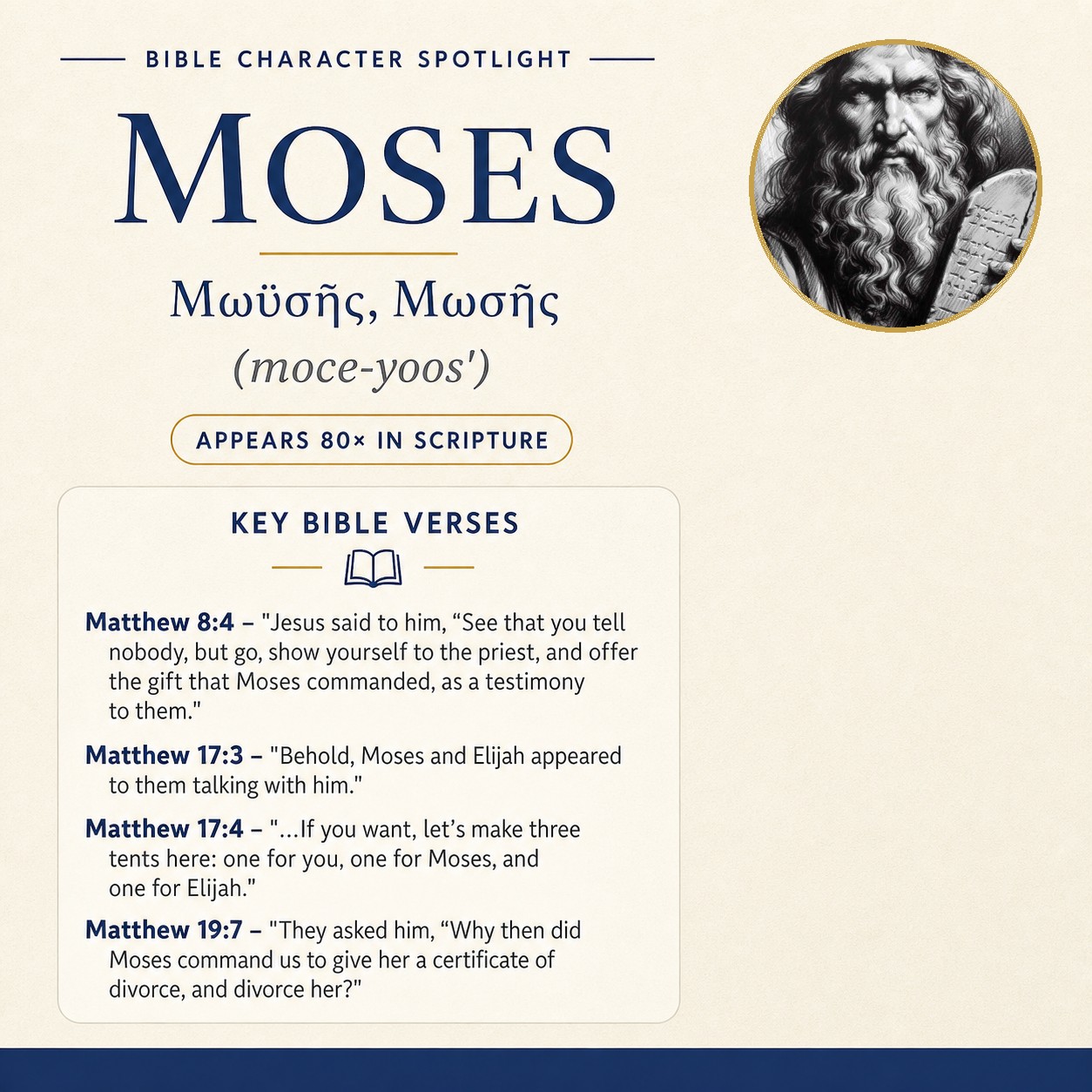
Moses in Scripture
In Matthew and Mark, Moses is repeatedly invoked as an authority for commands, permitted practices, and sayings. Jesus himself refers to what Moses “commanded,” and others cite what Moses “said.”
Early in Matthew, Jesus directs a healed man to follow what Moses had required for ritual confirmation:
“Jesus said to him, ‘See that you tell nobody, but go, show yourself to the priest, and offer the gift that Moses commanded, as a testimony to them.’” (Matthew 8:4)
Mark parallels this instruction with closely matching wording, again linking the action to Moses’ command:
“and said to him, ‘See you say nothing to anybody, but go show yourself to the priest, and offer for your cleansing the things which Moses commanded, for a testimony to them.’” (Mark 1:44)
A central narrative setting for Moses’ appearance is given in Matthew 17. Jesus takes Peter, James, and John up a mountain, where Jesus is “changed before them,” and Moses appears in company with Elijah:
“After six days, Jesus took with him Peter, James, and John his brother, and brought them up into a high mountain by themselves.” (Matthew 17:1)
“He was changed before them. His face shone like the sun, and his garments became as white as the light.” (Matthew 17:2)
“Behold, Moses and Elijah appeared to them talking with him.” (Matthew 17:3)
Peter responds to this scene by proposing three shelters—one for Jesus, one for Moses, and one for Elijah:
“Peter answered, and said to Jesus, ‘Lord, it is good for us to be here. If you want, let’s make three tents here: one for you, one for Moses, and one for Elijah.’” (Matthew 17:4)
While Peter is speaking, a cloud overshadows them and a voice identifies Jesus as God’s beloved Son and commands attention to him. The disciples are afraid, Jesus reassures them, and when they look up, they see only Jesus. As they descend the mountain, Jesus commands silence about what they saw “until the Son of Man has risen from the dead.” The chapter then continues with other events: questions about Elijah, a healing of a boy, private instruction on faith, Jesus’ prediction of his death and resurrection, and the matter of the didrachma coin—yet Moses’ part in the chapter is confined to the moment in which he appears with Elijah “talking with him” (Matthew 17:3) and Peter’s proposal about tents (Matthew 17:4).
Mark also records the appearance of Moses with Elijah, stating their presence and Peter’s similar suggestion:
“Elijah and Moses appeared to them, and they were talking with Jesus.” (Mark 9:4)
“Peter answered Jesus, ‘Rabbi, it is good for us to be here. Let’s make three tents: one for you, one for Moses, and one for Elijah.’” (Mark 9:5)
Beyond this appearance narrative, Moses is cited as the source for specific commands and sayings. In debates about divorce, questioners ask why Moses “command” a certificate, and Jesus answers by describing Moses as having “allowed” divorce due to hardness of heart:
“They asked him, ‘Why then did Moses command us to give her a certificate of divorce, and divorce her?’” (Matthew 19:7)
“He said to them, ‘Moses, because of the hardness of your hearts, allowed you to divorce your wives, but from the beginning it has not been so.’” (Matthew 19:8)
In Mark’s version of a related exchange, Jesus directs attention to what Moses had commanded:
“He answered, ‘What did Moses command you?’” (Mark 10:3)
Moses is also cited in a legal-style question about family obligation when a man dies without children:
“saying, ‘Teacher, Moses said, “If a man dies, having no children, his brother shall marry his wife, and raise up offspring for his brother.”’” (Matthew 22:24)
In another setting, Jesus describes a recognized teaching position associated with Moses:
“saying, ‘The scribes and the Pharisees sat on Moses’ seat.’” (Matthew 23:2)
Mark preserves an explicit appeal to Moses as the one who “said” commandments concerning honoring parents and the penalty for cursing them:
“For Moses said, ‘Honor your father and your mother;’ and, ‘He who speaks evil of father or mother, let him be put to death.’” (Mark 7:10)
Taken together, these passages present Moses as (1) an authoritative source for commanded religious actions (“the gift that Moses commanded,” “the things which Moses commanded”), (2) a cited speaker of moral and legal instruction (“Moses said”), (3) a figure associated with a recognized position of teaching authority (“Moses’ seat”), and (4) a participant in the mountain scene where he appears with Elijah “talking with” Jesus.
Name and Meaning
The Greek forms given are Μωϋσῆς and Μωσῆς, transliterated “Moseus” and pronounced “moce-yoos’.” The lexicon information states that the name is of Hebrew origin (linked in Strong’s to H04872) and identifies the bearer as Moses.
Observation
In these passages, Moses is both referenced as an enduring authority—“Moses commanded” (Matthew 8:4; Mark 1:44) and “Moses said” (Mark 7:10; Matthew 22:24)—and also portrayed in the narrative moment where “Moses and Elijah appeared to them talking with him” (Matthew 17:3).
Frequently Asked Questions
What does the name Moses mean?
The name means “Moses.”
How many times does Moses appear in the Bible?
Moses occurs 80 times.
Who was Moses?
Moses is a Bible figure mentioned in connection with commands and sayings (“Moses commanded,” Matthew 8:4; “Moses said,” Mark 7:10). He is also shown appearing and talking with Jesus alongside Elijah (Matthew 17:3).
Where do the scribes and Pharisees sit in relation to Moses?
Jesus said, “The scribes and the Pharisees sat on Moses’ seat” (Matthew 23:2).
Explore Further
If you found this page about Moses interesting and would like to discover more about other biblical characters, explore our comprehensive Encyclopedia of Biblical Characters. For those looking to delve deeper into the Greek origins of these names and terms, our Greek Lexicon is an invaluable resource.
Sources: Name and occurrence data from Strong’s Exhaustive Concordance and STEPBible reference data (CC BY). Scripture quotations from the World English Bible (public domain).




