
Who was Stephen in the bible?
Stephen is a man in Acts 6–8, 11, and 22, chosen by the disciples and later stoned.

What Happened
Some “arose, disputing with Stephen” (Acts 6:9), and he was seized and brought before the council (Acts 6:12). “They stoned Stephen as he called out” (Acts 7:59).
Learn More →Name Meaning
The Greek name Stephanos is derived from a word meaning “crown.” In Acts, Stephen is called “your witness” whose blood “was shed” (Acts 22:20).
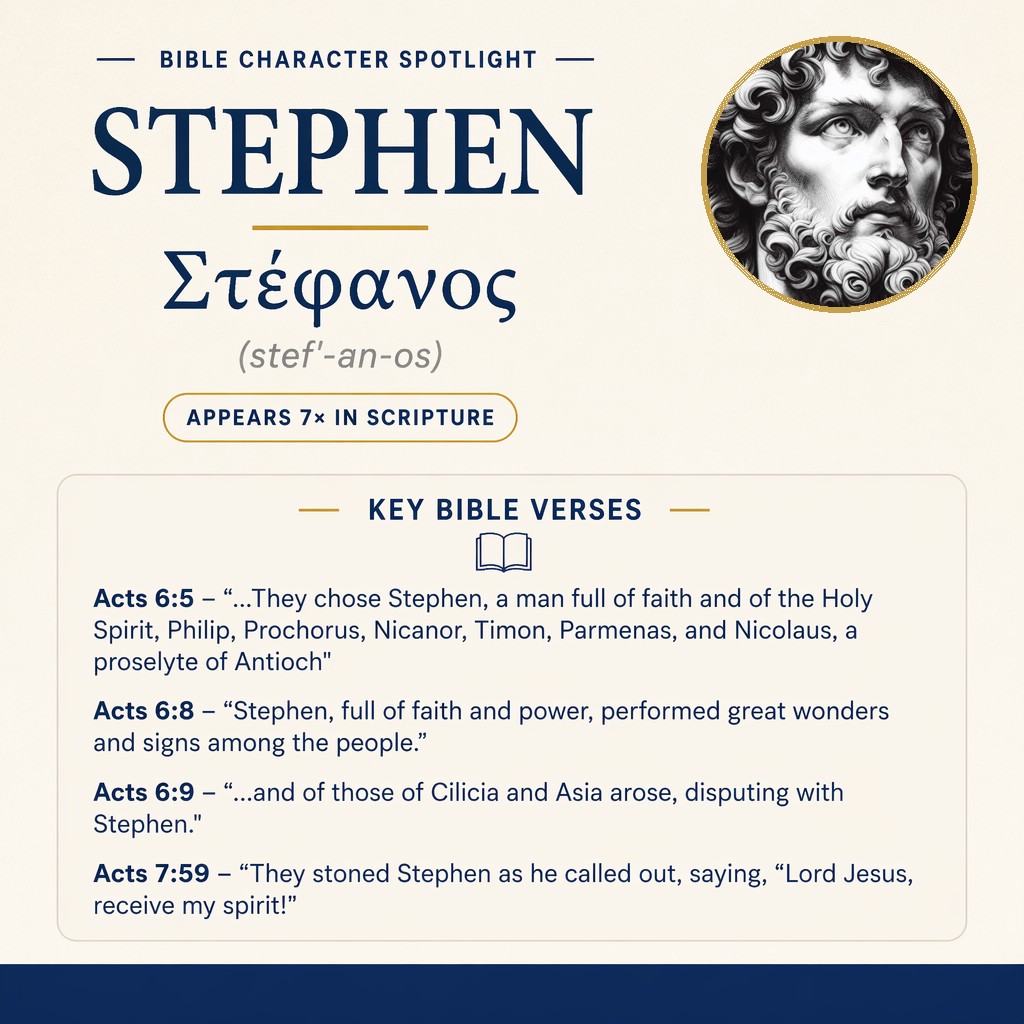
Learn More →Stephen (Greek Στέφανος, Stephanos, pronounced stef’-an-os) is a man described in Acts as “full of faith and of the Holy Spirit” and later remembered as a “witness” whose blood was shed. His name is derived from a Greek word meaning “crown.”
Stephen in Scripture
Stephen first appears in a moment when “the number of the disciples was multiplying” and a practical dispute surfaced: “a complaint arose from the Hellenists against the Hebrews, because their widows were neglected in the daily service” (Acts 6:1). The twelve addressed the larger community and framed the solution in terms of roles and priorities: “It is not appropriate for us to forsake the word of God and serve tables” (Acts 6:2). They directed the group to appoint others for this need: “Therefore select from among you, brothers, seven men of good report, full of the Holy Spirit and of wisdom, whom we may appoint over this business” (Acts 6:3), while the twelve would “continue steadfastly in prayer and in the ministry of the word” (Acts 6:4).
The community responded by choosing seven men, with Stephen listed first and described in distinctive terms.
“These words pleased the whole multitude. They chose Stephen, a man full of faith and of the Holy Spirit, Philip, Prochorus, Nicanor, Timon, Parmenas, and Nicolaus, a proselyte of Antioch;” (Acts 6:5)
After the selection, the seven were presented to the apostles in a formal, prayerful act of commissioning: “whom they set before the apostles. When they had prayed, they laid their hands on them” (Acts 6:6). The narrative immediately links this arrangement with growth in the community: “The word of God increased and the number of the disciples greatly multiplied in Jerusalem. A great company of the priests were obedient to the faith” (Acts 6:7).
Stephen’s public ministry is then emphasized in terms of spiritual character and visible power.
“Stephen, full of faith and power, performed great wonders and signs among the people.” (Acts 6:8)
Opposition arose around him, taking the form of dispute from multiple groups identified with particular synagogues and regions.
“But some of those who were of the synagogue called ‘The Libertines’, and of the Cyrenians, of the Alexandrians, and of those of Cilicia and Asia arose, disputing with Stephen.” (Acts 6:9)
The account states that Stephen’s opponents could not overcome what they encountered in his speech: “They weren’t able to withstand the wisdom and the Spirit by which he spoke” (Acts 6:10). As the conflict escalated, covert accusation was arranged: “Then they secretly induced men to say, ‘We have heard him speak blasphemous words against Moses and God’” (Acts 6:11). The agitation spread beyond the disputants to broader leadership: “They stirred up the people, the elders, and the scribes, and came against him and seized him, then brought him in to the council” (Acts 6:12).
In the council setting, the accusations were amplified through testimony the narrative labels as false: “and set up false witnesses who said, ‘This man never stops speaking blasphemous words against this holy place and the law’” (Acts 6:13). The reported claim involved both Jesus and the customs associated with Moses:
“For we have heard him say that this Jesus of Nazareth will destroy this place, and will change the customs which Moses delivered to us.” (Acts 6:14)
The chapter closes with a striking description of Stephen’s appearance as the council stared at him: “All who sat in the council, fastening their eyes on him, saw his face like it was the face of an angel” (Acts 6:15).
Later, Acts records Stephen’s death by stoning and preserves his final appeal addressed to Jesus.
“They stoned Stephen as he called out, saying, ‘Lord Jesus, receive my spirit!’” (Acts 7:59)
Afterward, the response of others is noted: “Devout men buried Stephen and lamented greatly over him” (Acts 8:2). The conflict connected with his death is also presented as a watershed that produced dispersion: “They therefore who were scattered abroad by the oppression that arose about Stephen traveled as far as Phoenicia, Cyprus, and Antioch, speaking the word to no one except to Jews only” (Acts 11:19).
Stephen is also named as a “witness” whose death was remembered in connection with consent and participation by another observer:
“When the blood of Stephen, your witness, was shed, I also was standing by, consenting to his death, and guarding the cloaks of those who killed him.’” (Acts 22:20)
Name and Meaning
The name Stephen is written in Greek as Στέφανος (Stephanos), pronounced stef’-an-os. Its derivation is tied to the Greek term stephanos (στέφανος), meaning “crown.”
Observation
Across these passages Stephen is consistently characterized by spiritual fullness and public testimony—introduced as “a man full of faith and of the Holy Spirit” (Acts 6:5), active in “great wonders and signs” (Acts 6:8), and remembered as “your witness” whose “blood… was shed” (Acts 22:20).
Frequently Asked Questions
What does the name Stephen mean?
Stephen (Greek: Stephanos) means “Stephen.”
How many times does Stephen appear in the Bible?
Stephen appears 7 times.
Who was Stephen?
Stephen is named in Acts and is described as “a man full of faith and of the Holy Spirit” (Acts 6:5). He is also described as “full of faith and power” and as performing “great wonders and signs among the people” (Acts 6:8).
How did Stephen die?
Stephen was stoned (Acts 7:59).
Explore Further
If you found this page about Stephen interesting and would like to discover more about other biblical characters, explore our comprehensive Encyclopedia of Biblical Characters. For those looking to delve deeper into the Greek origins of these names and terms, our Greek Lexicon is an invaluable resource.
Sources: Name and occurrence data from Strong’s Exhaustive Concordance and STEPBible reference data (CC BY). Scripture quotations from the World English Bible (public domain).




