
Exploring the Meaning of Trapezites in Greek
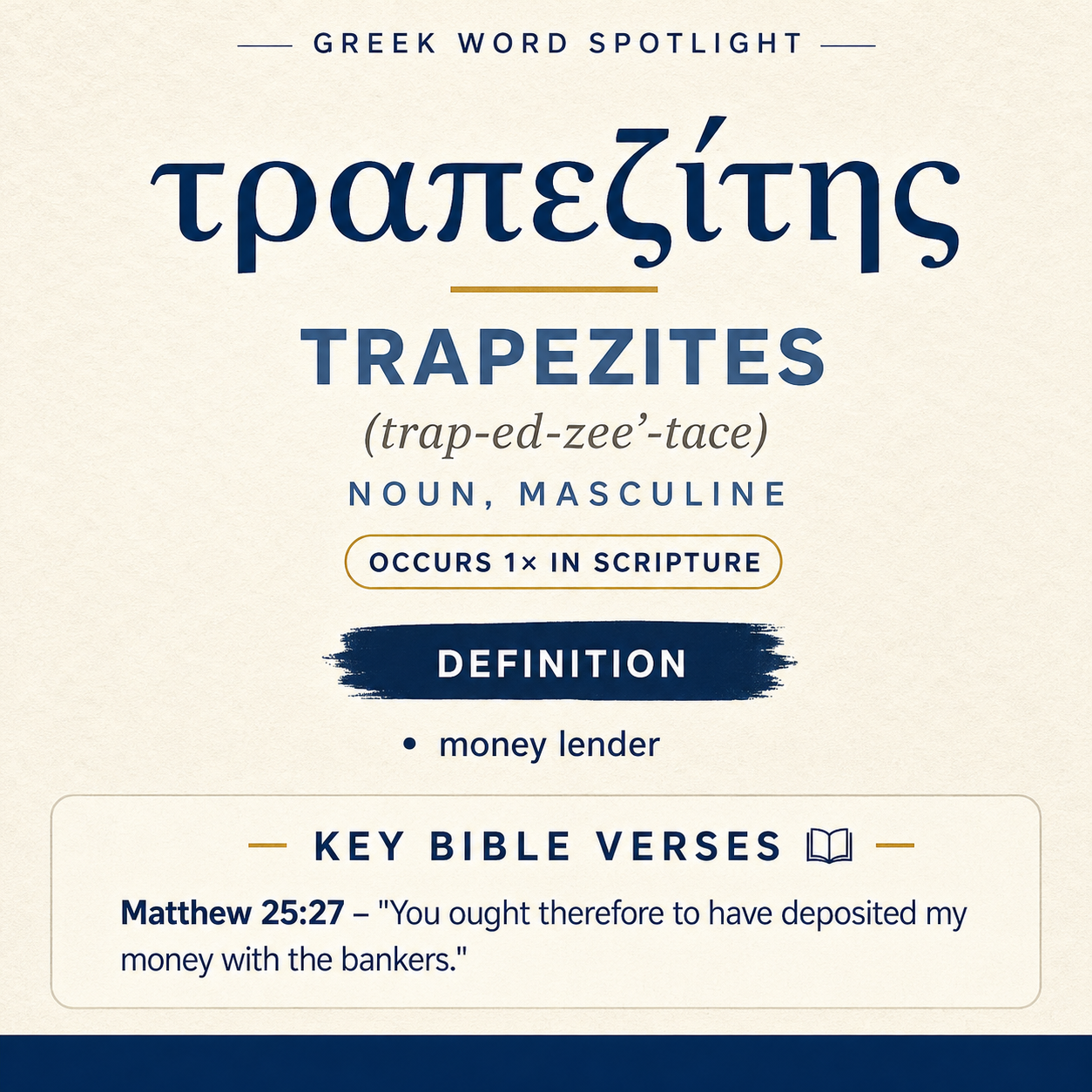
τραπεζίτης (Trapezites) means “money lender” and appears once in Scripture, in Matthew 25:27.
Scripture Occurrence
It occurs 1 time in Scripture. The occurrence is in Matthew 25:27.
Learn More →Verse Context
In Matthew 25:27, it appears in the instruction to deposit money with “the bankers.”
Learn More →τραπεζίτης refers to a “money lender,” and it appears in Jesus’ parable of the talents in Matthew 25:27. In that setting, the term belongs to a brief but pointed rebuke about what should have been done with entrusted money.
Root and Related Words
τραπεζίτης is connected with trapeza (τράπεζα), “table” (Strong’s G5132). The relationship naturally suggests a naming link between the person designated by τραπεζίτης and a table as a concrete point of business activity.

Occurrences
“You ought therefore to have deposited my money with the bankers, and at my coming I should have received back my own with interest.” (Matthew 25:27)
In this line the speaker addresses a servant who has failed to put entrusted funds to work. τραπεζίτης is the professional alternative the servant should have used: someone with whom money can be “deposited,” so that the owner’s “coming” would be met with a return that includes “interest.” The word therefore marks a particular kind of agent in the economic world of the parable—an identifiable person or class of persons who receive money from others, hold it, and return it in a way that results in increase. The focus is not on the banker’s character or methods, but on the servant’s missed opportunity: even a minimal, conventional step—placing the money with such people—would have avoided the complete lack of gain.

The verse also frames τραπεζίτης with two time markers: the earlier action (“deposited my money”) and the later reckoning (“at my coming”). That structure gives the term a functional role: the bankers are the means by which the money could have remained active and productive during the master’s absence. In the logic of the rebuke, τραπεζίτης represents a baseline option for responsible handling of entrusted resources, contrasted with inaction.
Sense and Usage
As “money lender,” τραπεζίτης in Matthew 25:27 is defined by the financial outcome expected from depositing funds—“interest.” The setting assumes that placing money with such a person produces a return beyond the original amount, so the term evokes a recognized practice in which entrusted money is handled in a way that yields increase. The word’s force in the sentence is practical rather than descriptive: it is invoked as an obvious solution the servant should have chosen if he was unwilling or unable to do more direct work with the money.
Because τραπεζίτης occurs here in the plural (“the bankers”), it functions as a generalized category rather than a specific named individual. The rebuke does not require the hearer to imagine a unique personality; it requires only the existence of a familiar financial role in society. This plural usage also strengthens the sense of accessibility: there would have been available options, not a single rare specialist. The servant’s failure is therefore heightened by the ordinariness of the alternative.
The term also stands in a sentence with possessive language—“my money,” “my coming,” “my own.” That repeated possession keeps attention on the owner’s rights and expectations. τραπεζίτης is not introduced to shift ownership or responsibility away from the servant; rather, it underscores that the servant could have acted in a way that preserved the owner’s interests and produced an appropriate gain. Even though the bankers are third parties, the outcome is measured entirely in terms of what the master “should have received back.”
Within the verse, the “deposit” with the bankers functions as a minimal form of stewardship: a way to avoid the waste of leaving money idle. τραπεζίτης thus carries connotations of ordinary financial prudence in the world assumed by the parable. The servant is not commended for using bankers, but condemned for not even taking that basic step. The word’s meaning is therefore sharpened by its rhetorical placement: it is the obvious, least demanding option that still produces “interest,” and that is precisely why its neglect is blameworthy.
Finally, the coupling of “bankers” and “interest” means the term is not merely about safekeeping. The anticipated result includes increase, and the verse frames this increase as a proper expectation at the master’s return. τραπεζίτης, in this usage, points to a socially recognized mechanism for turning entrusted money into a greater sum during a period of absence, so that the return of the owner is met with an accounting that includes growth.
Imagery in Context
Matthew 25:27 gives τραπεζίτης a concrete economic image: money placed into the hands of professionals so that it comes back with “interest” when the owner arrives. The verse invites the reader to picture a simple transaction—an act of deposit followed later by the recovery of “my own”—and the word τραπεζίτης anchors that picture in a recognizable figure: the one whose business makes that increase possible.
Sources: Lexical data from Strong’s Exhaustive Concordance and the Translators Brief Lexicon of Extended Strongs for Greek (STEPBible, CC BY). Occurrence data from the Translators Amalgamated Greek New Testament (STEPBible, CC BY). Scripture quotations from the World English Bible (public domain).




