Exploring the Meaning of Throeo in Greek
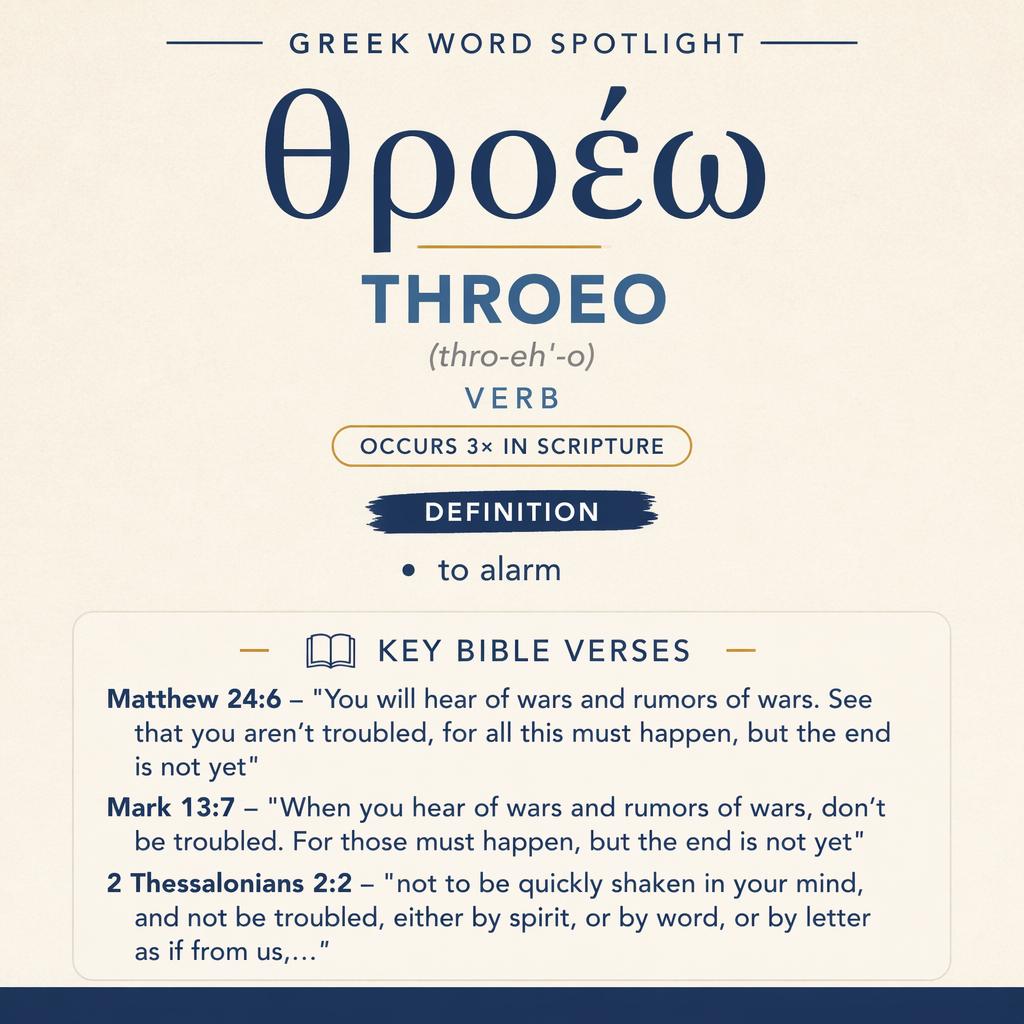
θροέω means “to alarm” and occurs three times in Scripture: Matthew 24:6, Mark 13:7, and 2 Thessalonians 2:2.
Core Meaning
θροέω means “to alarm.” In its listed occurrences, it is used in the sense of being troubled.
Learn More →Gospel Context
In Matthew 24:6 and Mark 13:7, it appears in warnings not to be troubled when hearing of wars and rumors of wars. Both passages add that these events must happen, but the end is not yet.
Learn More →Thessalonian Context
In 2 Thessalonians 2:2, it appears in an exhortation not to be quickly shaken in mind and not be troubled. The verse mentions spirit, word, or letter as possible sources of such trouble.
Learn More →θροέω means “to alarm” and appears in Jesus’ teaching about coming unrest (Matthew 24:6; Mark 13:7) and in Paul’s warning against being unsettled by claims about the day of Christ (2 Thessalonians 2:2). In each setting it names an inward disturbance that is explicitly discouraged in the face of troubling reports.
Occurrences
“You will hear of wars and rumors of wars. See that you aren’t troubled, for all this must happen, but the end is not yet.” (Matthew 24:6)
Here θροέω is framed as the improper response to “wars and rumors of wars.” The saying acknowledges that the hearers “will hear” alarming reports; the problem addressed is not the existence of frightening information but the reaction it provokes. The imperative, “See that you aren’t troubled,” treats alarm as something that can seize a person on the basis of what is heard, and it is paired with a rationale that places the reports inside a larger sequence: “for all this must happen, but the end is not yet.” Within the sentence, the force of θροέω is thus tied to timing and interpretation. Alarm would treat the reports as decisive or final, whereas the instruction explicitly separates these events (“all this”) from “the end.” The word contributes the idea of an emotional jolt or agitation that threatens steadiness when external news is threatening; the correction aims at keeping perception aligned with the stated necessity (“must happen”) and the stated limitation (“not yet”).
“When you hear of wars and rumors of wars, don’t be troubled. For those must happen, but the end is not yet.” (Mark 13:7)
Mark presents the same pairing of troubling news and the command against being troubled, again grounded in the explanation about what “must happen” and what is “not yet.” θροέω sits directly after the hearing (“When you hear…”), marking the psychological hazard that follows exposure to ominous reports. The command “don’t be troubled” stands as a guardrail for disciples who will live amid circulating accounts of conflict. The reason clause functions similarly: the events are real (“those”), necessary (“must happen”), and still not the terminus (“the end is not yet”). In this frame, θροέω signals a reaction that would collapse the distinction between preliminary upheavals and the culminating end; the instruction preserves the distinction by forbidding the alarm that would naturally arise from hearing about war. The word therefore contributes an emphasis on internal steadiness in an external atmosphere of instability, without denying that the instability itself is genuine.
“not to be quickly shaken in your mind, and not be troubled, either by spirit, or by word, or by letter as if from us, saying that the day of Christ has already come.” (2 Thessalonians 2:2)
In 2 Thessalonians the setting shifts from public reports of conflict to claims about a specific theological timeline: “saying that the day of Christ has already come.” θροέω is coordinated with another description of disturbance, “quickly shaken in your mind,” and together they portray an inner destabilization that can be triggered by communications presented as authoritative. The range of possible sources is deliberately broad—“either by spirit, or by word, or by letter as if from us”—so the threat is not confined to one mode of persuasion. Within this sentence, θροέω names the alarm that such messages can provoke, especially when they appear to carry spiritual weight (“by spirit”) or apostolic endorsement (“as if from us”). The instruction aims to prevent a rapid cascade from hearing a claim to becoming inwardly agitated and mentally unsettled. The word’s contribution is to mark that agitation as something the readers must resist, particularly when the claim concerns whether a decisive day “has already come.”

Sense and Usage
Across these three passages, θροέω consistently operates at the point where information becomes agitation. In Matthew and Mark the triggering information is broadly public—“wars and rumors of wars”—and the hearers are prepared in advance for the emotional effect such news tends to have. The command does not minimize the severity of the subject matter; it assumes that hearing about war is naturally capable of producing alarm. What is challenged is the conclusion that alarm presses upon the hearer: that such reports signal immediate finality. This is why the prohibition is tethered to the clarifying statement, “but the end is not yet.” θροέω, in this context, is an inward surge that distorts perspective by treating preliminary upheaval as the endpoint.
In 2 Thessalonians the mechanism is more targeted. Alarm is not generated by distant conflicts but by interpretive claims about a culminating moment: “the day of Christ.” The passage highlights how alarm can be cultivated through purportedly reliable channels—spiritual impressions, spoken messages, and even documents framed as apostolic. θροέω is thus shown to be inducible by rhetoric and authority-claims, not only by events. The verb belongs to a cluster of mental and emotional disturbance (“shaken… in your mind,” “troubled”) and functions as the affective counterpart: the heart’s agitation that accompanies a mind thrown off balance. In all three passages, the imperative mood (“aren’t troubled,” “don’t be troubled,” “not be troubled”) treats alarm as a response to be refused rather than an inevitable state to be endured.
Another common feature is the proximity of θροέω to verbs of hearing and receiving messages. In the Synoptic sayings, “You will hear” / “When you hear” places the hearer at the mercy of reports, yet θροέω is precisely what the hearer must not permit those reports to produce. In the letter, the range “by spirit… by word… by letter” similarly locates alarm at the point of reception. θροέω therefore characterizes a reaction that arises through mediated knowledge—what one is told, what one reads, what circulates as rumor or claim—rather than through direct participation described in these verses. The danger addressed is that secondhand information, whether factual (“wars”) or misleading (“saying that the day of Christ has already come”), can rapidly set the inner person into a state of alarm.
Finally, θροέω is portrayed as time-sensitive: it is connected to “quickly” in 2 Thessalonians (“quickly shaken”) and to “not yet” in Matthew and Mark. Alarm tends to accelerate conclusions and compress timelines; these passages counter that tendency by insisting on measured understanding. In the Synoptic material, the news is real but not determinative of the end’s arrival; in the epistle, the asserted arrival of the decisive day is precisely what must not be accepted in a way that produces disturbance. The verb thus functions to name and forbid an inner destabilization that feeds on premature certainty.
Imagery and Force
The imagery carried by θροέω in these texts is the moment when unsettling news lands—reports of war, rumors, and urgent messages—and the hearer feels the pull toward panic. Jesus’ words place that moment within a larger horizon: events “must happen,” yet they do not authorize alarm because “the end is not yet” (Matthew 24:6; Mark 13:7). Paul places the same inward disturbance in the context of competing voices and documents that demand immediate acceptance; θροέω names the agitation that such claims can spark, which the community is commanded to resist (2 Thessalonians 2:2).
Sources: Lexical data from Strong’s Exhaustive Concordance and the Translators Brief Lexicon of Extended Strongs for Greek (STEPBible, CC BY). Occurrence data from the Translators Amalgamated Greek New Testament (STEPBible, CC BY). Scripture quotations from the World English Bible (public domain).