
Exploring the Meaning of Krazo in Greek
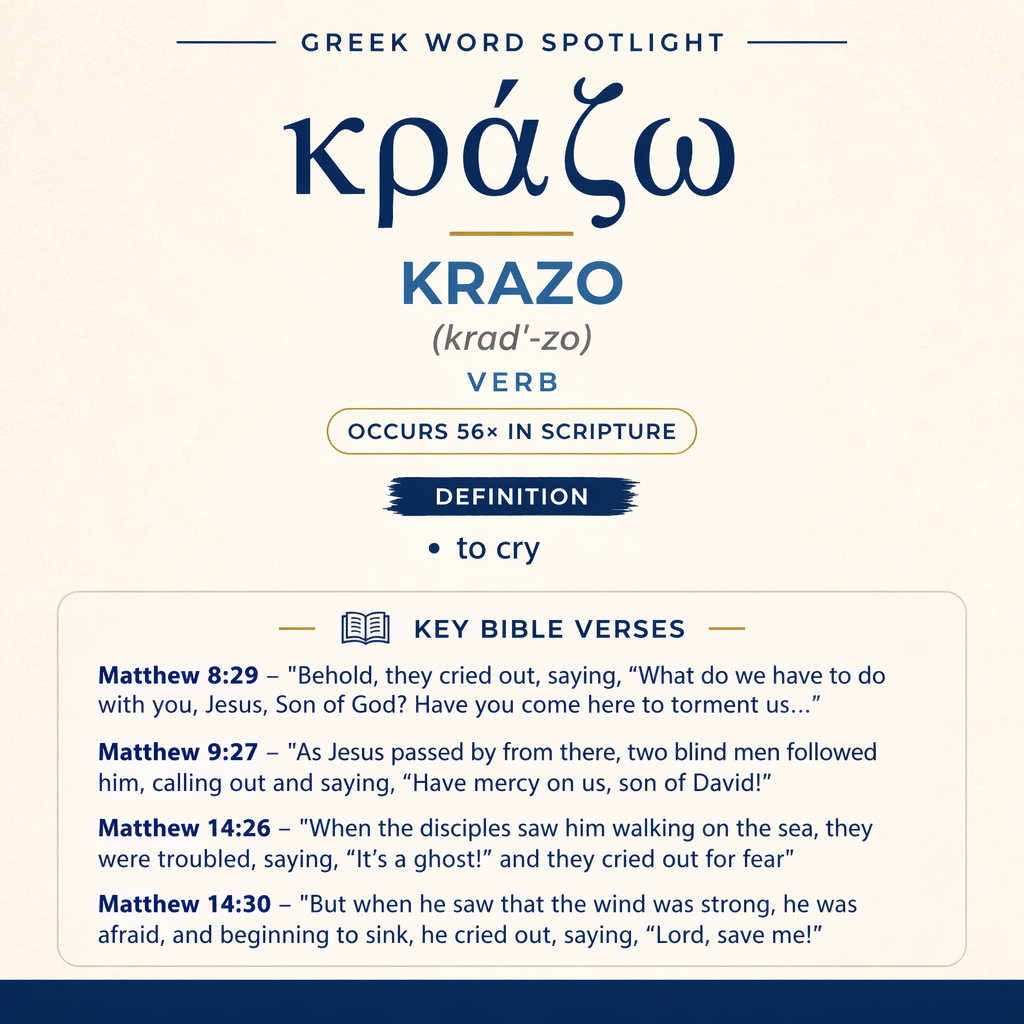
κράζω (Krazo) means “to cry” and occurs 56 times in Scripture, including Matthew 8:29; 9:27; 14:26,30; 15:22–23; 20:30–31.
Matthew Examples
In Matthew, κράζω describes urgent cries, including “Lord, save me!” (14:30) and “Have mercy on us” (9:27; 20:30–31).
Learn More →κράζω means “to cry.” In the cited passages it marks urgent, public, and often emotionally charged speech—ranging from fear and pleading to praise and hostile demand—directed toward Jesus or about him.
Occurrences
Matthew 8:29 — “Behold, they cried out, saying, ‘What do we have to do with you, Jesus, Son of God? Have you come here to torment us before the time?’”
Here κράζω frames a confrontational outcry. The cry is not mere noise; it carries a direct address (“Jesus, Son of God”) and a fearful protest about torment and timing, so the verb underscores alarm and resistance expressed aloud.

Matthew 9:27 — “As Jesus passed by from there, two blind men followed him, calling out and saying, ‘Have mercy on us, son of David!’”
κράζω conveys persistent vocal appeal as the blind men “followed him,” turning movement into petition. Their cry is shaped as a request for mercy and a pointed identification (“son of David”), so the verb highlights a plea meant to be heard and answered.
Matthew 14:26 — “When the disciples saw him walking on the sea, they were troubled, saying, ‘It’s a ghost!’ and they cried out for fear.”
In this scene the cry is reflexive and fear-driven: the disciples interpret what they see as a threatening apparition, and κράζω marks the audible burst of panic that matches their troubled perception.
Matthew 14:30 — “But when he saw that the wind was strong, he was afraid, and beginning to sink, he cried out, saying, ‘Lord, save me!’”
κράζω becomes the voice of crisis. As fear rises with the wind and the sinking begins, the verb signals an urgent appeal at the edge of danger—short, direct, and addressed to “Lord,” with rescue as the immediate concern.
Matthew 15:22 — “Behold, a Canaanite woman came out from those borders, and cried, saying, ‘Have mercy on me, Lord, you son of David! My daughter is severely possessed by a demon!’”
The cry here is intercession. κράζω introduces a forceful public request that combines reverent address (“Lord”) with the mother’s distress about her daughter; the verb suits a plea that presses into Jesus’ attention.
Matthew 15:23 — “But he answered her not a word. His disciples came and begged him, saying, ‘Send her away; for she cries after us.’”
κράζω is now reported by others: the disciples characterize the woman’s continued appeals as something that follows behind them. The verb therefore carries the sense of a repeated, audible persistence that becomes socially burdensome to those around Jesus.
Matthew 20:30 — “Behold, two blind men sitting by the road, when they heard that Jesus was passing by, cried out, ‘Lord, have mercy on us, you son of David!’”
κράζω marks the moment when hearing prompts vocal pursuit. Though stationary (“sitting by the road”), the blind men engage Jesus through a cry that reaches across distance, shaped again as a mercy-request with the title “son of David.”
Matthew 20:31 — “The multitude rebuked them, telling them that they should be quiet, but they cried out even more, ‘Lord, have mercy on us, you son of David!’”
This occurrence highlights volume and determination: the crowd tries to suppress the sound, but κράζω intensifies (“even more”). The verb underscores that the cry is not easily silenced; it presses through social opposition to reach its target.
Matthew 21:9 — “The multitudes who went in front of him, and those who followed, kept shouting, ‘Hosanna to the son of David! Blessed is he who comes in the name of the Lord! Hosanna in the highest!’”
κράζω here is communal and celebratory. The crowds “kept shouting,” so the verb carries the idea of sustained, repeated acclamation that surrounds Jesus from “in front” and “followed,” filling the scene with public praise.
Matthew 21:15 — “But when the chief priests and the scribes saw the wonderful things that he did, and the children who were crying in the temple and saying, ‘Hosanna to the son of David!’ they were indignant,”
Now the cry belongs to children and is located “in the temple.” κράζω marks their audible praise as a conspicuous response to “the wonderful things that he did,” and the verb helps explain why the leaders notice it and react with indignation.
Matthew 27:23 — “But the governor said, ‘Why? What evil has he done?’ But they cried out exceedingly, saying, ‘Let him be crucified!’”
κράζω becomes the sound of collective demand. The adverbial force (“cried out exceedingly”) presents an overwhelming shout that answers the governor’s question not with argument but with volume and insistence, driving toward a specific outcome.
Matthew 27:50 — “Jesus cried again with a loud voice, and yielded up his spirit.”
Here κράζω is associated with Jesus’ own voice at the climactic moment of his death. The verb, coupled with “with a loud voice,” emphasizes an audible, forceful cry immediately before he “yielded up his spirit,” marking a final utterance that stands out in the narrative.

Sense and Usage
Across these passages κράζω consistently signals speech that is projected outward—meant to reach someone, dominate a moment, or break through a barrier. It appears in fear responses (“they cried out for fear” as the disciples mistake Jesus for a ghost), in emergency appeal (“beginning to sink, he cried out”), and in repeated pleas for mercy by the blind and by the Canaanite woman. In those mercy-scenes, κράζω regularly bears a directed address and a compact request (“Have mercy on us”), showing how a cry can function as a petition rather than a mere exclamation.
The verb also covers public acclaim: multitudes “kept shouting” and children are “crying in the temple,” both voicing “Hosanna to the son of David.” In those settings, κράζω contributes the sense of a crowd-sound—many voices creating a single audible atmosphere around Jesus, whether on the road or within the temple courts. Finally, it can describe hostile insistence, as when the crowd “cried out exceedingly” for crucifixion. The same verb thus marks opposite stances toward Jesus (pleading for help, praising, resisting, condemning), yet in every case the common thread is an intensified utterance—speech made loud and urgent by fear, need, joy, or anger.
Several occurrences also show κράζω interacting with attempts to control speech. The multitude tries to make the blind men “be quiet,” and the disciples want the Canaanite woman sent away because “she cries after us.” In both cases the verb points to a cry that intrudes into public space and refuses to fade into the background; it is precisely the audible persistence of the cry that creates friction.
Imagery
The imagery attached to κράζω in these verses is strongly auditory and situational: a shout over wind and water, a roadside cry that stops a passing teacher, temple praise that echoes among onlookers, and a courtroom-like clamor that drowns a governor’s question. Even when the content differs—“Lord, save me!” versus “Let him be crucified!”—the verb paints scenes where the voice becomes a force in the moment, pressing fear, need, celebration, or condemnation into the open.
Sources: Lexical data from Strong’s Exhaustive Concordance and the Translators Brief Lexicon of Extended Strongs for Greek (STEPBible, CC BY). Occurrence data from the Translators Amalgamated Greek New Testament (STEPBible, CC BY). Scripture quotations from the World English Bible (public domain).




