
Exploring the Meaning of Tetrarches in Greek
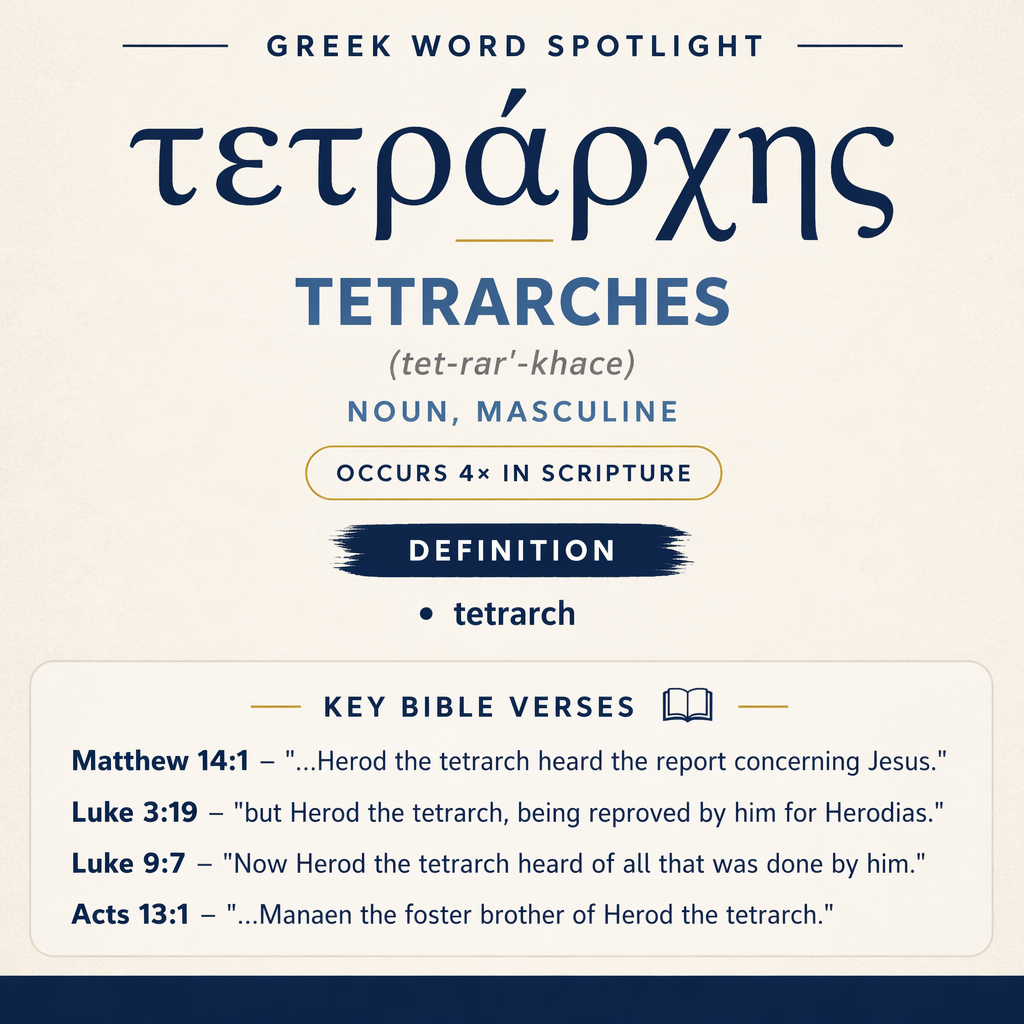
τετράρχης means “tetrarch” and occurs four times in Scripture: Matthew 14:1; Luke 3:19; Luke 9:7; Acts 13:1.
Gospel References
In Matthew 14:1, Luke 3:19, and Luke 9:7, it refers to Herod the tetrarch in narrative settings.
Learn More →Acts Appearance
In Acts 13:1, τετράρχης appears within the description of the assembly at Antioch.
Learn More →Tetrarches means “tetrarch,” a title used of Herod in Gospel narratives and referenced again in Acts in connection with the Antioch church. In these passages the word functions as a marker of political authority, locating the events around Jesus and John within the actions and reactions of a named ruler.
Root and Related Words
Tetrarches is presented as deriving from tessares (τέσσαρες), “four,” and archo (ἄρχω), “be first.” Together these related words frame the title as a form of rulership language, joining a numerical element with the idea of leading.

Occurrences
Matthew 14:1 — “At that time, Herod the tetrarch heard the report concerning Jesus,”
Here tetrarches identifies Herod by office at the moment he receives information about Jesus. The title places him in the role of a ruler who is addressed by reports and whose awareness matters for the unfolding situation. Matthew’s wording is spare: the emphasis falls on the fact that the one hearing these reports is “Herod the tetrarch,” so the news about Jesus is immediately set within a political sphere where such reports travel to governing figures.

Luke 3:19 — “but Herod the tetrarch, being reproved by him for Herodias, his brother’s wife, and for all the evil things which Herod had done,”
Luke uses tetrarches in a setting of moral confrontation. The title connects Herod’s personal conduct (“Herodias, his brother’s wife”) and public record (“all the evil things which Herod had done”) with his status as ruler: he is not merely a private individual being criticized, but a tetrarch whose actions are significant enough to be openly reproved. The phrase “being reproved by him” sets the rebuke against the weight of Herod’s office, highlighting the tension between authority and accountability implied by the narrative.
Luke 9:7 — “Now Herod the tetrarch heard of all that was done by him; and he was very perplexed, because it was said by some that John had risen from the dead,”
In this occurrence tetrarches again marks Herod as the ruler who receives reports—this time “of all that was done by him.” The title frames Herod’s reaction (“he was very perplexed”) as the response of someone positioned to monitor events and to feel the pressure of public explanation. The verse also shows how rumors and interpretations circulate in a ruler’s orbit: the perplexity is tied to competing claims about John (“it was said by some that John had risen from the dead”). The word tetrarches, placed next to Herod’s hearing and perplexity, casts him as a political figure confronted with unsettling accounts that touch both public action and popular speculation.
Acts 13:1 — “Now in the assembly that was at Antioch there were some prophets and teachers: Barnabas, Simeon who was called Niger, Lucius of Cyrene, Manaen the foster brother of Herod the tetrarch, and Saul.”
Acts uses tetrarches not to narrate Herod’s direct actions but to identify a relationship: Manaen is “the foster brother of Herod the tetrarch.” The title serves as a distinguishing label for which Herod is meant, anchoring Manaen’s background to a recognizable ruler. Within the list of leaders at Antioch (“prophets and teachers”), the mention of a foster brother tied to “Herod the tetrarch” places the Christian assembly’s leadership alongside connections that reach into governing circles. The word thus functions as a social locator, showing how figures within the church can be linked—by upbringing or household ties—to a person known by a ruling title.
Sense and Usage
Across these four passages tetrarches operates as a formal designation attached to Herod’s name (“Herod the tetrarch”). Its consistent placement directly after “Herod” gives the narrative a stable way to reference him: he appears as a titled ruler whose awareness, conduct, and connections matter. In Matthew 14:1 and Luke 9:7 the title is paired with hearing (“heard the report,” “heard of all that was done”), portraying a tetrarch as someone to whom news travels and who must interpret what is happening in the region. In Luke 3:19 the title stands in a sentence shaped by accusation and reproof, so that Herod’s office is implicitly implicated in the seriousness of the rebuke; the narrative does not treat his wrongdoing as insignificant because the wrongdoer is “the tetrarch.”
Acts 13:1 shows a different angle: tetrarches functions as a point of reference for identity and relation rather than as an active role in the scene. Even there, the title still carries the weight of public recognition—Luke can name Manaen by connecting him to “Herod the tetrarch,” expecting the title to clarify which person is meant and why the connection is noteworthy. In all four cases, tetrarches signals rulership in a way that shapes how the reader hears the surrounding verbs and descriptions: hearing becomes the hearing of a ruler; perplexity becomes the perplexity of a ruler; reproof becomes reproof addressed toward a ruler; family-like ties become ties to a ruler.
The passages also show that the title does not insulate its bearer from narrative scrutiny. Herod the tetrarch is presented as a receiver of reports and a subject of moral evaluation, and his title is repeated rather than omitted at precisely those points where his actions and reactions are in view. The effect is that “tetrarch” is not merely a label of rank; it is a narrative tool that keeps questions of authority, responsibility, and influence in the foreground whenever Herod is mentioned.
Imagery
The recurring picture attached to tetrarches in these texts is the ruler as a listening figure: a man in authority who “heard the report concerning Jesus” (Matthew 14:1) and “heard of all that was done” (Luke 9:7). Around that listening are two further images: the ruler under reproof for personal and public evil (Luke 3:19), and the ruler whose name and title are prominent enough to identify someone else’s background within the church at Antioch (Acts 13:1). Together these scenes keep the title “tetrarch” associated with a public office that hears, is answered, and serves as a reference point for social connections.
Sources: Lexical data from Strong’s Exhaustive Concordance and the Translators Brief Lexicon of Extended Strongs for Greek (STEPBible, CC BY). Occurrence data from the Translators Amalgamated Greek New Testament (STEPBible, CC BY). Scripture quotations from the World English Bible (public domain).





