
Exploring the Meaning of Tetraploos in Greek
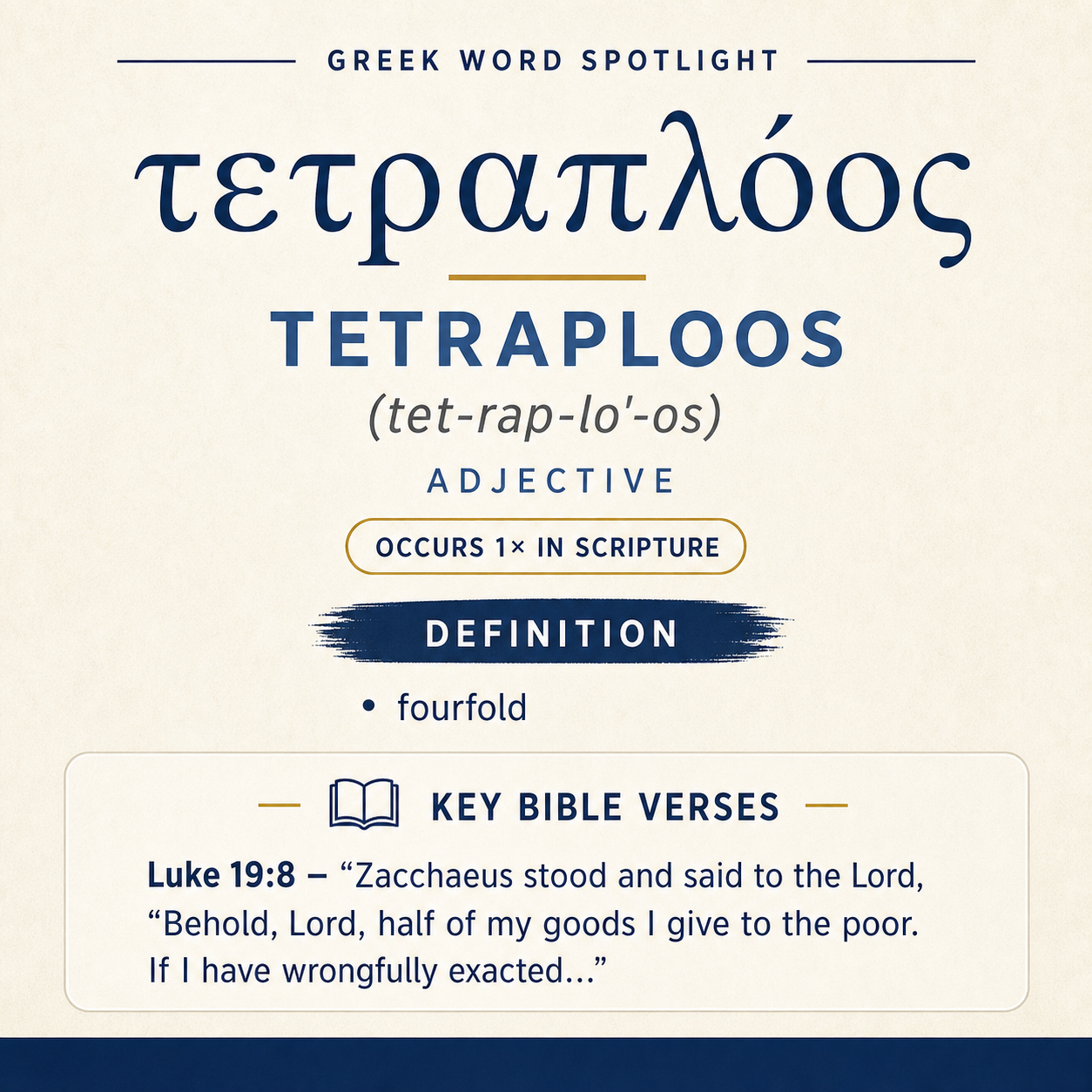
τετραπλόος means “fourfold” and appears once in Scripture, in Luke 19:8.
Scripture Occurrence
This word occurs 1 time in Scripture. The occurrence is in Luke 19:8.
Learn More →Verse Context
In Luke 19:8, Zacchaeus speaks to the Lord about giving to the poor. The verse includes his statement about wrongful exaction.
Learn More →τετραπλόος means “fourfold” and appears in the New Testament in Luke’s account of Zacchaeus’s response to Jesus. In that scene it marks the scale of repayment Zacchaeus promises where he has done wrong.
Root and Related Words
τετραπλόος is connected with tessares (τέσσαρες), “four” (Strong’s G5064). It is also linked in the supplied relationships to pleistos (πλεῖστος), “most” (Strong’s G4118).

Occurrences
“Zacchaeus stood and said to the Lord, “Behold, Lord, half of my goods I give to the poor. If I have wrongfully exacted anything of anyone, I restore four times as much.”” (Luke 19:8)
In Luke 19:8, τετραπλόος shapes Zacchaeus’s pledge by specifying the measure of restitution: “four times as much.” The promise is stated in the conditional form, “If I have wrongfully exacted anything of anyone,” and the fourfold repayment answers that contingency with a concrete, quantified response. The word therefore functions as a multiplier: it does not merely indicate that repayment will happen, but fixes its proportion as exceeding the original loss by a factor of four. In the flow of Zacchaeus’s speech, this fourfold restitution stands alongside another concrete commitment (“half of my goods I give to the poor”), together forming a public declaration directed “to the Lord.”
The setting implied by the verse is immediate and interpersonal: Zacchaeus “stood” and “said to the Lord,” and the language “anything of anyone” keeps the scope broad, not limited to a single named victim or a single transaction. Within that breadth, τετραπλόος gives the statement precision. It turns a general willingness to make things right into a defined standard: restoration is envisioned as abundant enough to go beyond simple replacement. Because the restitution is expressed as “I restore,” the word attaches to an action Zacchaeus takes responsibility to perform, not a vague aspiration or sentiment. It is, within the line of speech, the numerical boundary that frames what “restore” will mean in practice for him.
Sense and Usage
As “fourfold,” τετραπλόος expresses a proportional increase measured against an implied base amount. In Luke 19:8 that base is “anything” Zacchaeus has “wrongfully exacted” from another person; the promised act of restoring is calibrated to that wrong by multiplying what is returned. The sense is therefore comparative and quantitative: it presumes an original sum or value, then describes a return that exceeds it according to a fixed ratio. The word’s force lies in its clarity—listeners can understand exactly what is being offered, because the measure is numerical rather than open-ended.
This numerical clarity also gives the statement a public, accountable character. Zacchaeus speaks out loud and in direct address (“Behold, Lord”), and the phrase “four times as much” sets an unmistakable benchmark that can be checked against specific cases. It is not only an emotional expression of regret but a declared policy for making amends. The conditional “If” does not weaken the commitment; instead, it defines the range of situations where the fourfold standard applies, namely wherever wrongful exaction has occurred. Thus the adjective’s semantic contribution is to bind restitution to a consistent, measurable scale across whatever instances may be included in “anything of anyone.”
Because τετραπλόος is linked with tessares (τέσσαρες), “four,” its sense is anchored in a straightforward numeral, and in this context it functions naturally in a commercial and ethical register: goods have been taken, and goods will be restored in a multiplied amount. The word does not describe a feeling, an attitude, or a social status; it describes a ratio. That ratio, expressed in ordinary counting terms, is fitted to the subject matter of the verse—“goods,” “wrongfully exacted,” and “restore”—all of which assume real transactions and real losses.
Imagery
Luke 19:8 presents τετραπλόος with the imagery of measured repayment: one amount is taken as a baseline, and another is returned that is four times larger. The picture evoked by the phrase “I restore four times as much” is of restitution that is not merely equal but multiplied—an act of restoration described in the concrete language of counting and giving.
Sources: Lexical data from Strong’s Exhaustive Concordance and the Translators Brief Lexicon of Extended Strongs for Greek (STEPBible, CC BY). Occurrence data from the Translators Amalgamated Greek New Testament (STEPBible, CC BY). Scripture quotations from the World English Bible (public domain).




