Exploring the Meaning of Tessares in Greek
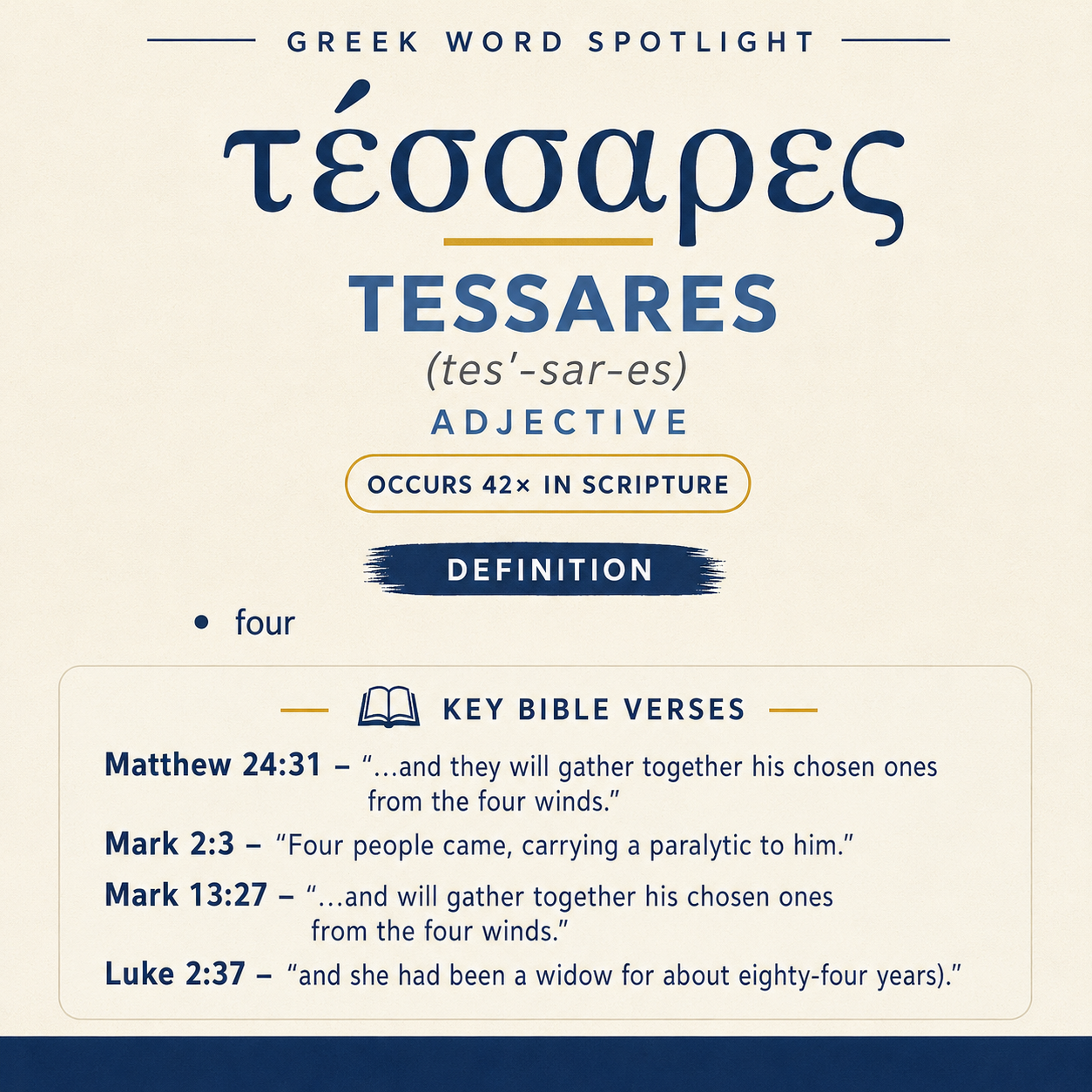
τέσσαρες means “four” in Greek and appears 42 times in Scripture, including Matthew 24:31, Mark 2:3, John 11:17, and Acts 10:11.
Scripture Occurrences
It occurs 42 times in Scripture. It appears in passages such as Matthew 24:31 and Mark 13:27.
Learn More →Example Usages
It describes “four days” (John 11:17) and “four parts” (John 19:23). It also appears with “four corners” (Acts 10:11).
Learn More →τέσσαρες denotes the number four. In the passages where it appears, it marks concrete quantities (people, days, parts, corners, squads, soldiers, daughters, men, anchors) and also frames a full scope in the expression “the four winds.”
Occurrences
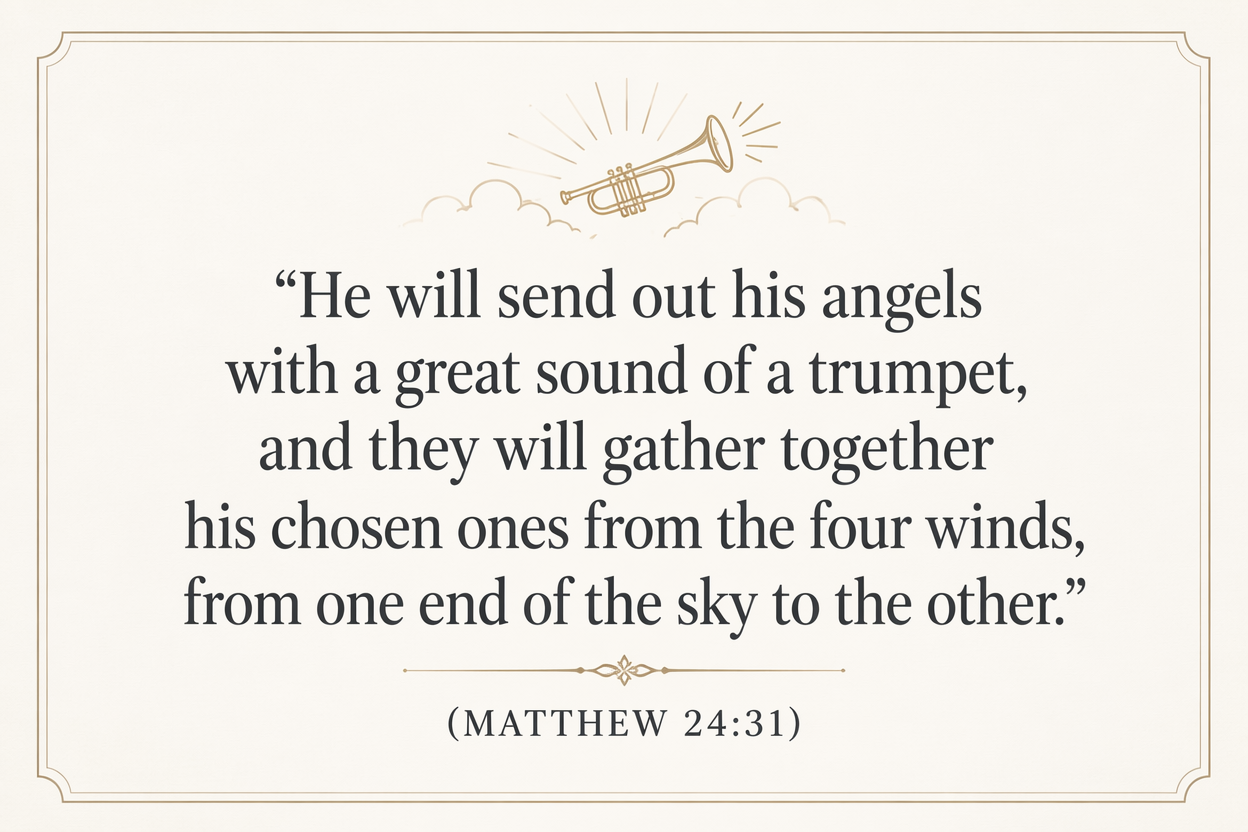
“He will send out his angels with a great sound of a trumpet, and they will gather together his chosen ones from the four winds, from one end of the sky to the other.” (Matthew 24:31)
Here τέσσαρες modifies “winds,” presenting a gathering that ranges across a complete spread of directions. The phrase is immediately expanded by “from one end of the sky to the other,” so “four” supports the picture of total reach rather than a small, local movement.
“Four people came, carrying a paralytic to him.” (Mark 2:3)
τέσσαρες gives a precise count of those who bring the paralytic. The number underlines that the paralytic is being carried by a coordinated group rather than by a single helper, making the action a shared effort in the scene.
“Then he will send out his angels, and will gather together his chosen ones from the four winds, from the ends of the earth to the ends of the sky.” (Mark 13:27)
As in Matthew, “four” shapes the idiom “the four winds,” coupled with the paired extremes “from the ends of the earth to the ends of the sky.” The number functions as a way of describing an all-encompassing sweep of space in which the gathering takes place.
“and she had been a widow for about eighty-four years), who didn’t depart from the temple, worshiping with fastings and petitions night and day.” (Luke 2:37)
τέσσαρες appears as part of “eighty-four,” setting a measured time span for her widowhood. The “four” is not a separate quantity by itself but contributes to the full numeral that frames the long duration alongside her continual worship “night and day.”
“So when Jesus came, he found that he had been in the tomb four days already.” (John 11:17)
τέσσαρες fixes the length of time in the tomb at “four days,” establishing the situation Jesus arrives to meet. The number makes the timing specific and concrete, anchoring the narrative moment in an exact count of days.
“Then the soldiers, when they had crucified Jesus, took his garments and made four parts, to every soldier a part; and also the coat. Now the coat was without seam, woven from the top throughout.” (John 19:23)
“Four parts” presents an orderly division of the garments that matches the group of soldiers implied by “to every soldier a part.” τέσσαρες therefore structures the distribution: the garments are portioned in a way that corresponds to each soldier receiving a share, while the coat is then described separately.
“He saw heaven opened and a certain container descending to him, like a great sheet let down by four corners on the earth,” (Acts 10:11)
τέσσαρες describes the sheet-like container as “let down by four corners,” giving the vision a defined shape and symmetry. The number helps the reader picture the object as spread and supported at its corners as it descends “on the earth.”
““I was in the city of Joppa praying, and in a trance I saw a vision: a certain container descending, like it was a great sheet let down from heaven by four corners. It came as far as me.” (Acts 11:5)
This retelling repeats the “four corners” detail, again using τέσσαρες to make the vision’s object vivid and concrete. The four-cornered sheet coming “as far as me” emphasizes controlled descent and proximity, with the number reinforcing the object’s defined form.
“When he had arrested him, he put him in prison, and delivered him to four squads of four soldiers each to guard him, intending to bring him out to the people after the Passover.” (Acts 12:4)
τέσσαρες occurs twice: “four squads” and “four soldiers each.” The repeated “four” organizes the guarding arrangement into a layered structure, highlighting the strength and method of the custody. The number functions administratively here, expressing how the guard is divided and assigned.
“Now this man had four virgin daughters who prophesied.” (Acts 21:9)
τέσσαρες counts the daughters and attaches that count to a descriptive phrase: they are “virgin daughters who prophesied.” The number supplies a concrete household detail, presenting the family as having a specific set of four daughters characterized by their prophetic activity.
“Therefore do what we tell you. We have four men who have taken a vow.” (Acts 21:23)
τέσσαρες gives the exact number of men associated with the vow. In the sentence’s practical counsel (“do what we tell you”), “four” supports a clear, actionable plan by specifying how many men are involved.
“Fearing that we would run aground on rocky ground, they let go four anchors from the stern, and wished for daylight.” (Acts 27:29)
τέσσαρες quantifies the emergency measure taken at sea: “four anchors from the stern.” The number makes the response concrete and weighty, conveying that multiple anchors—not merely one—are deployed in an effort to hold position while they “wished for daylight.”

Sense and Usage
Across these contexts, τέσσαρες functions as a straightforward marker of quantity, but it does so in several distinct kinds of discourse. In some places it counts people: “Four people” carry a paralytic (Mark 2:3), “four virgin daughters” belong to a household (Acts 21:9), and “four men” are linked with a vow (Acts 21:23). Each of these uses makes a group immediately graspable and bounded; the number defines the group’s size and helps the reader track who is acting or being discussed.
In other passages τέσσαρες measures time: the “eighty-four years” of widowhood (Luke 2:37) and the “four days” in the tomb (John 11:17). Such uses anchor the narrative in calendrical reality. The “four” in Luke is embedded in a larger numeral and thus serves the broader purpose of precise duration, whereas in John the “four” stands directly with “days,” placing an exact interval between the burial and Jesus’ arrival.
τέσσαρες also structures objects and space. The “four parts” of the garments (John 19:23) describe a division into equal or at least corresponding shares, matched to “every soldier a part,” so the number expresses an orderly apportionment. The “four corners” of the sheet-like container (Acts 10:11; 11:5) are spatial, giving the object a recognizable geometry as it descends; the repeated detail in the retelling shows that the fourfold description is integral to how the vision is remembered and narrated.
Finally, τέσσαρες appears in settings where scale or completeness is in view. The phrase “the four winds” (Matthew 24:31; Mark 13:27) serves as a directional total, strengthened by the accompanying expressions “from one end of the sky to the other” and “from the ends of the earth to the ends of the sky.” Here “four” does not invite the reader to think of four items laid out on a table, but of comprehensive range. Even in Acts 12:4, where the language is logistical (“four squads of four soldiers each”), the repeated fourfold pattern conveys thoroughness of guard and careful arrangement. In Acts 27:29, “four anchors” similarly suggests a substantial, stabilizing action appropriate to the danger described, with the number shaping the reader’s sense of how serious the situation is and how strong a restraint is being attempted.
Imagery
The passages give τέσσαρες a set of recurring pictures: winds from every direction (Matthew 24:31; Mark 13:27), a stretcher-team bringing a paralytic (Mark 2:3), the measured passage of days (John 11:17), garments divided into parts (John 19:23), a great sheet held by its corners (Acts 10:11; 11:5), guards arranged in squads (Acts 12:4), and anchors dropped in fear of rocks (Acts 27:29). The number four, used this way, repeatedly turns scenes into countable, graspable realities—whether in the vastness of “winds” or in the concrete detail of corners, parts, and anchors.
Sources: Lexical data from Strong’s Exhaustive Concordance and the Translators Brief Lexicon of Extended Strongs for Greek (STEPBible, CC BY). Occurrence data from the Translators Amalgamated Greek New Testament (STEPBible, CC BY). Scripture quotations from the World English Bible (public domain).