
Exploring the Meaning of Tetrarcheo in Greek
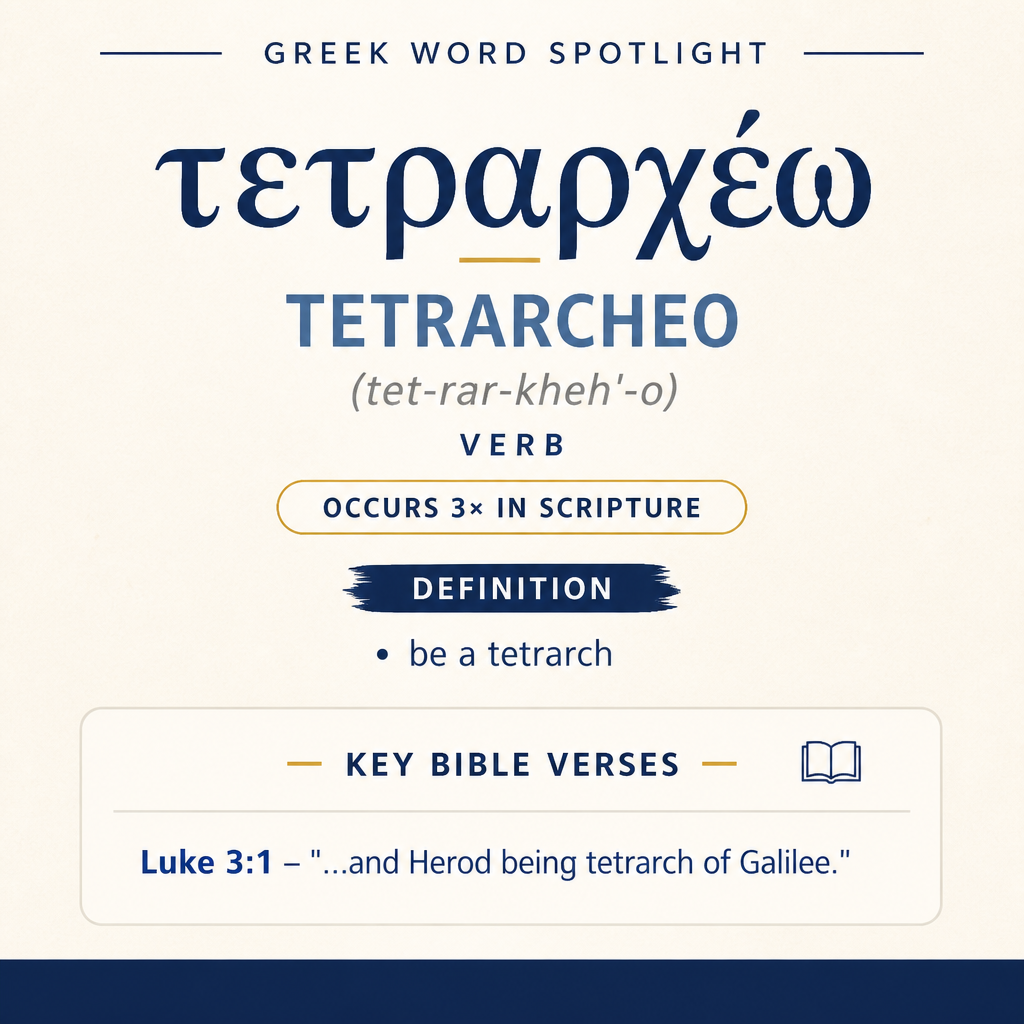
τετραρχέω means “be a tetrarch” and occurs three times in Scripture, including Luke 3:1.
Scripture Footprint
This word occurs 3 times in Scripture. One occurrence is in Luke 3:1.
Learn More →Example Context
In Luke 3:1 it appears within a list of rulers and officials. The verse includes “Herod being tetra…”
Learn More →τετραρχέω means “be a tetrarch,” describing the holding of a specific political office. It appears in Luke’s dating of John the Baptist’s public emergence, where multiple rulers are named to fix the setting in time and place.
Root and Related Words
τετραρχέω corresponds to the related noun tetrarches (τετράρχης), “tetrarch” (Strong’s G5076), from which this verb is derived.

Occurrences
Luke 3:1 — “Now in the fifteenth year of the reign of Tiberius Caesar, Pontius Pilate being governor of Judea, and Herod being tetrarch of Galilee, and his brother Philip tetrarch of the region of Ituraea and Trachonitis, and Lysanias tetrarch of Abilene,”
Here τετραρχέω supplies an official descriptor within a carefully layered list of authorities. Luke stacks offices across the Roman imperial sphere (“Tiberius Caesar”), the provincial administration (“Pontius Pilate being governor of Judea”), and then several local rulers identified specifically as tetrarchs over defined regions (“Herod … of Galilee,” “Philip … of the region of Ituraea and Trachonitis,” “Lysanias … of Abilene”). Within this sentence, the word functions less as narrative action and more as a marker of administrative status: it assigns a recognized role to each named figure and ties that role to a particular territory.
The effect is geographical as well as chronological. By pairing each tetrarch-designation with a region, Luke’s wording maps political oversight onto distinct locations, setting the stage for where subsequent events unfold. The repeated naming of tetrarchs (Galilee; Ituraea and Trachonitis; Abilene) creates a sense of a divided landscape under multiple local rulers, contrasted with the single emperor and the single governor mentioned earlier in the same verse.
Even in this brief setting statement, the verb’s contribution is concrete: it identifies what kind of ruler Herod is in relation to Galilee and places him in parallel with Philip and Lysanias. The phrase “being tetrarch” operates as an explanatory label, telling the reader how to understand each individual’s political standing within the broader order Luke is outlining. The scene is not about what these rulers do in the verse, but about who they are officially, and τετραρχέω is the key term used to make that official identity explicit.
Sense and Usage
In Luke 3:1, “be a tetrarch” is used as a formal designation tied to named persons and specified jurisdictions. The word is embedded in a roster of offices, so its sense is institutional: it marks the status of rulership rather than describing personal character or a single decision. This helps the verse function as a chronological and political heading. By distributing authority across several tetrarchs and attaching each one to a region, Luke’s phrasing presents the setting as administratively segmented, with multiple localized rulers existing within a larger framework of imperial and provincial governance.
The immediate co-text also shapes how the word is heard. Luke places “tetrarch” alongside “reign” (of the emperor) and “governor” (of Judea). That juxtaposition emphasizes that “being tetrarch” is one among several tiers of rule named in a single sweep. The verb therefore contributes to a picture of ordered authority: different titles correspond to different scopes of rule, and the narrative’s starting point is anchored in that structured world.
Because Luke attaches the tetrarch-title to several individuals in one sentence, the word’s use also carries a comparative force. Herod is not introduced as an isolated figure but as one tetrarch among others, each governing a different place. The meaning “be a tetrarch” remains stable, but its narrative role is to align multiple rulers under the same kind of office while distinguishing them by territory.
Imagery
The imagery of τετραρχέω in Luke 3:1 is administrative and territorial: rulers named, offices assigned, and regions delineated. The word evokes the public face of government—who holds authority over Galilee, over Ituraea and Trachonitis, and over Abilene—so the reader enters the narrative with a mental map of jurisdictions and their appointed leaders.
Sources: Lexical data from Strong’s Exhaustive Concordance and the Translators Brief Lexicon of Extended Strongs for Greek (STEPBible, CC BY). Occurrence data from the Translators Amalgamated Greek New Testament (STEPBible, CC BY). Scripture quotations from the World English Bible (public domain).




