Exploring the Meaning of Tetrapous in Greek
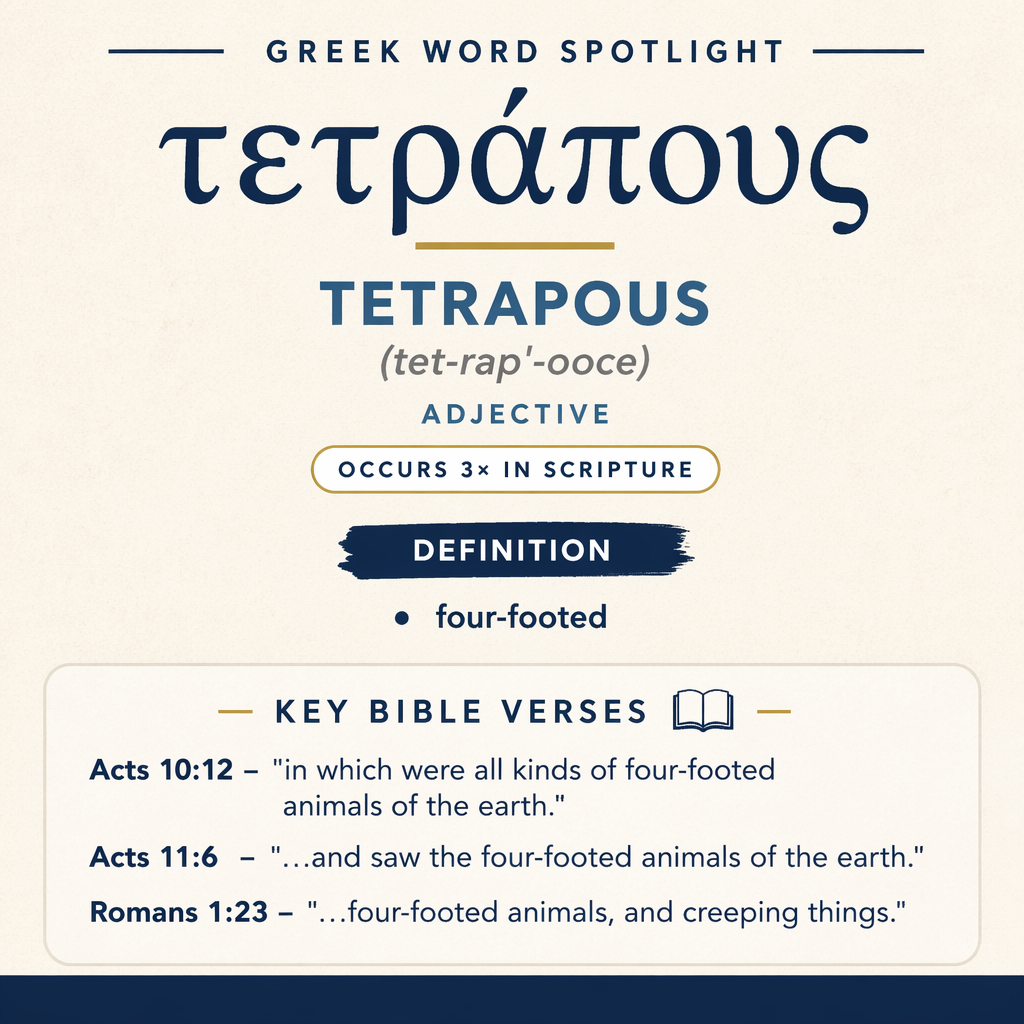
τετράπους means “four-footed” and appears in Acts 10:12, Acts 11:6, and Romans 1:23.
Acts Context
In Acts 10:12 and 11:6 it describes the “four-footed animals of the earth,” alongside wild animals, reptiles/creeping things, and birds.
Learn More →Romans Context
In Romans 1:23 it appears in a list including birds and four-footed creatures.
Learn More →τετράπους describes something as “four-footed,” and it appears in a pair of narrative descriptions of a visionary sheet in Acts and in Paul’s catalog of created likenesses in Romans. In each setting it marks out a class of earthly creatures by the most basic feature of their bodily form: having four feet.
Root and Related Words
τετράπους is built from τέσσαρες (tessares), “four” (Strong’s G5064), and πούς (pous), “foot” (Strong’s G4228). The compound structure makes the descriptive force of the word transparent: it classifies living creatures by number of feet.
Occurrences
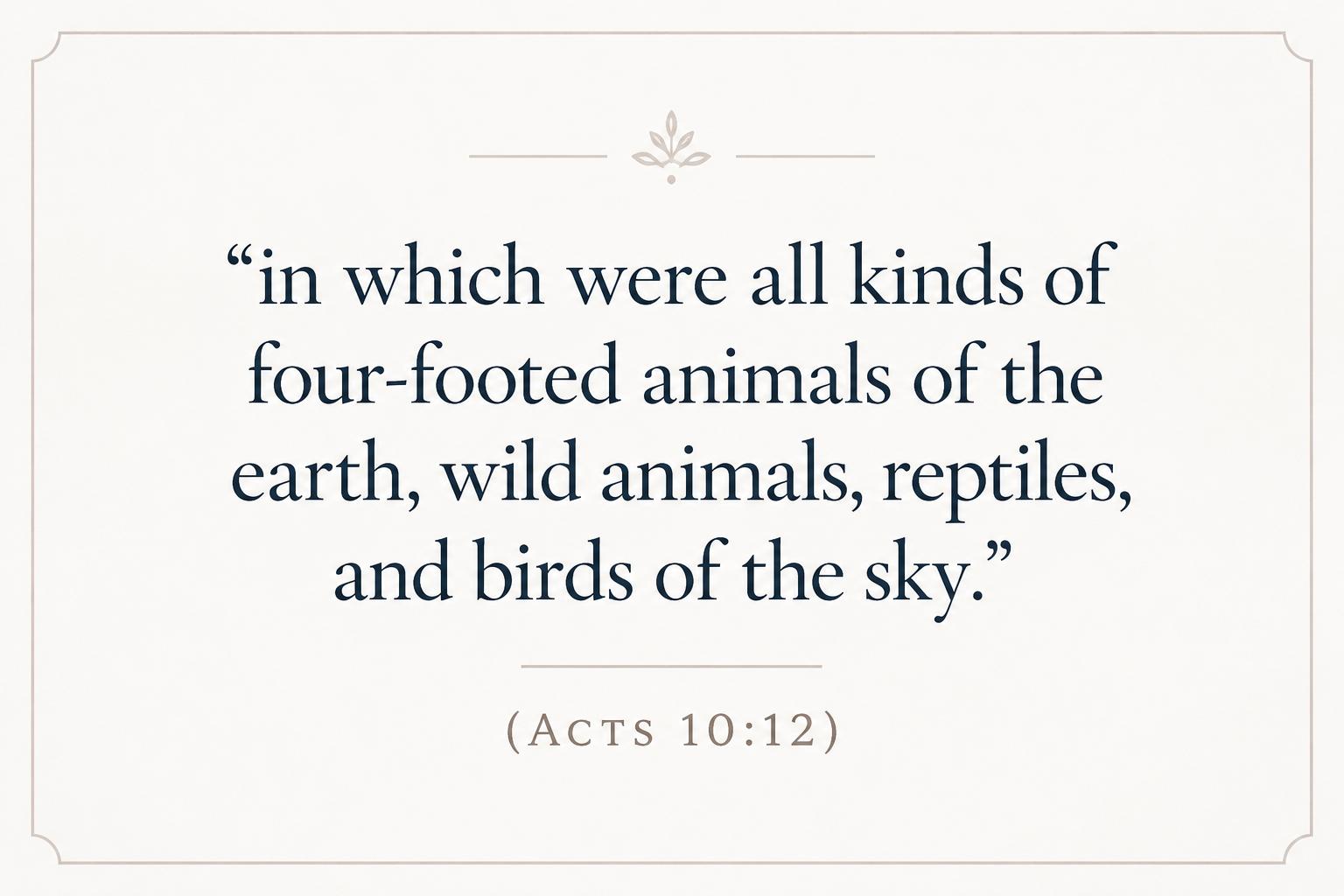
“in which were all kinds of four-footed animals of the earth, wild animals, reptiles, and birds of the sky.” (Acts 10:12)
Here τετράπους functions inside a list that divides animal life into broad, recognizable groupings. “Four-footed animals of the earth” stands alongside “wild animals,” “reptiles,” and “birds of the sky,” mapping the contents of the sheet across land and sky and across different modes of movement. The phrase “of the earth” sets the four-footed creatures firmly in the terrestrial realm, and the adjective helps make the scene concrete: the vision is not presented as a vague mass of “animals,” but as a collection containing creatures whose bodies are imagined in a particular way, as footed land animals.
“When I had looked intently at it, I considered, and saw the four-footed animals of the earth, wild animals, creeping things, and birds of the sky.” (Acts 11:6)
This is a retelling of the earlier vision, and τετράπους again anchors the description in observable detail. The speaker’s actions—“looked intently,” “considered,” “saw”—frame the list that follows as the result of careful perception. Within that careful seeing, “the four-footed animals of the earth” are not incidental; they are part of what is distinctly recognized as the contents are surveyed. The word helps the inventory feel like a genuine sight, not merely an abstract idea, because it reflects a simple visual criterion: some of what is present is recognized as four-footed. In the same breath, the account keeps the categories broad (“wild animals,” “creeping things,” “birds of the sky”), so τετράπους contributes a stabilizing, bodily descriptor amid a sweeping assortment.
“and traded the glory of the incorruptible God for the likeness of an image of corruptible man, and of birds, four-footed animals, and creeping things.” (Romans 1:23)
In Romans, τετράπους appears in a rhetorical sequence of “likeness of an image” that moves from “corruptible man” outward to other forms of created life: “birds, four-footed animals, and creeping things.” The adjective serves as a compact way to denote a major slice of the animal world, placed between aerial creatures (“birds”) and ground-level movers (“creeping things”). The effect is a widening array of living likenesses—human, then nonhuman—where four-footed animals represent a familiar, substantial category of earthly creatures. By using this bodily description, the text draws attention to the concreteness of what is being imaged: not an ethereal concept, but created forms with identifiable physical traits.
Sense and Usage
Across these passages, τετράπους operates as a classificatory adjective that marks animals by a plain anatomical feature. In Acts, the word belongs to a descriptive catalogue of what is seen “in” the sheet, and it works with location language (“of the earth”) to situate the creatures in their expected sphere. The narrative pairing in Acts 10 and Acts 11 shows the term fitting naturally into a remembered inventory: a speaker can recount what was seen by naming broad creature-types, and “four-footed” is one of the salient features that makes those types recognizable.
In Romans, the term is used not for scenic description but for moral argument, yet it still depends on the same concrete, observational category. The sequence “birds, four-footed animals, and creeping things” groups living creatures by readily grasped distinctions: winged, four-footed, and creeping. τετράπους thus functions as a middle category between the sky-oriented and the ground-clinging, emphasizing ordinary animal embodiment as part of a larger list of created likenesses.
The word’s placement alongside other broad groupings also shows how it behaves semantically in context: it does not stand alone as the entire description of an animal, but contributes one clear axis of classification within a larger taxonomy. In Acts, it is one element in a fourfold list that spans “animals of the earth” and “birds of the sky.” In Romans, it is one link in a chain of likenesses, set among other creature categories that together evoke a wide range of animate forms.
Imagery
The imagery tied to τετράπους in Acts is vivid and inventory-like: a container “in which were all kinds of” creatures, including those recognizable by four feet (Acts 10:12), later recalled after intentional scrutiny (Acts 11:6). In Romans the imagery becomes iconographic—“the likeness of an image” taking the shape of created beings—yet the same down-to-earth bodily descriptor remains: four-footed animals as one of the concrete forms that can be pictured and represented (Romans 1:23).
Sources: Lexical data from Strong’s Exhaustive Concordance and the Translators Brief Lexicon of Extended Strongs for Greek (STEPBible, CC BY). Occurrence data from the Translators Amalgamated Greek New Testament (STEPBible, CC BY). Scripture quotations from the World English Bible (public domain).