Exploring the Meaning of Pleistos in Greek
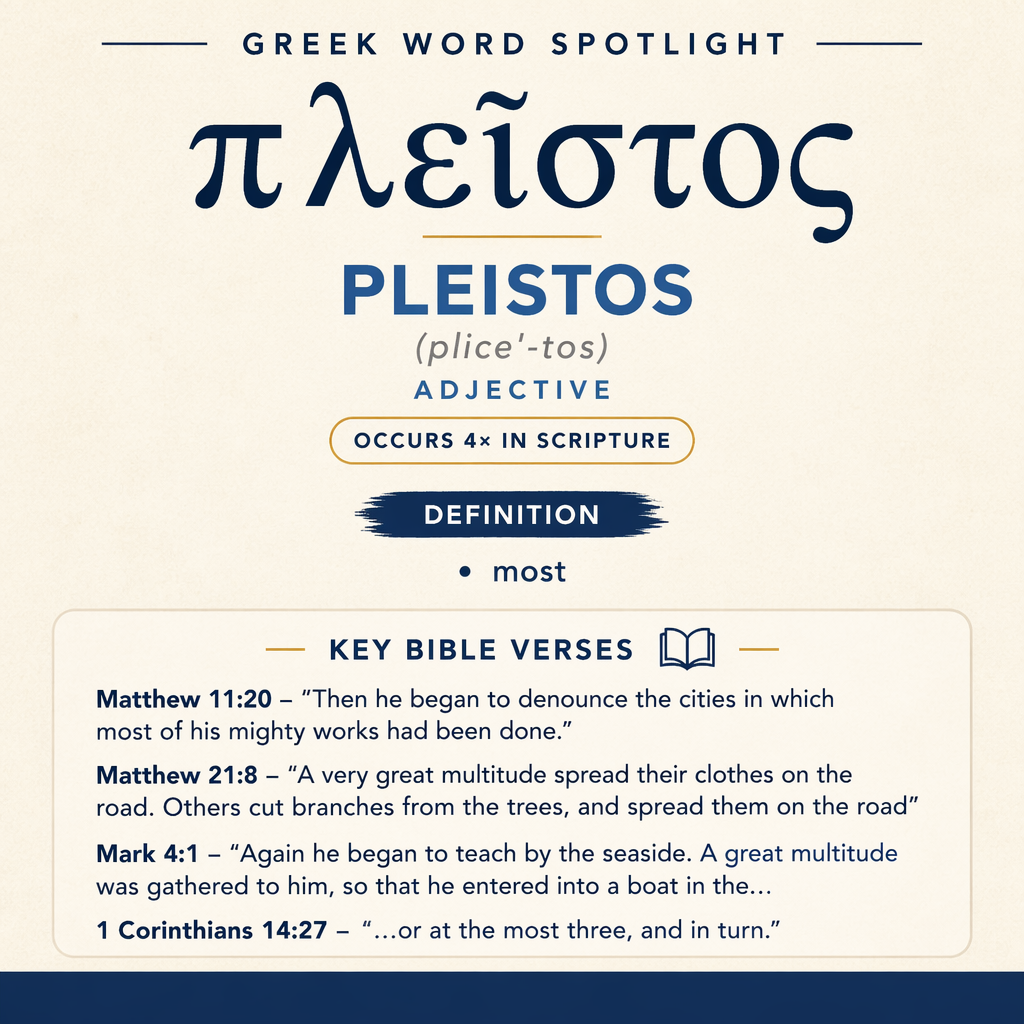
πλεῖστος means “most” and appears 4 times in Scripture: Matthew 11:20; Matthew 21:8; Mark 4:1; 1 Corinthians 14:27.
Core Meaning
πλεῖστος is translated “most.” It marks the greatest number or extent in its contexts.
Learn More →Gospel Contexts
In Matthew 11:20 it describes cities where most mighty works were done. In Matthew 21:8 and Mark 4:1 it modifies a very great/great multitude.
Learn More →Church Order
In 1 Corinthians 14:27 it sets an upper limit: “at the most three” may speak in another language, in turn, with interpretation.
Learn More →πλεῖστος expresses the idea of “most,” marking a superlative measure that highlights what is greatest in extent or what reaches an upper limit. It appears in Gospel scenes describing crowds and cities, and in an instruction about how many may speak in a church gathering.
Root and Related Words
πλεῖστος is related to polys (πολύς), “much” (Strong’s G4183).

Occurrences
Matthew 11:20: “Then he began to denounce the cities in which most of his mighty works had been done, because they didn’t repent.”
Here πλεῖστος concentrates attention on a comparison among places: certain “cities” stand out because the greatest concentration of “mighty works” happened there. The word does not describe the works as qualitatively different; it marks their extent in those locations as surpassing what happened elsewhere. That superlative heightens the force of the rebuke—these cities are singled out because they had received the largest measure of extraordinary acts, and yet “they didn’t repent.” In the logic of the sentence, “most” functions as an intensifier of responsibility: the greater the exposure to “mighty works,” the more striking the lack of repentance appears.
Matthew 21:8: “A very great multitude spread their clothes on the road. Others cut branches from the trees, and spread them on the road.”
In this entry’s occurrence, πλεῖστος supports the narrator’s emphasis on scale: the crowd is not merely present but characterized as exceptionally large (“A very great multitude”). The scene is described with coordinated actions—some laying garments, others cutting branches—suggesting that the largeness of the multitude shows itself in the abundance of people able to participate in different, simultaneous gestures. “Most” here serves to expand the reader’s mental picture: the roadway becomes a place filled with collective action on a broad scale.
Mark 4:1: “Again he began to teach by the seaside. A great multitude was gathered to him, so that he entered into a boat in the sea, and sat down. All the multitude were on the land by the sea.”
In Mark’s account, πλεῖστος (rendered in this translation as “A great multitude”) functions as a narrative driver: the crowd’s size explains the shift in setting and posture. The teacher is pressed to the point that “he entered into a boat in the sea, and sat down,” while “All the multitude were on the land by the sea.” The word’s contribution is therefore not only descriptive but also practical within the scene: the superlative sense of “most” underlies the reason the teaching takes place with water separating speaker and listeners, and with the whole shoreline occupied by the gathered people. The scale implied by the term helps account for the spatial arrangement—boat, sea, and land become part of the solution to addressing such a mass of hearers.
1 Corinthians 14:27: “If any man speaks in another language, let it be two, or at the most three, and in turn; and let one interpret.”
In this instruction, πλεῖστος appears in a limiting phrase: “at the most three.” The term sets an upper boundary rather than depicting a large quantity for its own sake. The rule is structured with careful constraints: a conditional (“If any man speaks in another language”), a numeric range (“two, or at the most three”), an order (“and in turn”), and an accompanying requirement (“and let one interpret”). Within that set of directions, “most” functions to cap the maximum number permitted in the meeting, placing a ceiling on how far the activity may extend. The superlative idea is thus used administratively: it marks the furthest allowable point, beyond which the instruction would be violated.
Sense and Usage
Across these passages, “most” operates in two closely related ways: (1) it highlights the greatest extent within a comparison, and (2) it defines the farthest permissible limit of an amount. Matthew 11:20 shows the comparative force most explicitly: among “cities,” some had the greatest share of “mighty works,” and the superlative sharpens the moral contrast with “they didn’t repent.” In Matthew 21:8 and Mark 4:1 the term strengthens narrative scale: the magnitude of the multitude shapes what can be seen and what must be done—roads covered with garments and branches, or a teacher seated offshore because the crowd is so large that a new arrangement is required. In 1 Corinthians 14:27, however, the superlative is used to restrain rather than to magnify: it fixes an absolute maximum (“two, or at the most three”), ensuring that the gathering proceeds “in turn” with interpretation rather than being overtaken by unchecked numbers.
The four occurrences together show that πλεῖστος can intensify a description (“most of his mighty works,” “a very great multitude”) and can also act as a precise limiter (“at the most three”). In both uses, the superlative idea remains consistent: it points to the highest point on a scale—either the highest level reached in reality (the greatest number of works in certain cities; the largest crowds present) or the highest level permitted by instruction (the maximum number of speakers in that particular activity).
Imagery
The word often carries imagery of scale—cities receiving the greatest share of mighty deeds, roads filled with a mass of people laying down garments and branches, and a shoreline crowded with listeners while the teacher sits in a boat. Even when used to set a limit, it evokes a measuring line drawn across communal life: “at the most three” pictures an upper boundary that keeps a gathering ordered and interpretable.
Sources: Lexical data from Strong’s Exhaustive Concordance and the Translators Brief Lexicon of Extended Strongs for Greek (STEPBible, CC BY). Occurrence data from the Translators Amalgamated Greek New Testament (STEPBible, CC BY). Scripture quotations from the World English Bible (public domain).