
Exploring the Meaning of Tetramenon in Greek
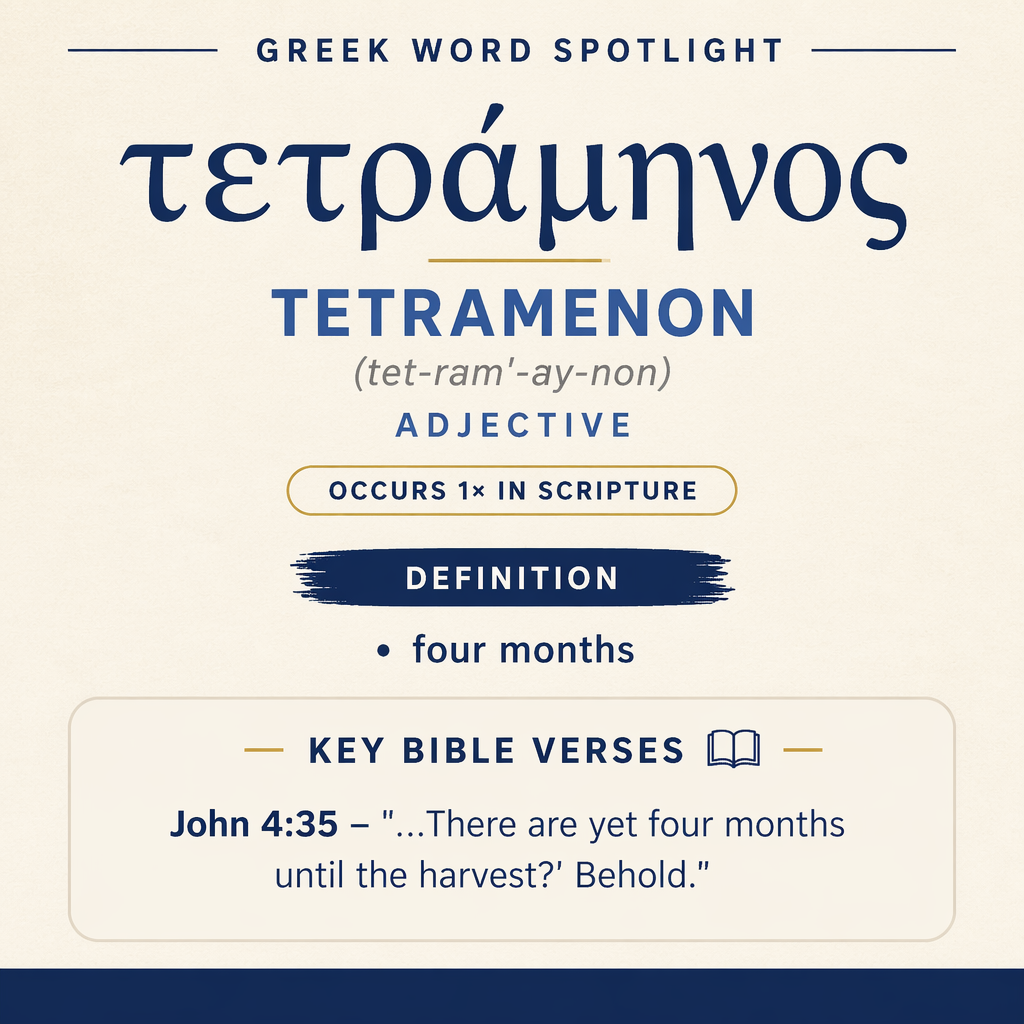
τετράμηνος means “four months” and appears once in Scripture, in John 4:35.
Biblical Usage
It occurs in John 4:35 in the saying, “There are yet four months until the harvest.”
Learn More →τετράμηνος means “four months” and appears in Jesus’ saying about harvest timing in John 4:35. In that line it functions as a concrete measure of time that frames the expectation of waiting versus the immediacy Jesus announces.
Root and Related Words
τετράμηνος is connected with τέσσαρες (tessares), “four” (Strong’s G5064), and μήν (mēn), “month” (Strong’s G3376). The formation brings a number term together with a calendrical unit to express a specific span of months.

Occurrences
“Don’t you say, ‘There are yet four months until the harvest?’ Behold, I tell you, lift up your eyes and look at the fields, that they are white for harvest already.” (John 4:35)
In John 4:35, τετράμηνος appears inside a reported proverb-like expectation: “There are yet four months until the harvest?” The phrase places harvest in the near future, but still at a remove—time enough to assume delay and to speak as though readiness is not yet present. By naming a span of “four months,” the saying makes the waiting concrete and countable, not vague: harvest is conceived as something scheduled, something that typically requires a period to elapse.
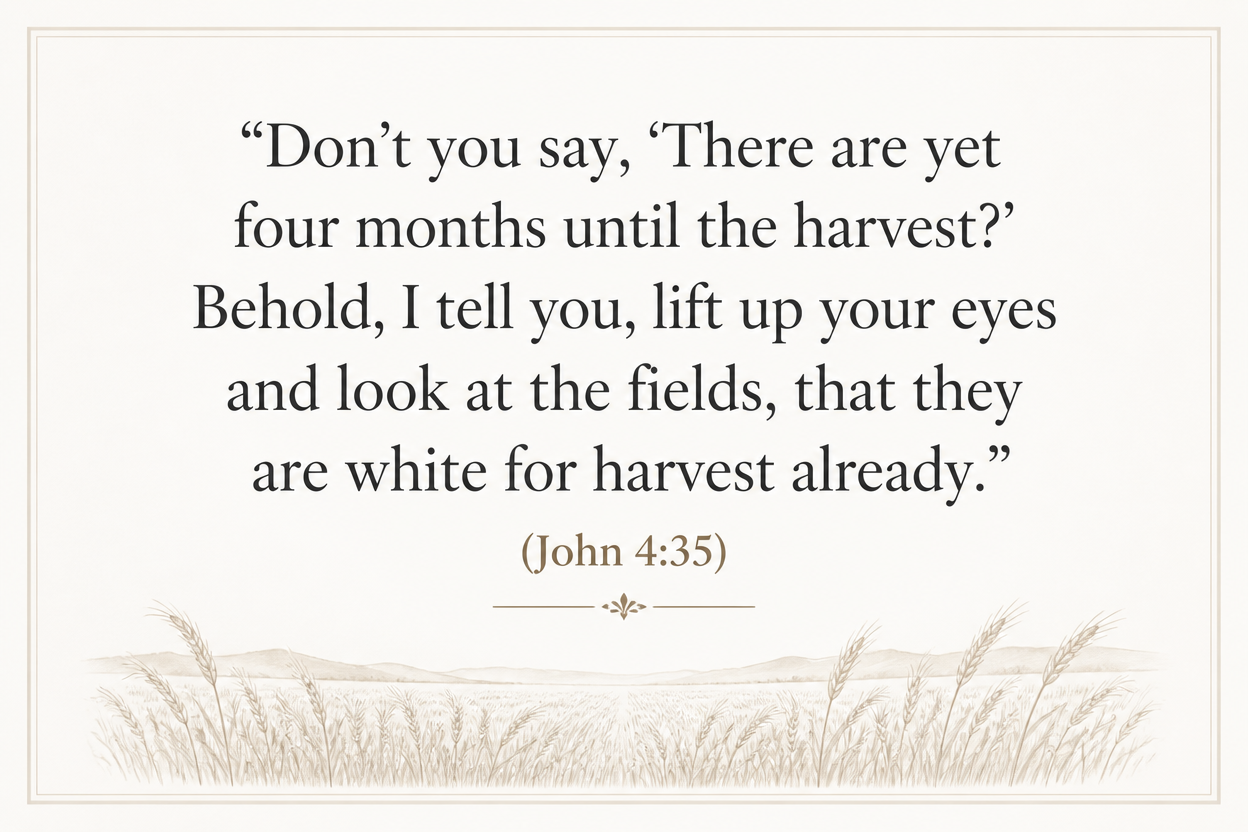
Jesus immediately counters that posture with commands that shift attention from a calendar to a present scene: “lift up your eyes and look at the fields.” The time statement (“four months”) and the visual imperative (“look at the fields”) are set against each other. The word’s contribution is to sharpen that contrast. If the hearers are accustomed to thinking in terms of months until harvest, Jesus’ instruction forces a different assessment—one based on what can be seen “already.” The adverb “already” gains force precisely because a definite interval has just been mentioned; the point is not merely that harvest will come sooner than expected, but that the assumption of waiting (“yet four months”) is being overturned by present readiness (“white for harvest already”).
The word also helps structure the sentence rhetorically. The first question voices a common way of speaking (“Don’t you say…”), and the measure of time supplies the content of that saying. Then “Behold, I tell you” introduces Jesus’ authoritative correction. τετράμηνος, by giving the content of the common assumption, becomes the foil against which Jesus’ directive stands out. The hearer is moved from calculating time to perceiving conditions: the fields are described as “white for harvest,” and the timing is asserted as current rather than postponed.
Sense and Usage
The sense “four months” is straightforwardly temporal: it quantifies time in months, presenting a bounded interval that can be anticipated. In John 4:35 the phrase “yet four months” is oriented toward the future (“until the harvest”), which implies a countdown mentality—harvest is expected, but not expected now. The expression therefore carries the feel of ordinary planning: a period remains, so the decisive moment is still ahead.
Within the same verse, however, that interval is not allowed to govern interpretation. The saying is quoted only to be challenged. The result is that “four months” functions as a conventional benchmark—an intelligible, everyday unit that people can easily invoke to justify postponement. By naming a specific period, it makes the implied delay reasonable and socially shareable: it is the kind of thing people “say.”
Jesus’ response reorients the assessment of time by coupling perception (“lift up your eyes and look”) with a condition statement (“the fields… are white for harvest already”). The interval of four months is not debated in agricultural terms; instead, it is displaced by a present-tense declaration. Thus the word participates in a contrast between an expected schedule (“yet four months”) and an asserted immediacy (“already”). The temporal unit is used to expose a mismatch between what is assumed about timing and what is true in the moment being addressed.
Because the word specifies months rather than days or years, it suggests a moderate, familiar span—not an instant, not a distant horizon. That makes it especially suitable for illustrating how easily people can put readiness just far enough away to avoid acting as though it is present. In the verse, the measurable interval highlights how small a shift in expectation can still be significant: even a few months of assumed delay can be corrected by the recognition that harvest conditions are present now.
Imagery
The verse pairs the time-count of “four months” with a field image: “look at the fields, that they are white for harvest already.” The mention of months evokes a farmer’s calendar, while the whitened fields evoke visible ripeness. Together they create a vivid tension between the time someone thinks remains and the scene someone can actually see. τετράμηνος anchors the first side of that tension—the spoken timeline—so that the command to look and the claim of “already” land with greater urgency.
Sources: Lexical data from Strong’s Exhaustive Concordance and the Translators Brief Lexicon of Extended Strongs for Greek (STEPBible, CC BY). Occurrence data from the Translators Amalgamated Greek New Testament (STEPBible, CC BY). Scripture quotations from the World English Bible (public domain).




