Exploring the Meaning of Stemma in Greek
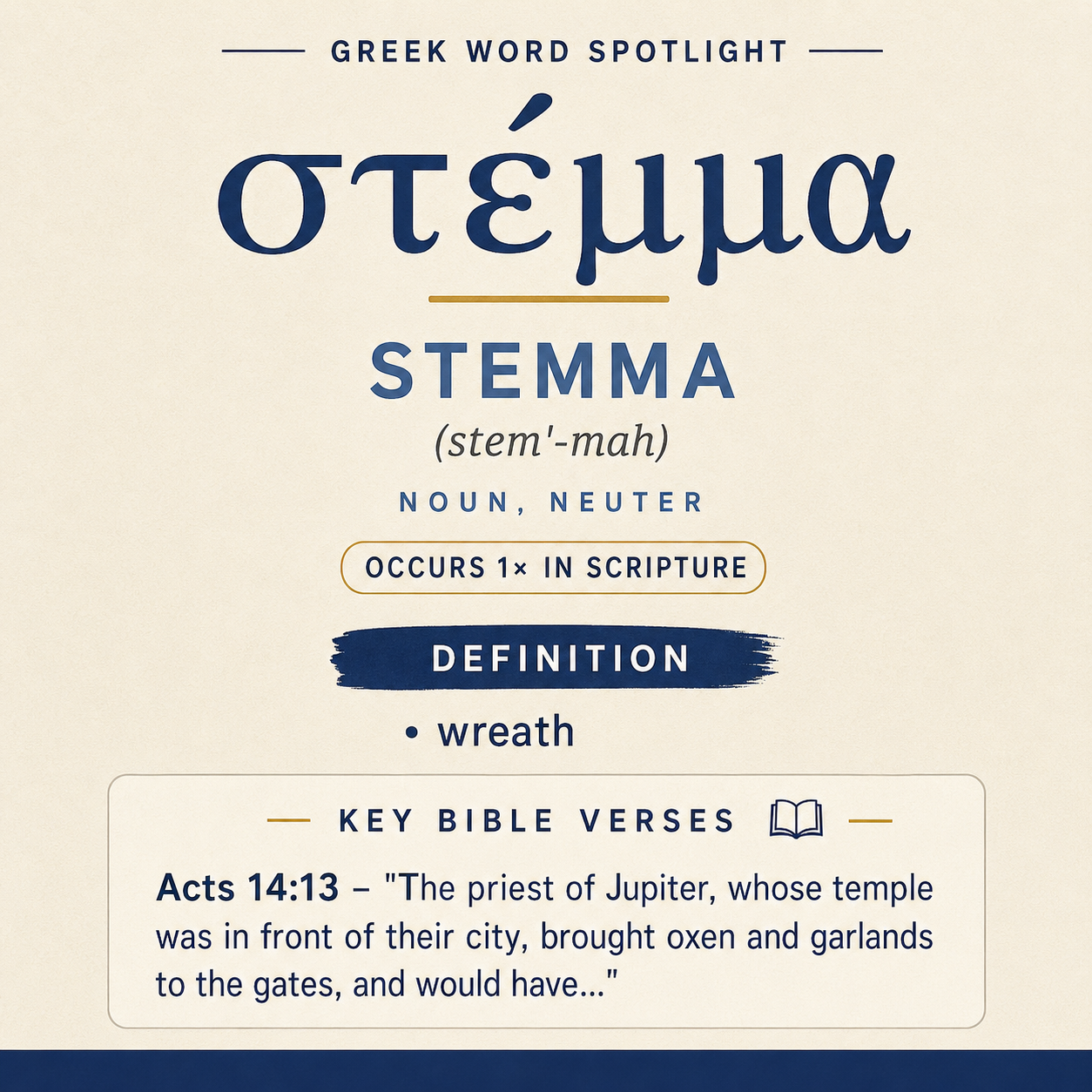
στέμμα means “wreath” and appears once in Scripture, in Acts 14:13.
Verse Context
In Acts 14:13, the priest of Jupiter brought oxen and garlands to the gates.
Learn More →στέμμα means “wreath” and appears in the narrative of Paul and Barnabas at Lystra. It is used in connection with a proposed sacrifice offered by a local priest and a gathered crowd.
Root and Related Words
στέμμα is related to the noun stephanos (στέφανος), “crown” (Strong’s G4735).

Occurrences
“The priest of Jupiter, whose temple was in front of their city, brought oxen and garlands to the gates, and would have made a sacrifice along with the multitudes.” (Acts 14:13)
Here στέμμα appears in the plural (“garlands”) among the items the priest brings: “oxen and garlands.” The pairing of these two concrete objects situates the wreathes within the preparations for a sacrificial act: the oxen as the animals for offering, and the garlands as accompanying adornments that mark the occasion as ceremonial. The action is deliberate and public—he brings them “to the gates”—and the wreathes belong to the visible staging of the event in a civic space where “the multitudes” can participate. In the flow of the sentence, the garlands are not incidental decoration; they function as part of what makes the intended sacrifice a formal, communal act rather than a private gesture. By placing the wreathes in the priest’s hands as he comes from a temple “in front of their city,” the text presents them as cultic implements of a recognized local religious setting, carried outward toward the city’s point of entry as the crowd gathers for the planned offering.
Sense and Usage
The single use of στέμμα anchors the word in a scene where a wreath serves as a tangible sign of honor and festivity in a religious procession. A wreath is inherently made to be seen: it is an object whose purpose in this context is to add visible splendor to the rite that is about to occur. Acts 14:13 frames the garlands as part of the priest’s attempt to act appropriately for a sacrifice carried out “along with the multitudes,” suggesting their role in shaping public perception—what the crowd witnesses and participates in at the gates.
The verse also sets up a contrast between ordinary civic movement and heightened ritual action. Gates are places of passage and gathering; bringing oxen and wreathes there turns a threshold into an altar-like setting. In that movement from temple-front to city gate, the wreathes signal that what is coming is not simply an encounter with travelers but an event requiring ceremonial treatment. The word therefore contributes to the narrative’s concreteness: it shows that the priest’s intention is not merely verbal or theoretical (“would have made a sacrifice”) but supported by the physical trappings that commonly accompany such a rite—animals to offer and wreathes to adorn.
Because στέμμα is listed as an item “brought” rather than something already present, it also carries the sense of preparation. The priest is equipping the moment: assembling what is needed for a public sacrifice and transporting it into the shared space of the city’s gates. The wreathes, in that regard, operate as portable ceremony—objects that can be carried, displayed, and used to mark persons, animals, or the place itself as set apart for the act that the priest intends to perform with the crowd.
Imagery
Within Acts 14:13, the imagery of στέμμα is bound to movement and display: garlands carried through the city to the gates, alongside oxen, with a multitude poised for a sacrifice. The wreathes evoke a scene of outward celebration and religious pageantry—an attempted honoring enacted through visible adornment as much as through the intended offering.
Sources: Lexical data from Strong’s Exhaustive Concordance and the Translators Brief Lexicon of Extended Strongs for Greek (STEPBible, CC BY). Occurrence data from the Translators Amalgamated Greek New Testament (STEPBible, CC BY). Scripture quotations from the World English Bible (public domain).