
Exploring the Meaning of Stege in Greek
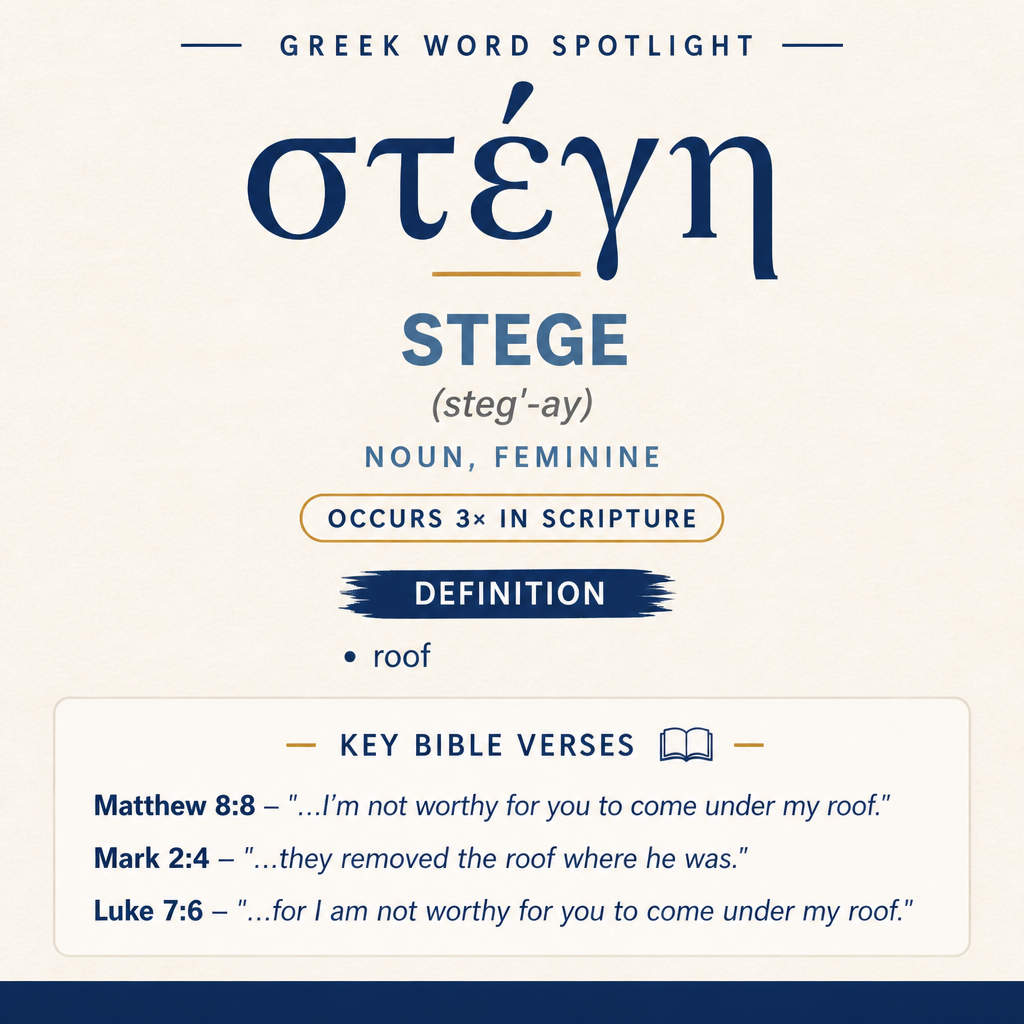
στέγη (Stege) means “roof” and occurs three times in Scripture: Matthew 8:8, Mark 2:4, and Luke 7:6.
Where It Appears
It occurs three times in Scripture: Matthew 8:8; Mark 2:4; Luke 7:6.
Learn More →How It’s Used
In Matthew 8:8 and Luke 7:6 it appears in the centurion’s words about coming under his roof. In Mark 2:4 it refers to the roof removed and broken up.
Learn More →στέγη names a “roof,” the overhead covering of a house. In the Gospels it appears in two scenes: a centurion’s household appeal and the lowering of a paralyzed man through an opened roof.
Occurrences
“The centurion answered, “Lord, I’m not worthy for you to come under my roof. Just say the word, and my servant will be healed.”” (Matthew 8:8)
Here στέγη marks the centurion’s home as a concrete, bounded space—an interior defined by what is “under” its covering. The centurion frames the issue in terms of personal unworthiness for Jesus to enter that space: “to come under my roof.” The roof therefore functions as a way of speaking about household presence and access. In the same breath, the centurion contrasts physical arrival with effective speech: “Just say the word.” The roof remains the image of a real place Jesus could enter, while the request insists that healing does not depend on bringing Jesus beneath that covering.
“When they could not come near to him for the crowd, they removed the roof where he was. When they had broken it up, they let down the mat that the paralytic was lying on.” (Mark 2:4)
In this account στέγη is not merely a household feature but an obstacle and then a point of entry. The crowd prevents approach (“they could not come near to him”), so the action shifts upward: “they removed the roof where he was.” The wording locates Jesus within a roofed space and makes the roof the decisive boundary between the sick man outside and Jesus inside. The verbs surrounding the noun press its physicality: the roof can be “removed,” then “broken…up,” creating an opening large enough to lower “the mat that the paralytic was lying on.” The roof is thus the structural overhead barrier that must be disrupted to bring a person down into the room where Jesus is present.
“Jesus went with them. When he was now not far from the house, the centurion sent friends to him, saying to him, “Lord, don’t trouble yourself, for I am not worthy for you to come under my roof.”” (Luke 7:6)
As in Matthew, στέγη appears in the centurion’s language of hospitality and restraint. The narrative emphasizes proximity—Jesus is “not far from the house”—yet the centurion again draws a line at the threshold: “don’t trouble yourself.” The roof serves as shorthand for the home’s interior domain: Jesus is near enough to enter, but the centurion insists he should not cross into the space “under my roof.” Because this message is carried by “friends,” the roof also frames the household as a place approached on behalf of another, without requiring Jesus to step inside.

Sense and Usage
Across these passages στέγη keeps its basic sense of an actual roof, the upper covering that defines an “under” and an “inside.” The noun’s contribution is spatial and concrete: it identifies the portion of a house that caps a room and, by doing so, marks the human space beneath it as a distinct setting for interaction.
In the centurion scenes (Matthew 8:8; Luke 7:6), the roof is invoked from the standpoint of entry. The phrase “under my roof” turns the roof into a boundary line: it is not only overhead architecture but the limit of where a guest might be received. That boundary is used rhetorically to express the centurion’s sense of unworthiness and his desire to spare Jesus inconvenience. The roof in these lines is therefore not described by its material or construction; it matters as the recognizable feature that makes “my house” a sheltered, personal realm into which someone may or may not come.
In Mark 2:4, the roof is treated in the opposite direction: not as a boundary politely maintained, but as a boundary forcibly crossed. The crowd blocks the usual horizontal approach, so the roof becomes the access route. The narrative treats the roof as something that can be acted upon—removed, broken, opened—so that the sick man can be brought into Jesus’ vicinity from above. The roof’s ordinary function is to cover; in this scene, its significance is highlighted by temporarily undoing that function.
The three occurrences together show that στέγη naturally fits speech about presence and approach (“come under my roof”) as well as description of physical action upon a building (“they removed the roof”). In each case the roof is the house’s defining overhead element, and the events turn on whether it remains intact as a covering or becomes the point where access is granted or withheld.
Imagery
These passages invest “roof” with the everyday imagery of shelter and enclosure without making it abstract. The centurion’s words picture a covered space that Jesus could enter, and the appeal is framed by distance: Jesus is near, yet asked to remain outside. Mark’s scene adds a vivid counterpart: the covering above Jesus is opened, and what is “under” the roof becomes reachable from above as a man is lowered on his mat. In both settings, στέγη keeps attention on the simple line a roof draws between outside and inside, and on what it means for that line to remain closed or be crossed.
Sources: Lexical data from Strong’s Exhaustive Concordance and the Translators Brief Lexicon of Extended Strongs for Greek (STEPBible, CC BY). Occurrence data from the Translators Amalgamated Greek New Testament (STEPBible, CC BY). Scripture quotations from the World English Bible (public domain).




