Exploring the Meaning of Stenos in Greek
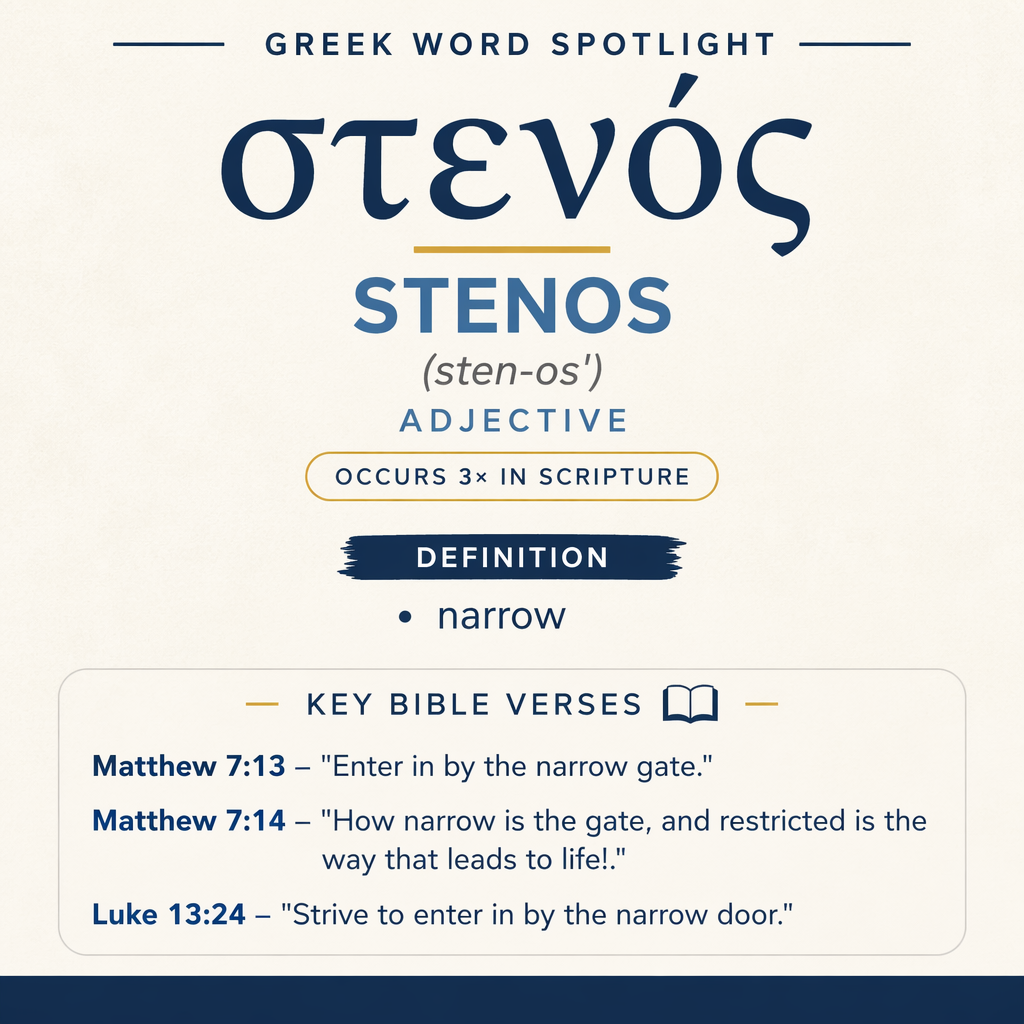
στενός means “narrow” and appears in Matthew 7:13–14 and Luke 13:24.
Core Meaning
στενός is defined as “narrow.” It describes a gate or door and the way associated with it.
Learn More →Gospel Occurrences
It occurs three times in Scripture: Matthew 7:13, Matthew 7:14, and Luke 13:24.
Learn More →Verse Context
In Matthew 7:13–14, it contrasts a narrow gate with a wide gate and a broad way. In Luke 13:24, it describes a narrow door people strive to enter.
Learn More →στενός describes something “narrow,” and in the Gospels it appears in sayings that picture entry points and paths as tightly bounded. In these passages the word shapes the contrast between an easy, spacious route taken by many and a constricted, difficult route found by few.
Root and Related Words
στενός is linked with the verb histēmi (ἵστημι), “to stand” (Strong’s G2476).

Occurrences
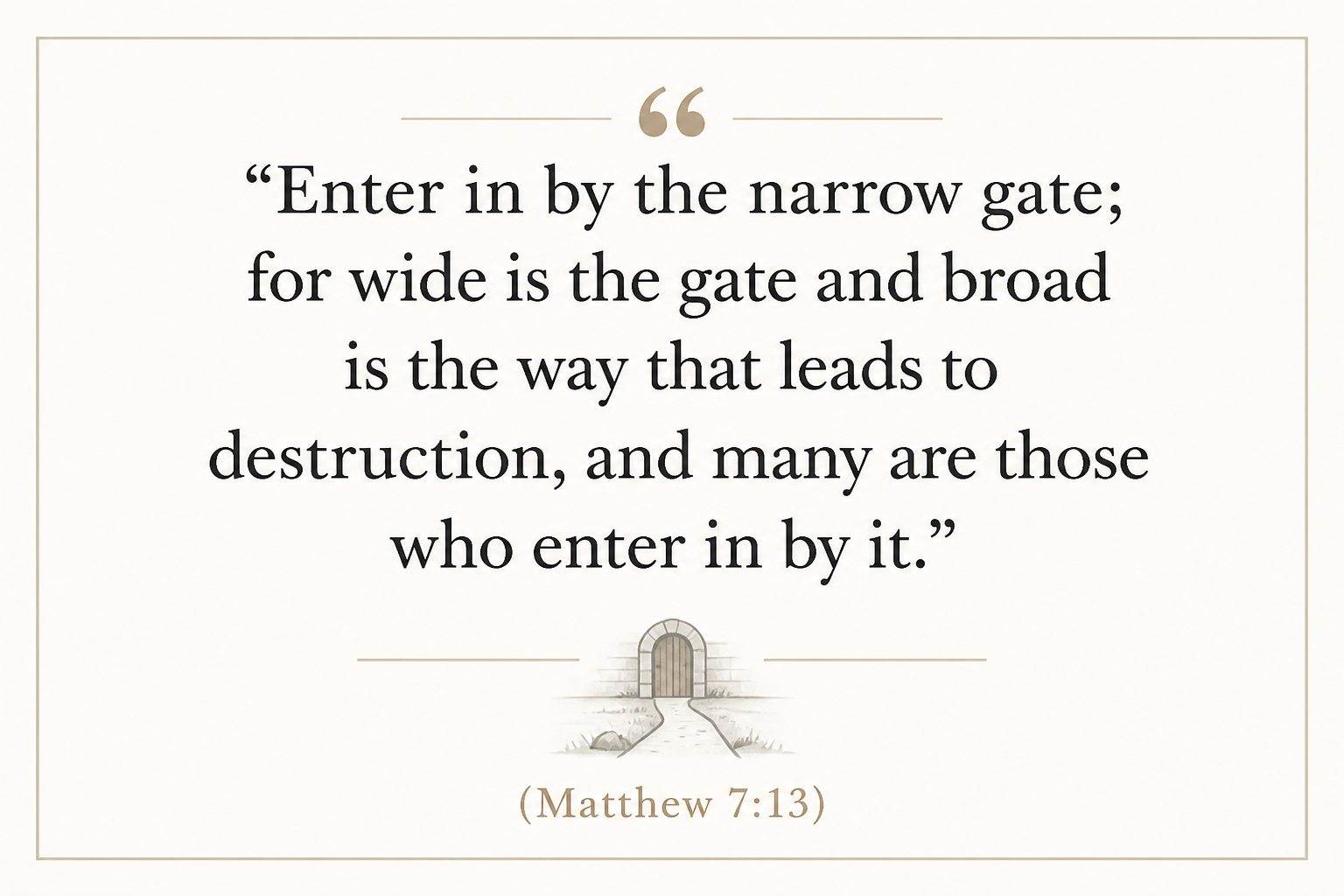
“Enter in by the narrow gate; for wide is the gate and broad is the way that leads to destruction, and many are those who enter in by it.” (Matthew 7:13)
Here στενός qualifies “the … gate,” presenting the first threshold as a tight point of entry. The saying sets that narrow gate against a “wide” gate and a “broad” way, and the contrast is immediately moral and practical: the spacious option is connected to a way “that leads to destruction,” and it is the route “many … enter in by.” Within the sentence, στενός is not an isolated descriptor of physical dimensions; it functions as the opening image in a paired comparison (narrow gate versus wide gate) that introduces the larger paired comparison of routes (broad way versus the other way implied by the initial command). The command “Enter in” makes the adjective press toward decision: a narrow gate is not merely observed; it is chosen as an entry.
How narrow is the gate, and restricted is the way that leads to life! Few are those who find it. (Matthew 7:14)
In this continuation, στενός again modifies “the gate,” but the rhetorical form shifts from command to exclamation: “How narrow is the gate.” The line pairs the narrowness of the gate with the “restricted” character of “the way that leads to life,” tying entry and journey together. στενός thus carries forward the idea that access is limited at the outset; the accompanying description of the way as “restricted” extends the same constricting imagery beyond the gateway into the whole route. The conclusion, “Few are those who find it,” draws a social outcome from that imagery: the narrow gate correlates with scarcity of finders. In this verse, στενός contributes to a picture in which life is reached through an entry that is hard to locate and hard to pass through, reinforcing the theme of selectivity implicit in the earlier contrast with what is “broad.”
“Strive to enter in by the narrow door, for many, I tell you, will seek to enter in and will not be able.” (Luke 13:24)
Luke uses στενός with “door” rather than “gate,” but the scene remains one of entry and access. The central imperative is stronger here: “Strive to enter in,” which frames the narrowness of the door as a reason for exertion. The following clause intensifies the urgency: “many … will seek to enter in and will not be able.” στενός shapes that warning by making the door an image of limited entry: it is a narrow point through which entry is not automatic, even for those who “seek.” The verse also sets up a contrast between two responses to the same entrance: striving that results in entry, and seeking that ends in inability. In this context, the adjective amplifies the idea that access is constrained and contested; the door is not portrayed as wide-open, and the verb “strive” fits the picture of a narrow passage that requires focused effort.
Sense and Usage
Across these sayings, στενός consistently marks an entry point as tightly bounded—either “gate” (Matthew) or “door” (Luke). The imagery is concrete enough to visualize: a narrow opening that limits passage and suggests difficulty. Yet the passages themselves make clear that the word’s force is not confined to architecture; it is used to frame a choice of routes and outcomes.
In Matthew 7:13–14 the narrow gate is part of a twofold contrast: narrow gate versus wide gate, and restricted way versus broad way. στενός works with the surrounding adjectives (“wide,” “broad,” “restricted”) to create a full spatial metaphor for moral direction. The narrow gate is not described alone but in deliberate opposition to what is roomy and popular. The consequences attached to each route—“destruction” on the broad way and “life” on the restricted way—show how the adjective participates in the larger argument: access that feels spacious and easy can nevertheless be disastrous, whereas access that is constricted corresponds to life. The final clauses in both verses connect the spatial contrast to human behavior: “many” enter the broad way; “few” find the narrow gate. στενός thus supports an observation about crowds and scarcity: narrowness is associated with fewer entrants and fewer finders.
Luke 13:24 uses the same core image but presses it into a different exhortation. The narrow door stands behind the command to “strive,” and the following warning that “many … will seek … and will not be able” turns the metaphor into a time-sensitive summons. στενός here is not paired explicitly with “wide” or “broad” alternatives in the same sentence; instead, it stands as the descriptor that makes striving intelligible. The inability of many seekers implies that the narrowness of the entrance corresponds to real limitation, not merely an impression. The verse also distinguishes “seek” from “strive,” implying that mere desire or attempt may fall short where determined effort is demanded.
Viewed together, these occurrences show στενός functioning as an adjective that lends weight to the entrance imagery in teachings about ultimate outcomes. The word’s consistent placement with “gate” or “door” keeps the focus on the threshold: a point of access that is constrained, that divides people into “many” and “few,” and that requires deliberate action—either the decisive choice to “enter in” (Matthew) or the sustained effort to “strive to enter” (Luke).
Imagery
The repeated pictures of a narrow “gate” and a narrow “door” draw attention to the moment of passage: a person stands before an opening that admits some and excludes others. In Matthew, that narrow entrance belongs to a route “that leads to life,” while the wide alternative leads to “destruction”; in Luke, the same kind of entrance becomes the focus of urgent striving amid the sobering prospect that “many … will not be able.” στενός, in these sayings, paints the threshold as tight and demanding, so that the way one approaches it—entering, finding, striving—becomes the decisive issue.
Sources: Lexical data from Strong’s Exhaustive Concordance and the Translators Brief Lexicon of Extended Strongs for Greek (STEPBible, CC BY). Occurrence data from the Translators Amalgamated Greek New Testament (STEPBible, CC BY). Scripture quotations from the World English Bible (public domain).