Exploring the Meaning of Stephanos in Greek
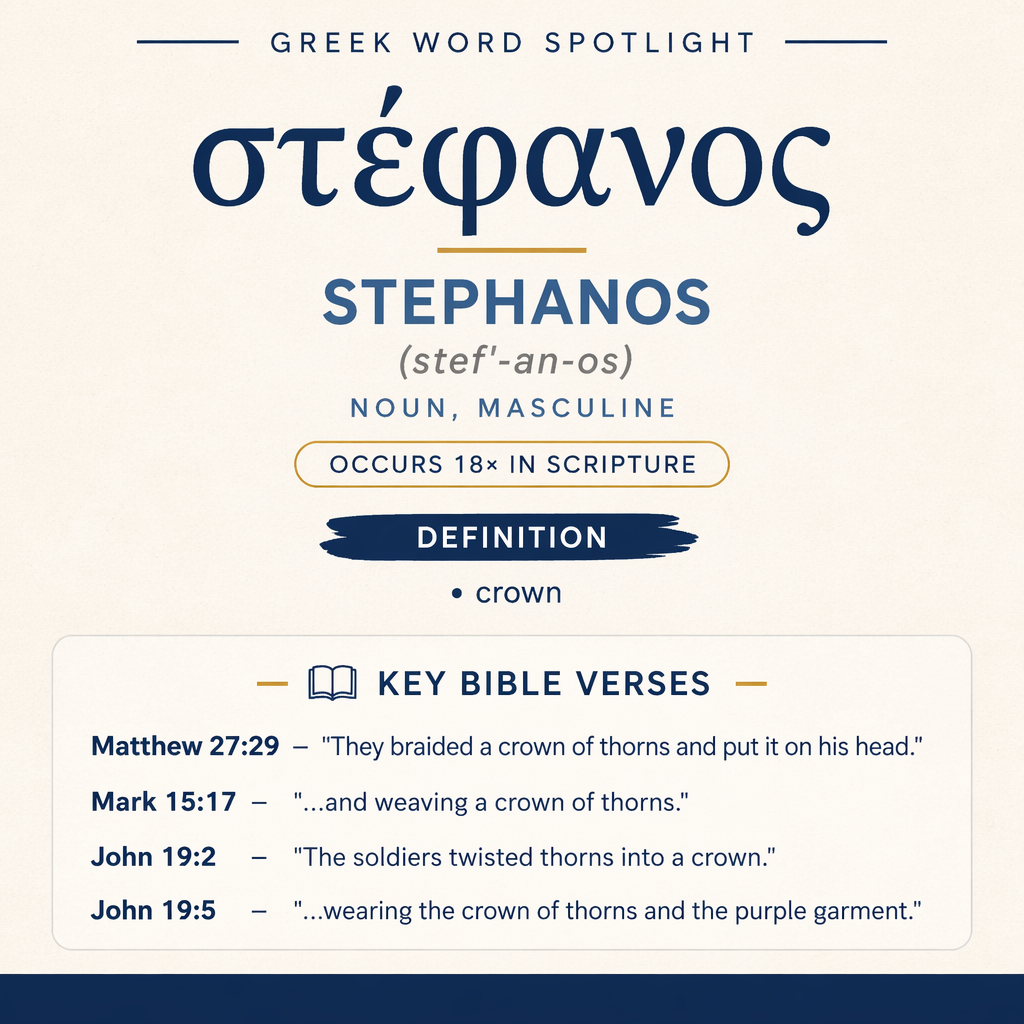
στέφανος means “crown” and appears 18 times in Scripture, including Matthew 27:29, Mark 15:17, John 19:2–5, and 2 Timothy 4:8.
Gospel Scenes
In Matthew 27:29, Mark 15:17, and John 19:2–5, it refers to a crown of thorns placed on Jesus.
Learn More →Crown Imagery
In 1 Corinthians 9:25 it is a corruptible crown, and in 2 Timothy 4:8 it is a crown of righteousness.
Learn More →στέφανος refers to a “crown,” appearing in narratives of Jesus’ suffering, in letters that contrast perishable and enduring reward, and in exhortations that link faithful endurance with promised recompense. Across these passages it can be a physical object placed on a person’s head, a metaphor for what is received or safeguarded, and a relational image for treasured people.
Occurrences
Matthew 27:29: “They braided a crown of thorns and put it on his head, and a reed in his right hand; and they kneeled down before him, and mocked him, saying, “Hail, King of the Jews!””
Here the crown is deliberately fashioned “of thorns” and placed “on his head” as part of a staged imitation of kingship. The surrounding actions—handing him a “reed,” kneeling, and speaking mock acclamation—show the crown functioning as a prop for ridicule, marking him out publicly and physically within their mock ceremony.
Mark 15:17: “They clothed him with purple, and weaving a crown of thorns, they put it on him.”
The crown again accompanies royal imagery (“purple”), but its material (“thorns”) and the act of placing it “on him” highlight humiliation under the guise of honor. The crown’s role is inseparable from the dressing-up scene: it completes an outfit meant to present a distorted picture of enthronement.
John 19:2: “The soldiers twisted thorns into a crown, and put it on his head, and dressed him in a purple garment.”
John emphasizes the soldiers’ crafting process—“twisted thorns”—before the crown is “put…on his head.” In the same breath, the crown is paired with a “purple garment,” reinforcing its visible, public character in the treatment Jesus receives from the soldiers.
John 19:5: “Jesus therefore came out, wearing the crown of thorns and the purple garment. Pilate said to them, “Behold, the man!””
The crown is now something Jesus is “wearing” as he is presented, not merely something momentarily placed. The scene frames the crown as part of what the onlookers are meant to see when Pilate draws attention to him; the crown becomes a sign carried into a public display.
1 Corinthians 9:25: “Every man who strives in the games exercises self-control in all things. Now they do it to receive a corruptible crown, but we an incorruptible.”
στέφανος is used for what is “received” as the outcome of disciplined striving. The comparison between a “corruptible crown” and “an incorruptible” one sets the crown as a symbol of reward, with the passage pressing the contrast between what perishes and what endures.
Philippians 4:1: “Therefore, my brothers, beloved and longed for, my joy and crown, stand firm in the Lord in this way, my beloved.”
Here the crown is not described as something worn or awarded but as a designation applied to people: “my joy and crown.” The term conveys value and honor in relationship; the community addressed is portrayed as what the speaker treasures and boasts in, in a way that motivates the exhortation to “stand firm.”
1 Thessalonians 2:19: “For what is our hope, or joy, or crown of rejoicing? Isn’t it even you, before our Lord Jesus at his coming?”
The crown is defined by its setting and emotion: “crown of rejoicing” linked with “hope” and “joy.” The text explicitly identifies the Thessalonian believers as that crown “before our Lord Jesus at his coming,” so the crown image carries the idea of celebratory honor in an anticipated future moment of appearance.
2 Timothy 4:8: “From now on, the crown of righteousness is stored up for me, which the Lord, the righteous judge, will give to me on that day; and not to me only, but also to all those who have loved his appearing.”
In this verse the crown is described as “stored up” and as something the Lord “will give…on that day.” The phrase “crown of righteousness” ties the crown to a quality named in the text, and the giving is judicially framed: “the Lord, the righteous judge.” The crown is also widened beyond the speaker to “all those who have loved his appearing,” making it a shared promised gift.
James 1:12: “Blessed is a person who endures temptation, for when he has been approved, he will receive the crown of life, which the Lord promised to those who love him.”
The crown functions as the stated outcome of endurance: the one who “endures temptation” and is “approved” will “receive the crown of life.” The crown is anchored in promise (“which the Lord promised”) and linked to love for the Lord (“to those who love him”), joining present testing to a promised future reception.
1 Peter 5:4: “When the chief Shepherd is revealed, you will receive the crown of glory that doesn’t fade away.”
The crown is tied to revelation—“When the chief Shepherd is revealed”—and to receipt—“you will receive.” The description “that doesn’t fade away” highlights durability, portraying the crown as lasting honor associated with the “glory” named in the phrase.
Revelation 2:10: “Don’t be afraid of the things which you are about to suffer. Behold, the devil is about to throw some of you into prison, that you may be tested; and you will have oppression for ten days. Be faithful to death, and I will give you the crown of life.”
The crown is placed at the end of a direct call to courage and fidelity under suffering. Imprisonment, testing, and a defined period of “oppression for ten days” set the pressure; against that backdrop, “Be faithful to death” is matched with a promise of personal bestowal: “I will give you the crown of life.” The crown thus stands as the promised counterweight to fear and affliction.
Revelation 3:11: “I am coming quickly! Hold firmly that which you have, so that no one takes your crown.”
Here the crown is something that can be “taken,” and the imperative “Hold firmly” is grounded in the risk of loss. The crown functions as a possession connected with perseverance, and the coming “quickly” supplies urgency: steadfast holding is portrayed as the means by which the crown remains secure.

Sense and Usage
Across these texts, a crown is consistently an item that marks a person in a way others can see and respond to, whether in derision or in honor. In the passion narratives (Matthew 27:29; Mark 15:17; John 19:2, 19:5) the crown is explicitly made “of thorns,” placed on Jesus’ head, and displayed alongside royal coloring (“purple”). The repeated combination of mock gestures and royal costume shows how the crown’s outward sign can be pressed into service for a purpose opposite to genuine honor: it becomes a tool for public shaming while still retaining the recognizable form of a crown.
In the letters, the crown image widens beyond a literal object to the idea of a conferred outcome. 1 Corinthians 9:25 uses the crown as the goal of athletic striving, with the crucial distinction between what is “corruptible” and what is “incorruptible.” Several passages describe receiving the crown in relation to endurance and future disclosure: it is “stored up” to be “given…on that day” (2 Timothy 4:8), “promised” and then “received” after approval (James 1:12), and received “when the chief Shepherd is revealed” (1 Peter 5:4). Revelation similarly places the crown at the end of testing and suffering, directly promised by the speaker who commands faithfulness (Revelation 2:10). Even where the crown is treated as already possessed, it is presented as something that must be guarded: “so that no one takes your crown” (Revelation 3:11). In these uses the crown is a compact image for reward, recognition, and the outcome of steadfastness.
Two occurrences apply crown language to persons rather than to an object of award: “my joy and crown” (Philippians 4:1) and “crown of rejoicing…even you” (1 Thessalonians 2:19). In these, the crown expresses relational pride and joy; it is not merely what one receives but whom one cherishes. The crown is located “before our Lord Jesus at his coming” (1 Thessalonians 2:19), placing that relational rejoicing within a forward-looking horizon that aligns with other passages where the crown is linked to future giving and revelation.
Imagery
The set of passages holds two strikingly different scenes together: a crown of thorns used in mockery and public display (Matthew 27:29; John 19:5), and crowns spoken of as durable gifts given by the Lord in response to faithful endurance (James 1:12; Revelation 2:10; 1 Peter 5:4). The same concrete image—something that rests upon a head and signifies status—can thus frame both humiliation and promised honor, depending on who places it, why it is worn, and what future it points toward.
Sources: Lexical data from Strong’s Exhaustive Concordance and the Translators Brief Lexicon of Extended Strongs for Greek (STEPBible, CC BY). Occurrence data from the Translators Amalgamated Greek New Testament (STEPBible, CC BY). Scripture quotations from the World English Bible (public domain).