Exploring the Meaning of Speira in Greek
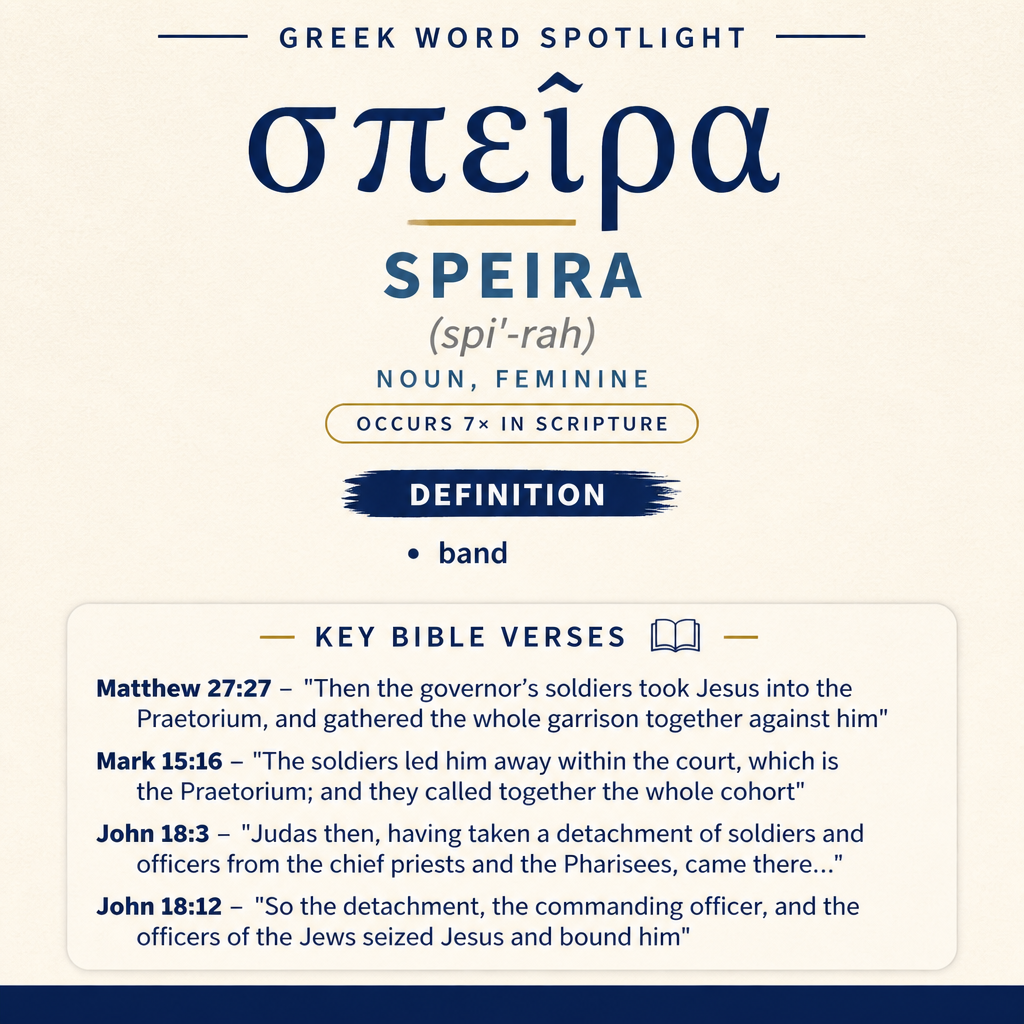
σπεῖρα (Speira) means “band” and occurs 7 times in Scripture, including Matthew 27:27; Mark 15:16; John 18:3, 18:12; and Acts.
Core Meaning
σπεῖρα is defined as “band.” In the listed passages it refers to an organized group of soldiers.
Learn More →Gospel Context
In Matthew 27:27 and Mark 15:16, soldiers gather as a whole garrison/cohort against Jesus in the Praetorium. In John 18:3 and 18:12, a detachment seizes and binds Jesus.
Learn More →Acts Context
In Acts 10:1, Cornelius is a centurion of the Italian Regiment. In Acts 21:31 and Acts 27:1, the word is used of a regiment connected with a commanding officer/centurion.
Learn More →σπεῖρα means “band,” a term used in the Gospels and Acts for an organized body of soldiers acting together under authority. In these passages it appears in scenes ranging from Jesus’ arrest and mockery to Roman command structures encountered by Cornelius, Paul, and others.
Occurrences
“Then the governor’s soldiers took Jesus into the Praetorium, and gathered the whole garrison together against him.” (Matthew 27:27)
Here σπεῖρα frames the action as more than a few soldiers improvising. The wording “gathered the whole garrison together” presents a coordinated band assembled as a unit “against him,” intensifying the imbalance between a solitary prisoner and a consolidated military group within the Praetorium. The scene emphasizes collective action: the soldiers function not as individuals but as a gathered body.
“The soldiers led him away within the court, which is the Praetorium; and they called together the whole cohort.” (Mark 15:16)
In Mark, the movement “within the court” and the act of calling “together the whole cohort” again highlight σπεῖρα as a band summoned into a single space for a single purpose. The word contributes the sense of a formal assembly of soldiers—an organized unit rather than an accidental crowd—convened in the governor’s environment where such a band would naturally be stationed and deployed.
“Judas then, having taken a detachment of soldiers and officers from the chief priests and the Pharisees, came there with lanterns, torches, and weapons.” (John 18:3)
σπεῖρα appears as a “detachment of soldiers” accompanying Judas, and the verse further adds “officers from the chief priests and the Pharisees.” The band’s presence supplies physical force to the mission; the inventory of “lanterns, torches, and weapons” depicts prepared, organized action carried out by a group equipped for control and confrontation. σπεῖρα thus colors the approach to Jesus as an operation backed by armed manpower, not merely an informant leading the way.
“So the detachment, the commanding officer, and the officers of the Jews seized Jesus and bound him,” (John 18:12)
This verse places σπεῖρα alongside a chain of personnel: “the detachment, the commanding officer, and the officers of the Jews.” The band is one component in a layered arresting party. By coupling the band with “the commanding officer,” the text portrays the seizure as disciplined and supervised; the binding of Jesus is executed not by a single hand but through coordinated participation. σπεῖρα contributes the corporate weight behind “seized” and “bound,” making the restraint of Jesus a group act under command.
“Now there was a certain man in Caesarea, Cornelius by name, a centurion of what was called the Italian Regiment,” (Acts 10:1)
Here σπεῖρα anchors Cornelius’s identity within a military band: he is a centurion belonging to a regiment that is “called the Italian Regiment.” The word functions as an organizational label, locating Cornelius within a recognized body of troops. It conveys that his rank and role are not abstract titles but positions within a structured band known by a specific designation.
“As they were trying to kill him, news came up to the commanding officer of the regiment that all Jerusalem was in an uproar.” (Acts 21:31)
In this violent public moment, σπεῖρα appears in the phrase “commanding officer of the regiment,” identifying the recipient of the report. The band is the military framework through which order responds to disorder: “news came up” to the officer because he stands over an organized body capable of intervention. σπεῖρα therefore supplies the administrative and operational context for the officer’s awareness and potential action amid the citywide “uproar.”
“When it was determined that we should sail for Italy, they delivered Paul and certain other prisoners to a centurion named Julius, of the Augustan band.” (Acts 27:1)
σπεῖρα again identifies a centurion’s affiliation—Julius is “of the Augustan band.” The word contributes to the logistics of custody and transport: prisoners are “delivered” into the hands of an officer whose authority is rooted in a defined military band. The designation marks Julius as part of a recognized unit, which in turn underwrites the reliability and responsibility attached to him in overseeing prisoners on an imperial journey.

Sense and Usage
Across these seven passages, σπεῖρα consistently denotes a band in the form of an organized military body acting as a unit. In the Passion narratives (Matthew 27:27; Mark 15:16; John 18:3, 12), the band is visible and active: it gathers, comes equipped, seizes, and binds. The repeated emphasis on collective mobilization (“gathered the whole garrison together,” “called together the whole cohort,” “having taken a detachment”) shows how σπεῖρα can heighten the portrayal of overwhelming force. The band is not merely present; it is assembled and directed, and this corporate presence shapes the emotional and narrative pressure of the scene.
In Acts, σπεῖρα primarily functions as an identifier within Roman military structure (Acts 10:1; 21:31; 27:1). Cornelius and Julius are each introduced or described through their relationship to a named band (“Italian Regiment,” “Augustan band”), indicating that σπεῖρα can carry the sense of an established unit with a recognized title. Acts 21:31 uses the term in a moment of civic instability, where the band’s commanding officer becomes a key node in the flow of information. In these contexts, σπεῖρα provides the framework for understanding authority: centurions and commanding officers are not free-floating enforcers but officers connected to a band that can be tasked, alerted, or deployed.
In both sets of passages, σπεῖρα regularly appears alongside terms that emphasize hierarchy and coordination. John 18:12 explicitly links the band with “the commanding officer,” and Acts 21:31 similarly features a “commanding officer of the regiment.” This pattern keeps σπεῖρα from being heard as an unstructured crowd; it is a band that belongs to a system of command. Even when the band is narrated in motion and action (coming with equipment, binding a prisoner), the surrounding language suggests order, leadership, and role differentiation.
The word also helps unify diverse scenes under a common social reality: armed force is carried by groups. Whether it is the governor’s soldiers assembling in the Praetorium, an arrest party arriving with light and weapons at night, or a centurion supervising prisoners bound for Italy, σπεῖρα provides a consistent way of depicting how power and custody are enacted through a band rather than by isolated individuals.
Imagery
The imagery tied to σπεῖρα in these passages is concrete and weighty: a band gathered in an official courtyard, a detachment moving with “lanterns, torches, and weapons,” and a chain of custody in which prisoners are “delivered” to an officer of a named band. The word repeatedly brings into view the collective, organized presence of soldiers—an assembled body that can surround, seize, bind, report, and transport.
Sources: Lexical data from Strong’s Exhaustive Concordance and the Translators Brief Lexicon of Extended Strongs for Greek (STEPBible, CC BY). Occurrence data from the Translators Amalgamated Greek New Testament (STEPBible, CC BY). Scripture quotations from the World English Bible (public domain).