
Exploring the Meaning of Spendo in Greek
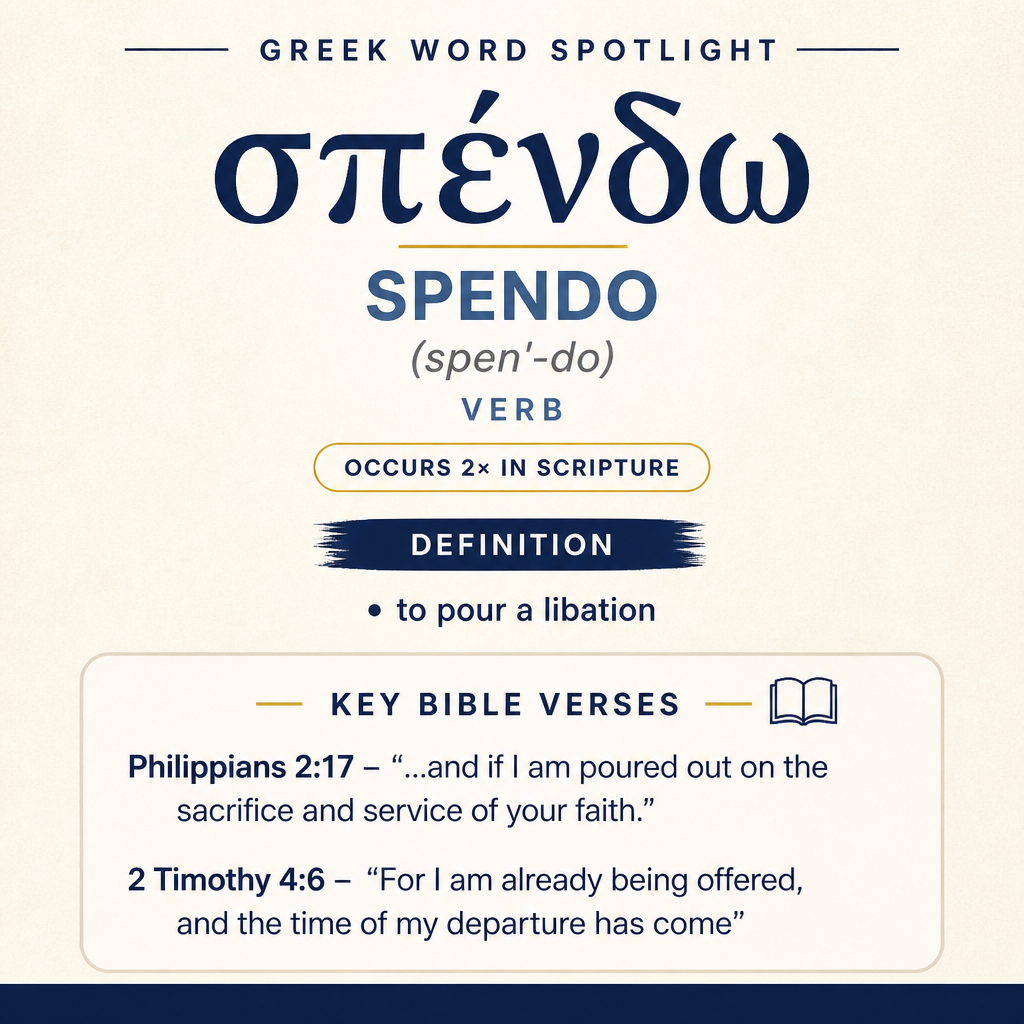
σπένδω means “to pour a libation” and appears twice in Scripture: Philippians 2:17 and 2 Timothy 4:6.
New Testament Occurrences
This verb occurs 2 times in Scripture: Philippians 2:17 and 2 Timothy 4:6.
Learn More →Verse Contexts
In Philippians 2:17, Paul speaks of being “poured out” on the sacrifice and service of their faith. In 2 Timothy 4:6, he says he is already being offered and his departure has come.
Learn More →σπένδω speaks of pouring a libation. It appears in two Pauline passages where the verb is used to frame personal self-giving in sacrificial terms (Philippians 2:17; 2 Timothy 4:6).
Occurrences
“Yes, and if I am poured out on the sacrifice and service of your faith, I rejoice, and rejoice with you all.” (Philippians 2:17)
Here σπένδω supplies the vivid action-image that ties Paul’s personal cost to a larger offering already in view: “the sacrifice and service of your faith.” The clause “if I am poured out” sets Paul’s potential suffering in a conditional frame, as something that may accompany what is already happening among the Philippians—namely, their faith expressed in costly devotion. The verb’s libation imagery places Paul’s “poured out” contribution alongside, and in relation to, their “sacrifice and service,” as though his own life is an added outpouring that lands “on” (that is, in connection with) what their faith is already presenting. In the immediate sentence, the emotional tone is not grim but celebratory: “I rejoice, and rejoice with you all.” σπένδω therefore functions not merely as a description of loss, but as the chosen metaphor that allows Paul to describe that loss as an offering poured in the course of worshipful service, thereby making rejoicing a coherent response within the same breath.

“For I am already being offered, and the time of my departure has come.” (2 Timothy 4:6)
In 2 Timothy 4:6 the verb stands at the front of a final, time-marked declaration. The line “I am already being offered” portrays the action as present and underway, not merely possible. σπένδω here bears the weight of imminence: Paul speaks as though the libation is in progress. The second clause, “and the time of my departure has come,” places this outpouring at the edge of transition—an offering that accompanies the closing of one stage of life and the approach of departure. Within the sentence, σπένδω is the verb that turns the approaching end into the language of cultic giving: the nearing “departure” is framed alongside an offering. The effect is to cast the moment not only as an ending but as a deliberate act described through the imagery of libation-pouring.

Sense and Usage
As a verb of libation, σπένδω brings a concrete ritual action—pouring out—to bear on experiences Paul describes as costly and definitive. In both occurrences, the verb is used in the first person (“I am poured out…,” “I am already being offered…”), so the imagery is not abstract but personally applied: the subject is Paul himself. The libation picture naturally highlights two features that are prominent in the way these sentences are built.
First, the verb’s action is directional and distributive: what is poured is not retained but released. In Philippians 2:17, that release is expressed with a relational orientation—“poured out on the sacrifice and service of your faith.” The phrase “on the sacrifice and service” keeps the focus on the Philippians’ faith as already active in service, and it places Paul’s poured-outness in close attachment to that existing offering. The verb thus helps express participation: Paul’s life is not described as a separate project but as an outpouring connected to their faithful service. The same verb, when used in 2 Timothy 4:6, is not anchored to the Philippians’ “sacrifice and service,” but to the timing of Paul’s own end: “already” and “the time…has come.” There the imagery chiefly underscores completion-in-progress—an offering that is being poured as the moment of departure arrives.
Second, σπένδω carries a sacrificial register without requiring a detailed explanation of ritual. In Philippians 2:17 the surrounding nouns already name “sacrifice” and “service,” so the libation image fits naturally as an additional sacrificial act. The verb intensifies the sacrificial atmosphere by adding motion: sacrifice is not only present as a category (“sacrifice and service”) but enacted as an outpouring. In 2 Timothy 4:6, where “sacrifice” is not explicitly named, the verb itself supplies that register. The sentence remains short and stark, and σπένδω is the chief metaphorical vehicle that allows “departure” to be spoken of alongside worshipful giving rather than only as a biographical fact.
The two contexts also show how σπένδω can operate with different degrees of contingency. Philippians 2:17 is framed with “if,” leaving room for a hypothetical or prospective outpouring. The conditional does not weaken the metaphor; instead, it reveals Paul’s readiness to interpret possible suffering in the same sacrificial terms as actual suffering. By contrast, 2 Timothy 4:6 uses “already,” signaling that the offering is not merely contemplated but happening. Taken together, these two uses show σπένδω functioning as a stable image for self-offering that can be applied both to what may come and to what has arrived.
Imagery in Context
In these passages, σπένδω evokes the picture of an offering poured out, and that picture shapes the emotional and rhetorical force of each line. In Philippians 2:17 the libation imagery supports a surprising pairing: costly self-giving and shared joy—“I rejoice, and rejoice with you all.” In 2 Timothy 4:6 the same imagery gives a measured, solemn clarity to a closing moment—“the time of my departure has come”—by presenting it as an offering already underway rather than an event merely endured.
Sources: Lexical data from Strong’s Exhaustive Concordance and the Translators Brief Lexicon of Extended Strongs for Greek (STEPBible, CC BY). Occurrence data from the Translators Amalgamated Greek New Testament (STEPBible, CC BY). Scripture quotations from the World English Bible (public domain).




