
Exploring the Meaning of Speiro in Greek
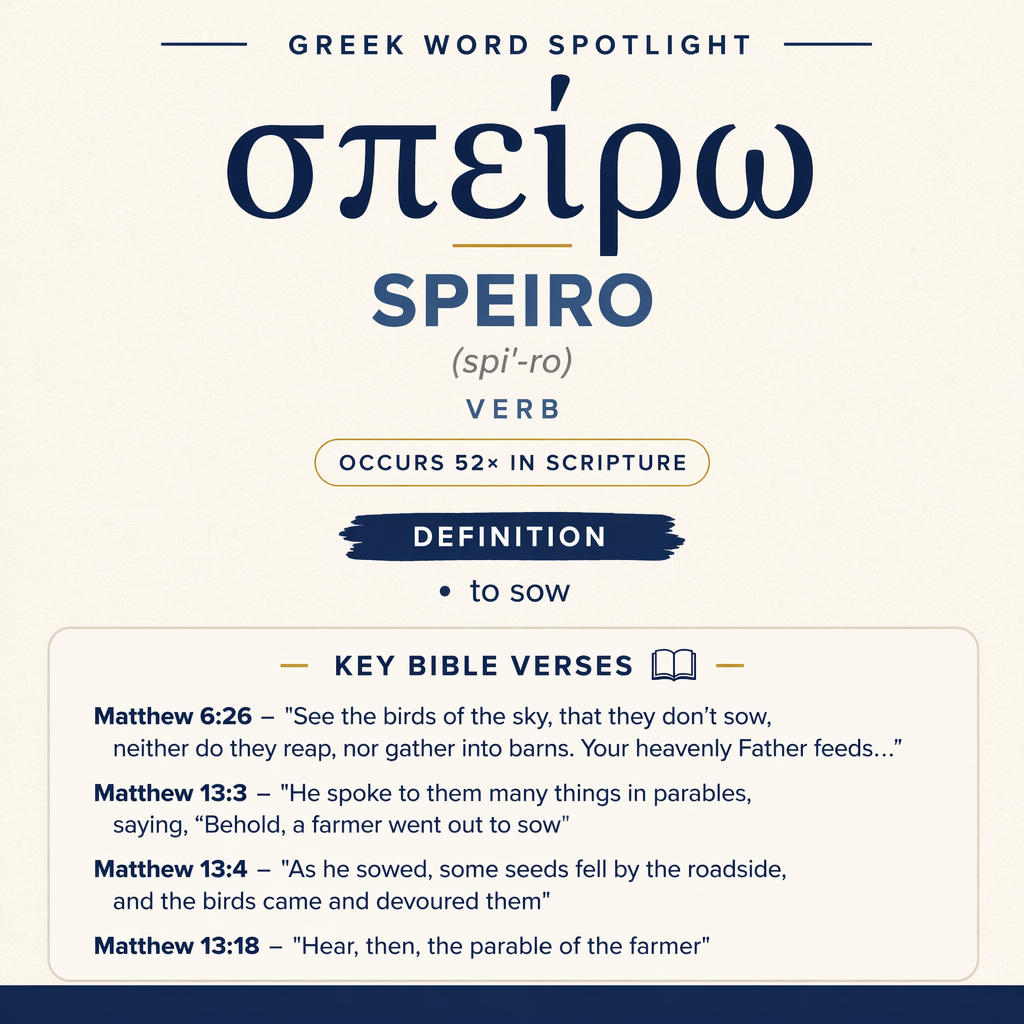
σπείρω (Speiro) means “to sow” and appears 52 times in Scripture, including Matthew 6:26 and Matthew 13:3–4, 18–20, 22–23.
Core Meaning
σπείρω means “to sow.” In Matthew 13, it describes a farmer sowing seed.
Learn More →Gospel Illustrations
In Matthew 6:26, birds “don’t sow” or reap, yet the Father feeds them. In Matthew 13:3–4, sowing results in seed falling in different places.
Learn More →Parable Explanation
In Matthew 13:19–20, 22–23, what is “sown” is connected with hearing the word of the Kingdom. The outcomes differ: snatched away, received with joy, choked, or bearing fruit.
Learn More →σπείρω means “to sow,” using the familiar act of scattering seed to frame both everyday observation and Jesus’ parables about the Kingdom. In the passages quoted here, it moves between literal farming and figurative speech about what is “sown” in a person’s heart and what grows—or fails to grow—afterward.
Occurrences
“See the birds of the sky, that they don’t sow, neither do they reap, nor gather into barns. Your heavenly Father feeds them. Aren’t you of much more value than they?” (Matthew 6:26)
Here σπείρω marks an activity birds do not perform. The verb belongs to a chain of agricultural tasks—sowing, reaping, gathering into barns—that humans normally do to secure food. By pointing out the birds’ lack of sowing, the saying highlights the contrast between ordinary means of provision and the Father’s care that “feeds them” without their participation in that cycle.
“He spoke to them many things in parables, saying, “Behold, a farmer went out to sow.” (Matthew 13:3)
σπείρω sets the parable in motion with a simple, concrete action: a farmer goes out for the purpose of sowing. The verb establishes the farmer’s intent and begins a sequence in which outcomes depend on where the seed lands. The picture assumes purposeful scattering as the initiating act that will later be evaluated by results.
“As he sowed, some seeds fell by the roadside, and the birds came and devoured them.” (Matthew 13:4)
In this scene σπείρω is the farmer’s ongoing activity (“As he sowed”), during which not all seed reaches a receptive place. The verb provides the background for the contrast between the farmer’s action and the immediate loss of “some seeds” to the birds. Sowing is shown as an act whose effects can be interrupted before any growth begins.
““Hear, then, the parable of the farmer.” (Matthew 13:18)
This call to “hear” introduces the explanation of the sowing story. Though σπείρω is not repeated in this sentence, the parable’s central action—sowing—remains the interpretive anchor for what follows, guiding the listener to connect the farmer’s action with the realities described next.
“When anyone hears the word of the Kingdom, and doesn’t understand it, the evil one comes, and snatches away that which has been sown in his heart. This is what was sown by the roadside.” (Matthew 13:19)
σπείρω is applied to an inward location: something has been “sown in his heart.” The verb carries the parable’s agricultural action into the domain of hearing “the word of the Kingdom.” The explanation links the “roadside” setting to a person who hears without understanding, where the “evil one” removes what was sown before it can take hold.
“What was sown on the rocky places, this is he who hears the word, and immediately with joy receives it;” (Matthew 13:20)
Here the verb remains in the passive (“What was sown”), keeping attention on the placement of the seed rather than the sower. The “rocky places” correspond to a hearer who receives “immediately with joy.” σπείρω thus frames a kind of reception that begins positively, yet is defined by the nature of the ground where the sowing occurs.
“What was sown among the thorns, this is he who hears the word, but the cares of this age and the deceitfulness of riches choke the word, and he becomes unfruitful.” (Matthew 13:22)
Again “What was sown” points to the seed’s placement “among the thorns.” σπείρω supplies the image for a hearing of “the word” that is later impeded: competing pressures (“the cares of this age and the deceitfulness of riches”) “choke the word.” The result is “unfruitful,” so the sowing is not denied, but its intended outcome is blocked.
“What was sown on the good ground, this is he who hears the word, and understands it, who most certainly bears fruit, and produces, some one hundred times as much, some sixty, and some thirty.” (Matthew 13:23)
σπείρω culminates in the best-case scenario: sowing “on the good ground.” The verb supports a direct link between “hears… and understands” and the agricultural outcome of bearing fruit and producing in differing measures. The varying yields (“one hundred… sixty… thirty”) show that sowing can succeed abundantly, yet not identically in every case, even within “good ground.”
“He set another parable before them, saying, “The Kingdom of Heaven is like a man who sowed good seed in his field,” (Matthew 13:24)
σπείρω introduces a new parable with a specific object: “good seed.” The action is located “in his field,” emphasizing ownership and intention. By identifying the sowing as the placement of “good seed,” the verb underlines that what is introduced into the field is not accidental; the problem to be addressed in the parable will not arise from a defective sowing.
“The servants of the householder came and said to him, ‘Sir, didn’t you sow good seed in your field? Where did these darnel weeds come from?’” (Matthew 13:27)
The servants appeal to the householder’s earlier sowing as a point of evidence: “didn’t you sow good seed in your field?” σπείρω functions as a memory of deliberate action that should have produced a corresponding result. The presence of “darnel weeds” prompts the question of origin; the verb’s implication is that the householder’s sowing was not the source of the weeds, since what he sowed was “good seed.”
“He set another parable before them, saying, “The Kingdom of Heaven is like a grain of mustard seed, which a man took, and sowed in his field;” (Matthew 13:31)
σπείρω here connects to a small, specific item: “a grain of mustard seed.” The man “took” it and “sowed” it “in his field,” presenting sowing as a decisive placing of even a tiny seed into the earth. The verb’s role is to locate the start of what the parable will develop: the Kingdom is compared to something that begins with a modest sowing.
“He answered them, “He who sows the good seed is the Son of Man,” (Matthew 13:37)
σπείρω becomes part of an identification: “He who sows the good seed is the Son of Man.” The verb defines the Son of Man by the act of sowing, and the object remains “the good seed.” In this explanatory statement, sowing is not merely a farmer’s task but a key action within the parable’s meaning, assigning responsibility for the introduction of the good seed.

Sense and Usage
Across these passages σπείρω consistently evokes the initiating act of placing seed so that an outcome may follow. In Matthew 6:26, the verb appears in a negative comparison: birds “don’t sow,” which frames sowing as a normal human strategy for provision. The parables in Matthew 13 then use the same action as a stable reference point while the focus shifts to what happens after sowing—loss, reception, choking, and fruitfulness.
The explanations of the first parable apply the verb in passive forms (“that which has been sown,” “What was sown”), which keeps attention on the condition of the “ground” and the subsequent response rather than on the mechanics of the sower’s hand. In those explanations, sowing functions as an image for the placement of “the word of the Kingdom” in the “heart” (Matthew 13:19). The verb’s agricultural sense supplies a concrete way to speak about hearing: the same “word” can be present in different hearers, yet the results diverge because understanding, joy, competing pressures, and fruit-bearing differ. Sowing is therefore depicted as a real beginning, but not as a guarantee of harvest.
In the parable of the field, σπείρω is paired with the quality of what is sown (“good seed,” Matthew 13:24, 13:27, 13:37). That pairing sets up a moral clarity within the story: the sower’s action is good, and the field’s later complication raises questions of origin. The servant’s question (“didn’t you sow good seed…?”) treats sowing as traceable and accountable—what is present in the field ought to correspond to what was sown there. Finally, the mustard seed parable keeps the action simple and decisive: a man “took, and sowed” a single small seed (Matthew 13:31), spotlighting sowing as the moment that begins what will later be recognized as much larger than its starting point.
Imagery
σπείρω carries field-and-seed imagery that moves easily between the visible world and the inner life. The same verb that describes a farmer scattering seed also describes something “sown in his heart” (Matthew 13:19), so the pictures of roadside, rocky places, thorns, and good ground become ways of speaking about hearing, understanding, pressure, and fruitfulness. Even where sowing is absent—birds that “don’t sow” (Matthew 6:26)—the verb still conjures the ordinary labor by which people expect to be fed, making the parables’ agricultural scenes feel like grounded, everyday experience.
Sources: Lexical data from Strong’s Exhaustive Concordance and the Translators Brief Lexicon of Extended Strongs for Greek (STEPBible, CC BY). Occurrence data from the Translators Amalgamated Greek New Testament (STEPBible, CC BY). Scripture quotations from the World English Bible (public domain).




