
Exploring the Meaning of Panourgos in Greek
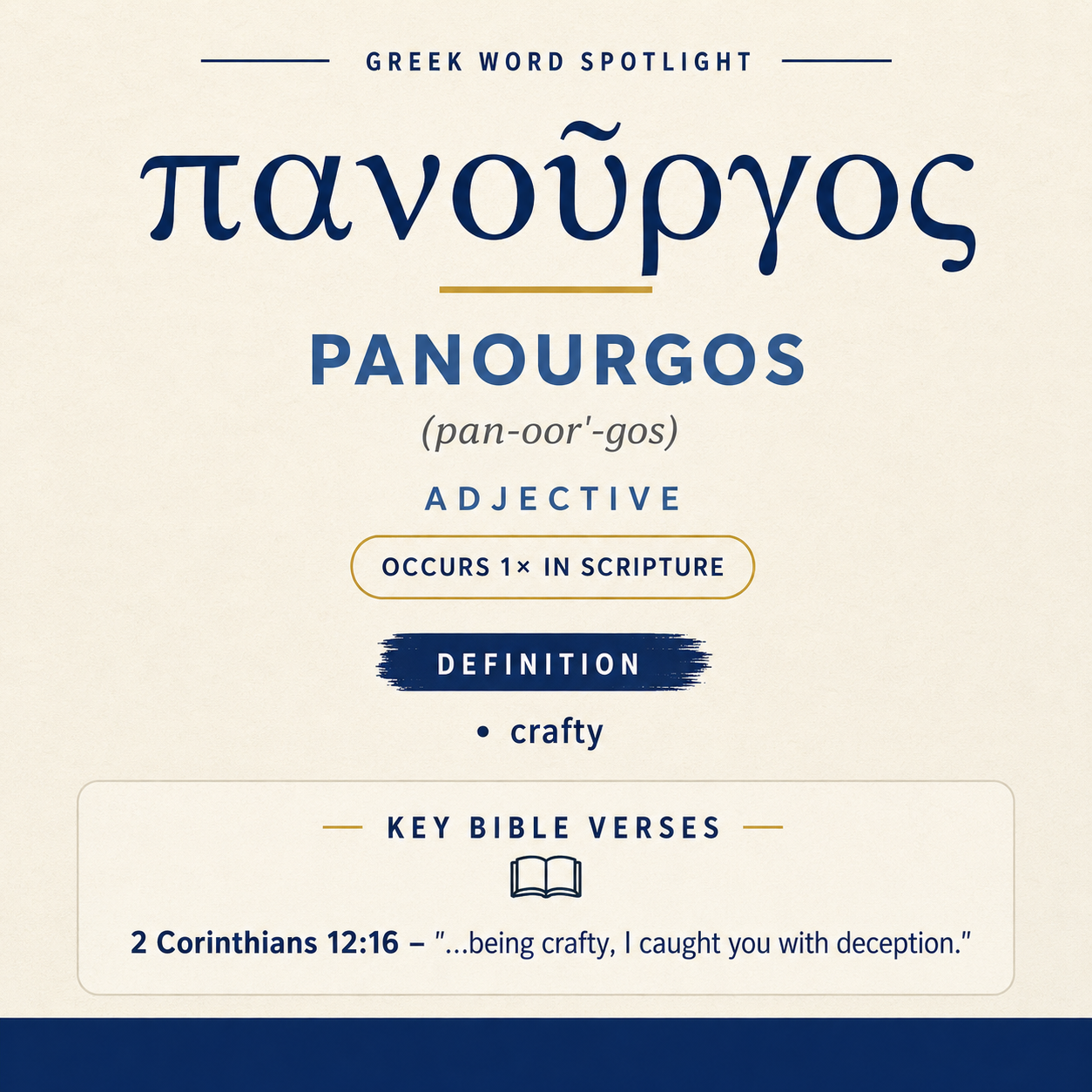
πανοῦργος means “crafty” and appears once in Scripture, in 2 Corinthians 12:16.
Verse Context
In 2 Corinthians 12:16, it is used in the line: “But, being crafty, I caught you with deception.”
Learn More →πανοῦργος describes someone as “crafty,” and it appears once in the New Testament, in Paul’s defense of his conduct toward the Corinthians. In that verse it is placed inside a quoted accusation, paired with the language of deception.
Root and Related Words
πανοῦργος is connected with πᾶς (pas), “all” (Strong’s G3956), and ἔργον (ergon), “work” (Strong’s G2041). The combination of these related elements frames the adjective as a descriptor formed from the ideas of “all” and “work,” providing the word’s inner shape as it functions in discourse.

Occurrences
“Even so, I myself didn’t burden you. “But, being crafty, I caught you with deception.”” (2 Corinthians 12:16)
In 2 Corinthians 12:16, πανοῦργος appears within a sharply worded line set in quotation marks: “But, being crafty, I caught you with deception.” The immediate setting is a dispute about Paul’s conduct—he begins by affirming, “I myself didn’t burden you,” and then turns to the charge that, despite that lack of burden, he acted with calculated skill to trap them. The adjective supplies the character assessment that makes the accusation plausible in its own frame: the speaker is portrayed not as openly oppressive, but as subtle and strategically effective.

The wording that follows (“I caught you with deception”) gives the concrete action associated with the characterization. The accusation does not stop at labeling him; it depicts an outcome—being “caught”—and a means—“with deception.” Within that accusation, πανοῦργος functions as the trait that explains how such “catching” could occur without “burdening” them. In other words, the charge implies a method that succeeds precisely because it does not look like a burden: the alleged craftiness is presented as the hidden mechanism behind an apparently gentle approach.
The verse also shows πανοῦργος operating as a contested description. Paul’s statement, “Even so,” links the two clauses and sets up a tension: one clause asserts restraint (“didn’t burden you”), while the quoted line asserts manipulative intent (“being crafty…with deception”). The adjective therefore participates in a rhetorical contrast between outward practice and inward motive. In the logic of the accusation, the absence of burden is reinterpreted not as generosity but as strategy; “crafty” supplies that reinterpretation.
Sense and Usage
The single occurrence provides a focused picture of how “crafty” works as a moral and relational descriptor. It is not used here as praise for ingenuity; it belongs to an allegation in which craftiness is inseparable from “deception.” The verse places the word in an ethical register: craftiness is not merely cleverness, but cleverness aimed at securing an advantage over others, especially through concealment.
Because the line is cast as quoted speech, the word also demonstrates how such a descriptor can be used as a weapon in conflict. “Crafty” is not offered as a neutral analysis but as a framing device: it invites the audience to reread the speaker’s prior actions (specifically, not burdening them) as a calculated tactic. In this way, πανοῦργος shows the power of character language in communal disputes: it assigns an inner quality to a person that is meant to make certain interpretations of events feel inevitable.
The immediate collocation with “caught” adds another nuance to the usage. The accusation is not that Paul merely spoke deceptively, but that he “caught” them—language of capture—using deception as the instrument. In that picture, “crafty” is the quality of the captor: the one who can set a trap or arrange circumstances so that others are taken in. The adjective thus supports a scenario in which relationships are treated as contests and persuasion as entrapment.
At the same time, the verse shows that the accusation depends on a paradox: a leader who “didn’t burden” them is accused of craftiness. This indicates that, in the social imagination reflected by the quotation, craftiness can be alleged precisely where actions appear restrained or considerate, as if gentleness itself could be recast as a tactic. The word therefore functions in a suspicious reading of motives, where benevolent-looking behavior becomes evidence of a hidden plan.
Since πανοῦργος appears only here, its attested New Testament usage is tightly bound to this polemical setting. The sense of “crafty” is not developed across multiple contexts; instead, it is anchored to one scene in which the word is explicated by its companion terms in the same sentence: deception as the means, and being “caught” as the result.
Imagery
The verse’s imagery is vivid and concrete: someone “caught” through “deception.” Within that picture, πανοῦργος supplies the implied posture of the deceiver—alert, calculating, and able to secure capture without overt force. The word’s effect in the passage is to make deception feel intentional and skilled, not accidental, and to cast the accused party’s relationship with the community in the terms of a trap rather than trust.
Sources: Lexical data from Strong’s Exhaustive Concordance and the Translators Brief Lexicon of Extended Strongs for Greek (STEPBible, CC BY). Occurrence data from the Translators Amalgamated Greek New Testament (STEPBible, CC BY). Scripture quotations from the World English Bible (public domain).




