
Exploring the Meaning of Panoiki in Greek
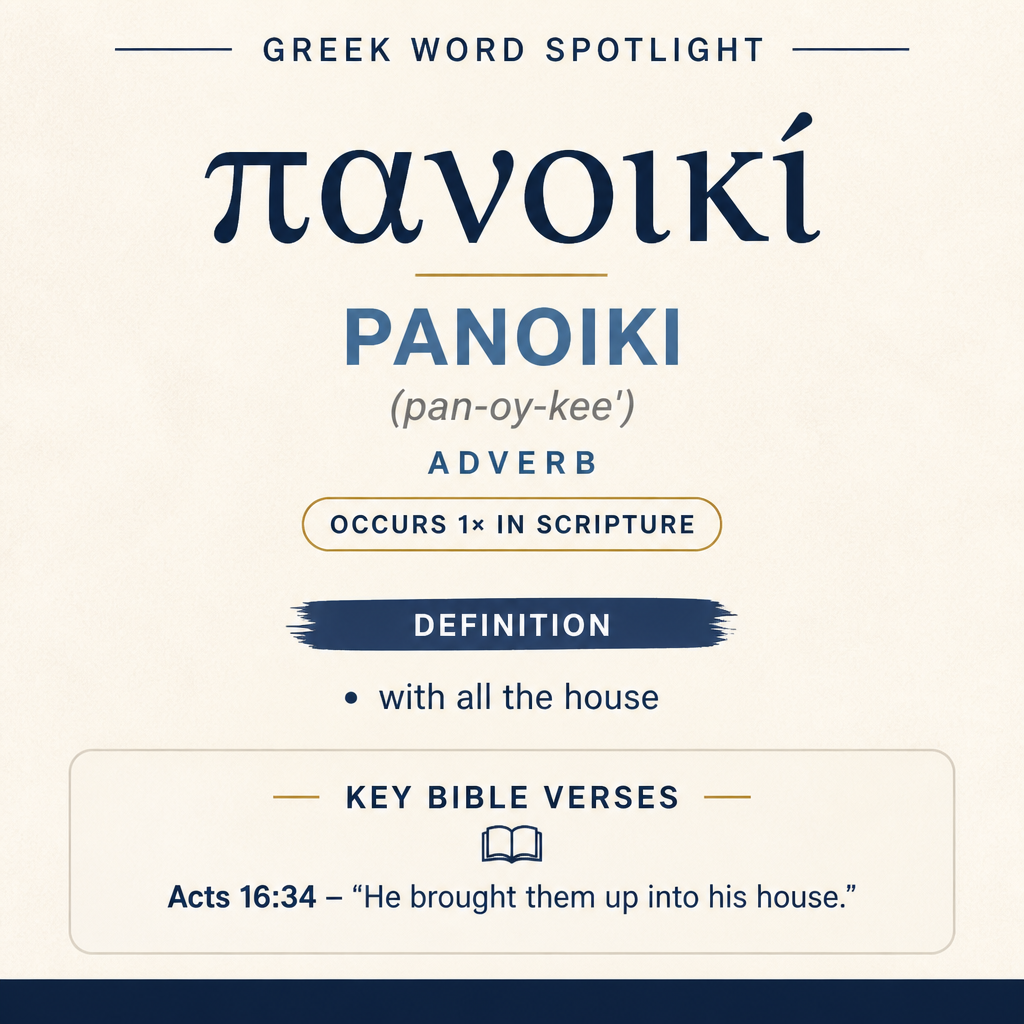
πανοικί means “with all the house” and appears once in Scripture, in Acts 16:34.
Scripture Occurrence
It occurs one time in Scripture. The occurrence is in Acts 16:34.
Learn More →πανοικί means “with all the house” and appears in the narrative of the Philippian jailer’s response to the gospel. In its single New Testament occurrence, it marks a shared joy that spreads across an entire household gathered within one home.
Root and Related Words
πανοικί is built from πᾶς (pas), “all” (Strong’s G3956), and οἶκος (oikos), “house: home” (Strong’s G3624). The combination yields an adverbial expression that frames an action or emotion as involving the whole household unit associated with a single house.

Occurrences
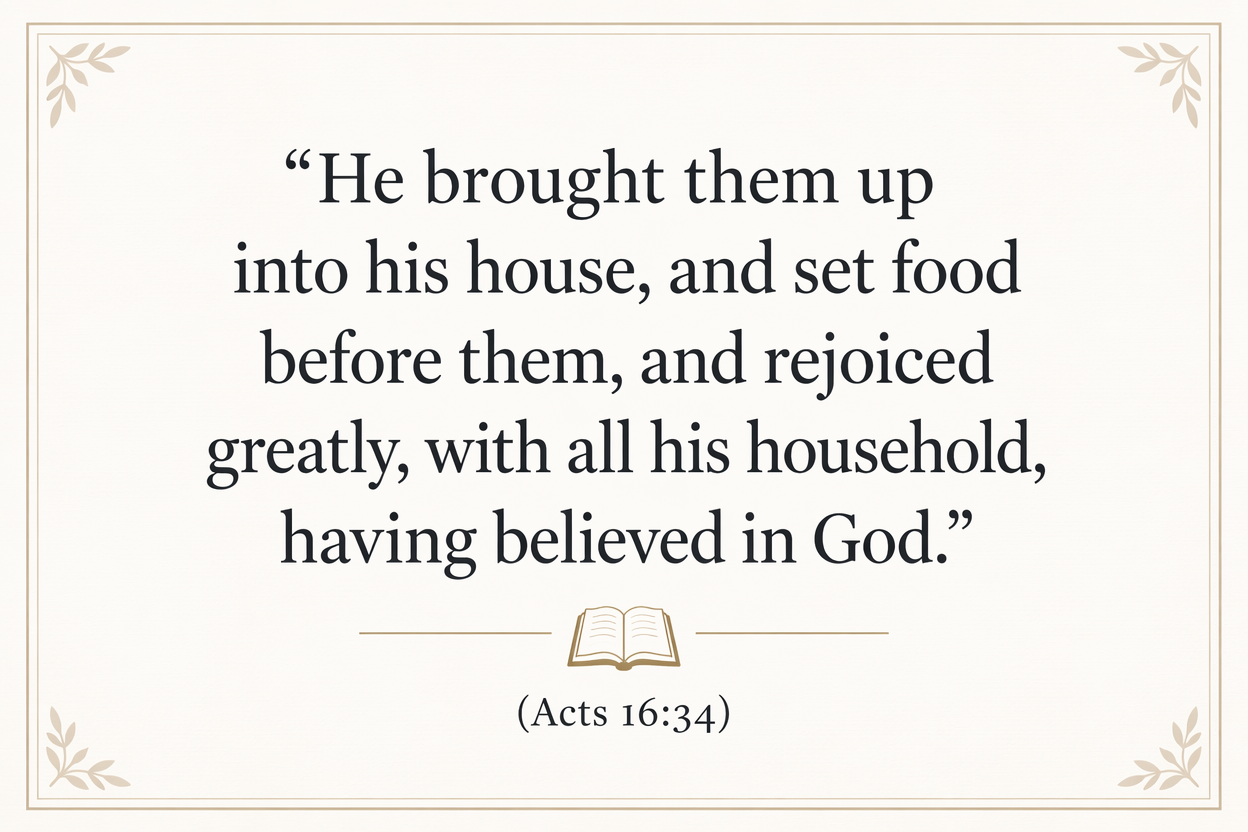
“He brought them up into his house, and set food before them, and rejoiced greatly, with all his household, having believed in God.” (Acts 16:34)
Here πανοικί attaches to the jailer’s rejoicing and locates that joy within the circle of everyone who belongs to his house. The sentence moves step by step: he brings “them” into “his house,” sets “food before them,” and then “rejoiced greatly,” and the adverbial phrase “with all his household” clarifies the scope of that rejoicing. It is not only an individual reaction; the joy is shared by the household as a whole, gathered in the domestic space where hospitality is being shown.
The phrase sits alongside the concluding clause, “having believed in God,” which supplies the reason for the celebration. Within the flow of the verse, πανοικί marks the social breadth of the response to that belief: the household is pictured as participating together in the gladness that follows. In this scene, the house functions as more than a building; it is the setting where people eat, receive guests, and express corporate joy, and πανοικί is the word that brings the entire household into view at once.
Sense and Usage
Because πανοικί means “with all the house,” its force in usage is to present an event as shared by the complete household connected with one home. It expresses inclusiveness: the action described is not confined to a single person but is experienced “with” the whole household group. The prepositional idea of accompaniment (“with”) makes the household not merely an audience observing from the edges, but companions in the same response.
In Acts 16:34, the word’s sense is carried by the way it pairs naturally with a communal emotion—rejoicing. The jailer’s home becomes a setting where belief leads directly into a meal and then into gladness, and πανοικί indicates that this gladness embraces the entire domestic circle present in that house. The expression therefore highlights the household as a meaningful social unit: one can speak of a response to God that is felt in the home as a whole, with everyone under that roof included in the scene’s joy.
Imagery
The verse’s imagery is domestic and concrete: a house opened, food set out, and a household rejoicing together. πανοικί contributes to that picture by widening the frame from the jailer alone to the full household gathered in the home, so that the rejoicing is heard as a shared celebration filling the house.
Sources: Lexical data from Strong’s Exhaustive Concordance and the Translators Brief Lexicon of Extended Strongs for Greek (STEPBible, CC BY). Occurrence data from the Translators Amalgamated Greek New Testament (STEPBible, CC BY). Scripture quotations from the World English Bible (public domain).




