
Exploring the Meaning of Ergon in Greek
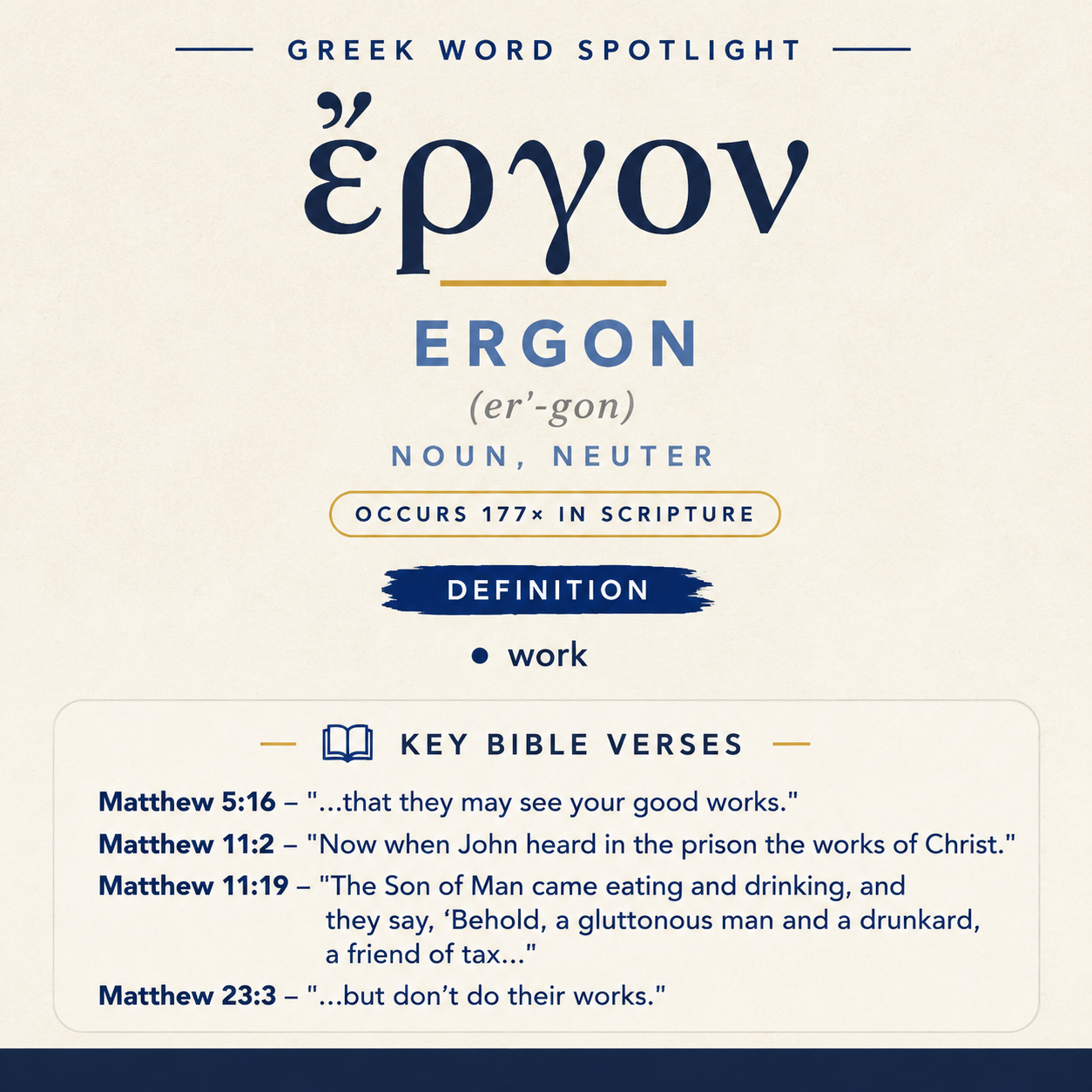
ἔργον (Ergon) means “work” and appears 177 times in Scripture, including in Matthew and Mark.
Core Meaning
ἔργον is defined as “work.” It is used in contexts speaking of works done by people and by Christ.
Learn More →Gospel Examples
Matthew includes “good works” seen by others (Matthew 5:16) and “the works of Christ” (Matthew 11:2). Jesus also calls a woman’s act “a good work” (Matthew 26:10; Mark 14:6).
Learn More →Seen or Hidden
Matthew contrasts works meant to be seen by men (Matthew 23:5) with the call for good works that glorify the Father (Matthew 5:16).
Learn More →ἔργον names “work” in a range of scenes that highlight what people do and what those actions show. In these passages it can describe public deeds, assigned tasks, patterns of behavior, and acts that invite evaluation—by other people and by God.
Occurrences
Matthew 5:16: Even so, let your light shine before men; that they may see your good works, and glorify your Father who is in heaven.
Here ἔργον refers to observable actions (“works”) that function as the visible expression of “light” in human life. The point of these “good works” is not self-display for its own sake but their public visibility (“before men”) leading others to “glorify your Father who is in heaven.” The word frames conduct as something that can be seen, assessed as “good,” and connected to honor rendered to God.

Matthew 11:2: Now when John heard in the prison the works of Christ, he sent two of his disciples
In this narrative notice, ἔργον gathers up what can be heard about Jesus’ activity—“the works of Christ”—as a reportable set of deeds. John’s response (“he sent two of his disciples”) shows that these “works” carry evidential weight: they are the kind of actions that prompt inquiry and require a response even at a distance, mediated through hearing.
Matthew 11:19: The Son of Man came eating and drinking, and they say, ‘Behold, a gluttonous man and a drunkard, a friend of tax collectors and sinners!’ But wisdom is justified by her children.”
This saying moves in the orbit of public evaluation: people interpret behavior (“came eating and drinking”) and draw moral conclusions. Though ἔργον is not expressed in the English wording here, the scene is shaped by the same concern that appears in nearby texts: deeds and patterns of conduct are scrutinized, and a verdict is rendered (“wisdom is justified…”). The statement sets the expectation that actions will be judged, whether fairly or unfairly, by observers.
Matthew 23:3: All things therefore whatever they tell you to observe, observe and do, but don’t do their works; for they say, and don’t do.
ἔργον distinguishes instruction from practice. The leaders “tell you to observe,” yet their “works” are a different matter; the issue is inconsistency: “they say, and don’t do.” The word thus points to the concrete outworking of a person’s claims, the lived behavior that either matches or contradicts what is taught.
Matthew 23:5: But they do all their works to be seen by men. They make their phylacteries broad, enlarge the fringes of their garments,
Here “works” are actions performed with an explicit social aim: “to be seen by men.” The following examples (“make their phylacteries broad,” “enlarge the fringes of their garments”) show how ἔργον can cover outward acts that are intentionally visible. The word brings motive into view: deeds may be shaped not only by what is done but by the intended audience and the desire for recognition.
Matthew 26:10: However, knowing this, Jesus said to them, “Why do you trouble the woman? She has done a good work for me.
In this defense of the woman, ἔργον names a single act evaluated as “good.” The word is personal and directed: “for me.” In the immediate conflict (“Why do you trouble the woman?”), calling her act a “good work” establishes its worth and rebukes those who would interpret it as trouble or waste. ἔργον here is a deed that receives authoritative appraisal.
Mark 13:34: “It is like a man, traveling to another country, having left his house, and given authority to his servants, and to each one his work, and also commanded the doorkeeper to keep watch.
In this parable-like comparison, ἔργον is assigned responsibility: each servant receives “his work.” The word highlights task and duty within a household entrusted to others during the master’s absence. It sits alongside “given authority” and the command to the doorkeeper “to keep watch,” portraying “work” as a defined role within an ordered arrangement, not merely spontaneous activity.
Mark 14:6: But Jesus said, “Leave her alone. Why do you trouble her? She has done a good work for me.
This parallels the evaluation in Matthew 26:10 and again places ἔργον at the center of a disputed action. The repeated phrasing underscores that “work” can be a single, concrete deed whose value is contested by onlookers but affirmed by Jesus. The word functions as a verdict: the action belongs in the category “good work,” and that categorization settles the complaint.
Luke 11:48: So you testify and consent to the works of your fathers. For they killed them, and you build their tombs.
ἔργον here refers to inherited deeds—“the works of your fathers”—with moral and historical continuity. The verse specifies actions: “they killed them, and you build their tombs.” The word thus gathers serious acts into a pattern across generations, and it can include both violent deeds (“killed”) and subsequent actions that, in context, amount to complicity (“testify and consent”). “Works” are not isolated moments but can form a legacy that later people align themselves with.
Luke 24:19: He said to them, “What things?” They said to him, “The things concerning Jesus, the Nazarene, who was a prophet mighty in deed and word before God and all the people;
In this recollection, ἔργον (rendered “deed”) pairs with speech: “mighty in deed and word.” The pairing suggests that “work” is one of the two chief avenues by which a prophet’s ministry is recognized—what is done and what is said—both “before God and all the people.” ἔργον carries the idea of public, observable activity that displays “might,” and it is framed simultaneously in divine and human sight.
John 3:19: This is the judgment, that the light has come into the world, and men loved the darkness rather than the light; for their works were evil.
ἔργον is central to the moral diagnosis: people choose “darkness” because “their works were evil.” The word ties preference and judgment to conduct. “Light” does not merely reveal information; it exposes what people do, and the evaluation “evil” is attached to “works” as the reason for rejecting the light.
John 3:20: For everyone who does evil hates the light, and doesn’t come to the light, lest his works would be exposed.
Here ἔργον is linked to exposure. The fear is not abstract but practical: coming “to the light” would mean “his works would be exposed.” The word emphasizes actions as things that can be brought into the open, scrutinized, and shown for what they are. The verse also tightens the connection between doing (“does evil”) and the resulting “works,” treating deeds as the traceable outcome of a person’s chosen practice.

Sense and Usage
Across these passages, ἔργον (“work”) consistently points to concrete human activity—what someone does in ways that can be observed, reported, assigned, or evaluated. In Matthew 5:16, “good works” are outwardly visible actions that lead observers to glorify God, showing that “work” can function as a public witness. In Matthew 11:2, “the works of Christ” are memorable and transmissible: they can be heard about and prompt further action, so ἔργον can denote a body of deeds associated with a person’s identity.
Matthew 23 uses ἔργον to expose the gap between speech and action and to uncover performance aimed at reputation. “Don’t do their works; for they say, and don’t do” (Matthew 23:3) makes “works” the standard by which integrity is tested. “They do all their works to be seen by men” (Matthew 23:5) shows that ἔργον can include deliberately conspicuous actions, and the examples of widened phylacteries and enlarged fringes locate “works” in embodied, visible practices.
In Matthew 26:10 and Mark 14:6, ἔργον is a single deed receiving a moral assessment (“a good work for me”), highlighting that “work” can be individual and specific, not only a general lifestyle. At the same time, Mark 13:34 uses the word in the more structured sense of assigned responsibility—“to each one his work”—showing that “work” may also be a task entrusted within an arrangement of authority and accountability.
Luke 11:48 expands the horizon to collective and inherited action: “works of your fathers” gathers the deeds of a previous generation into a pattern that later people can “consent” to. Luke 24:19 pairs “deed and word,” presenting “work” as a principal dimension of recognized strength in a public ministry. John 3:19–20 then places ἔργον in the setting of judgment and revelation: “works” are what people do in darkness or light, and exposure of works is a decisive element in why people either approach or avoid the light. Taken together, these uses keep ἔργον anchored in actions that can be seen and appraised, whether praised as good, denounced as evil, or measured for consistency with one’s claims.
Imagery
These verses repeatedly picture “work” as something that comes into view. Light “shine[s] before men” so “good works” can be seen (Matthew 5:16), and people avoid the light “lest his works would be exposed” (John 3:20). Alongside that imagery of visibility stands the household scene of assigned duties (Mark 13:34), where “work” is the concrete task given to each servant while a master is away—an image of everyday responsibility that, like deeds in the light, implies eventual accounting.
Sources: Lexical data from Strong’s Exhaustive Concordance and the Translators Brief Lexicon of Extended Strongs for Greek (STEPBible, CC BY). Occurrence data from the Translators Amalgamated Greek New Testament (STEPBible, CC BY). Scripture quotations from the World English Bible (public domain).




