Exploring the Meaning of Panoplia in Greek
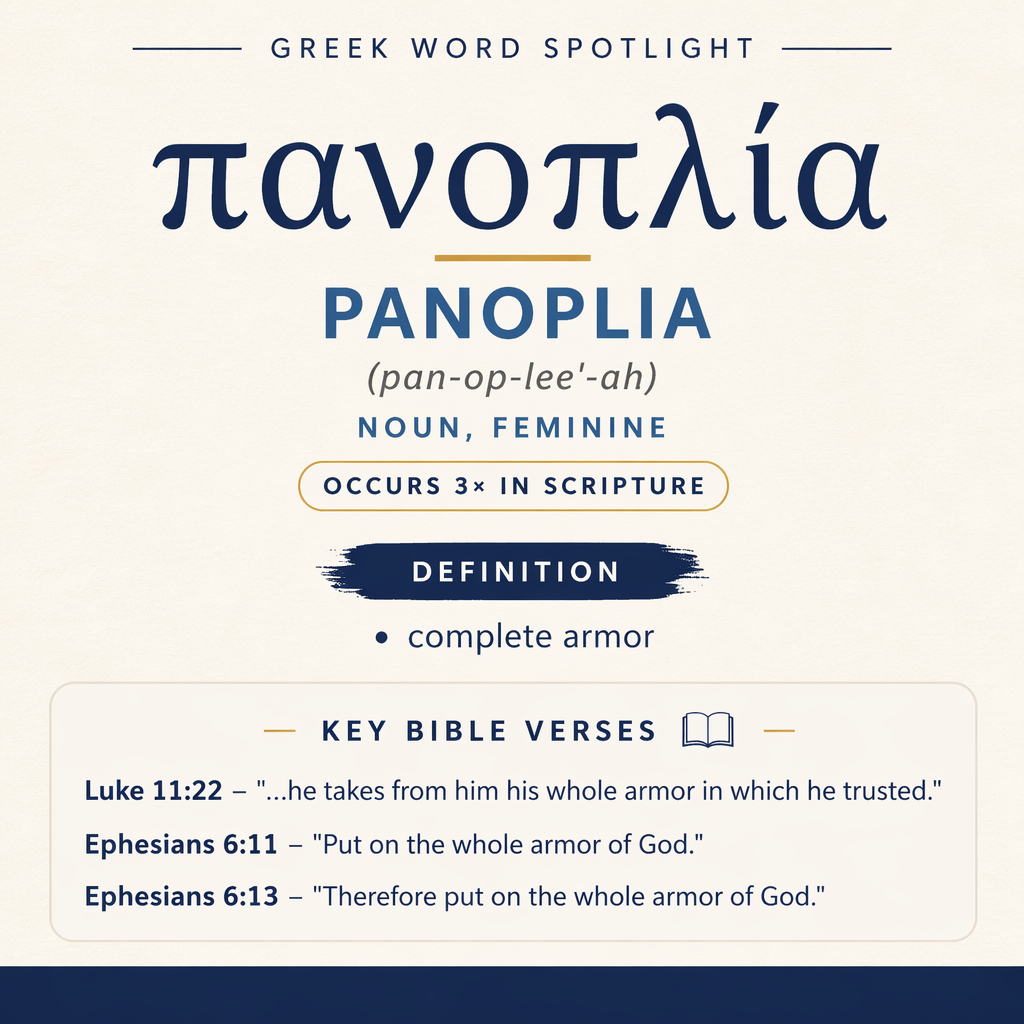
πανοπλία means “complete armor” and appears three times in Scripture: Luke 11:22; Ephesians 6:11; Ephesians 6:13.
Scripture Occurrences
This word occurs three times in Scripture. The references are Luke 11:22; Ephesians 6:11; and Ephesians 6:13.
Learn More →Context In Verses
In Luke 11:22, it describes a person’s “whole armor” taken away. In Ephesians 6:11 and 6:13, it is “the whole armor of God.”
Learn More →πανοπλία denotes “complete armor” and appears once in Jesus’ teaching (Luke 11:22) and twice in Paul’s exhortation to believers (Ephesians 6:11, 6:13). In each setting it evokes the image of a person thoroughly equipped for conflict and the consequences of being stripped of that equipment.
Root and Related Words
Panoplia is connected with hoplon (ὅπλον), “weapon” (Strong’s G3696), and pas (πᾶς), “all” (Strong’s G3956). Together these related terms support the idea of an all-encompassing set of weapons or protective gear rather than a single item.

Occurrences
“But when someone stronger attacks him and overcomes him, he takes from him his whole armor in which he trusted, and divides his plunder.” (Luke 11:22)
Here πανοπλία is pictured as the “whole armor” possessed by a man who is initially secure enough to place trust in it. The narrative movement is decisive: a stronger attacker “overcomes him,” then “takes from him” the armor, and finally “divides his plunder.” The armor functions as the defeated man’s relied-on safeguard; once it is removed, his defenses are not merely weakened but exposed as inadequate against superior strength. The word contributes the sense of a full defensive array—something comprehensive enough to be trusted—yet still vulnerable to being seized in conquest. In the verse’s logic, the removal of complete armor marks the turning point from security to loss, and it explains how plunder becomes possible.
“Put on the whole armor of God, that you may be able to stand against the wiles of the devil.” (Ephesians 6:11)
In Ephesians, πανοπλία is framed as something to be “put on,” shifting the image from an enemy stripping armor away (Luke 11:22) to believers actively taking up a full set of equipment. The phrase “whole armor of God” ties the completeness of the armor to its divine source: the equipment is not self-generated but belongs to God and is to be worn by his people. The purpose clause “that you may be able to stand” makes the armor’s function practical and immediate: it enables stability and resistance rather than retreat. The specific threat named is “the wiles of the devil,” and the word “whole” underscores that piecemeal readiness is not the point; the envisioned readiness is comprehensive enough to meet calculated opposition. In this sentence, πανοπλία supplies the concrete metaphor for preparedness and endurance in the face of strategized hostility.
“Therefore put on the whole armor of God, that you may be able to withstand in the evil day, and having done all, to stand.” (Ephesians 6:13)
This second occurrence in Ephesians repeats the command to “put on the whole armor of God,” but the surrounding language expands the time and pressure of the conflict. The aim is “that you may be able to withstand in the evil day,” which portrays a situation of concentrated adversity: a time when the need for complete equipment becomes unmistakable. The closing sequence—“and having done all, to stand”—reinforces the emphasis on remaining upright after full exertion. In this verse, πανοπλία is linked with endurance through a day characterized as “evil” and with perseverance after every required action has been taken. The armor is not merely for initial engagement; it is suited for sustaining resistance and maintaining one’s ground to the end of the ordeal described.
Sense and Usage
Across these three passages, “complete armor” consistently evokes total equipment for conflict, but the scenes highlight different aspects of what such completeness implies. In Luke 11:22, the completeness is something possessed and trusted, yet it can be confiscated when a stronger opponent prevails. The word’s force there lies in the contrast between the former security that a full defensive setup seems to promise and the sudden exposure that follows when it is taken away. The verse assumes that a person’s “whole armor” represents the sum of what protects him; once stripped, nothing comparable remains to prevent the “plunder” that follows.
In Ephesians 6:11 and 6:13, the same term is placed in the imperative mood (“Put on”), and the completeness becomes an exhortation: believers are to be fully equipped, not partially armed. The goal is expressed with two closely related verbs of steadiness—“stand” and “withstand”—and in both verses πανοπλία is the image that makes those verbs concrete. Standing is not presented as passive inactivity; it is the posture achieved by being outfitted for pressure. The opponents described differ from Luke’s “someone stronger” who attacks openly and strips armor; here the danger is “the wiles of the devil,” and the crisis point is “the evil day.” In this context, the completeness of the armor corresponds to the complexity of the threat: the equipment is imagined as covering the whole person for sustained resistance, not just giving a momentary advantage.
Taken together, the uses show how the same expression can function in two complementary ways: as a marker of what can be lost in defeat (Luke) and as a call to readiness that enables continued firmness (Ephesians). In both, the imagery assumes that armor is a coherent set—something that, when intact and worn, signifies preparedness, and when removed, signals vulnerability and impending loss.
Imagery
The word’s imagery is vivid and practical: a fully equipped figure in a contest where the decisive outcomes are either seizure and plunder or endurance and standing. Luke 11:22 pictures the grim moment when “his whole armor in which he trusted” is taken, highlighting how quickly confidence can be overturned by superior strength. Ephesians 6:11 and 6:13 answer that vulnerability with a command to be clothed in “the whole armor of God,” so that, in the face of “the wiles of the devil” and “the evil day,” one can remain standing even after “having done all.”
Sources: Lexical data from Strong’s Exhaustive Concordance and the Translators Brief Lexicon of Extended Strongs for Greek (STEPBible, CC BY). Occurrence data from the Translators Amalgamated Greek New Testament (STEPBible, CC BY). Scripture quotations from the World English Bible (public domain).