Exploring the Meaning of Nossion in Greek
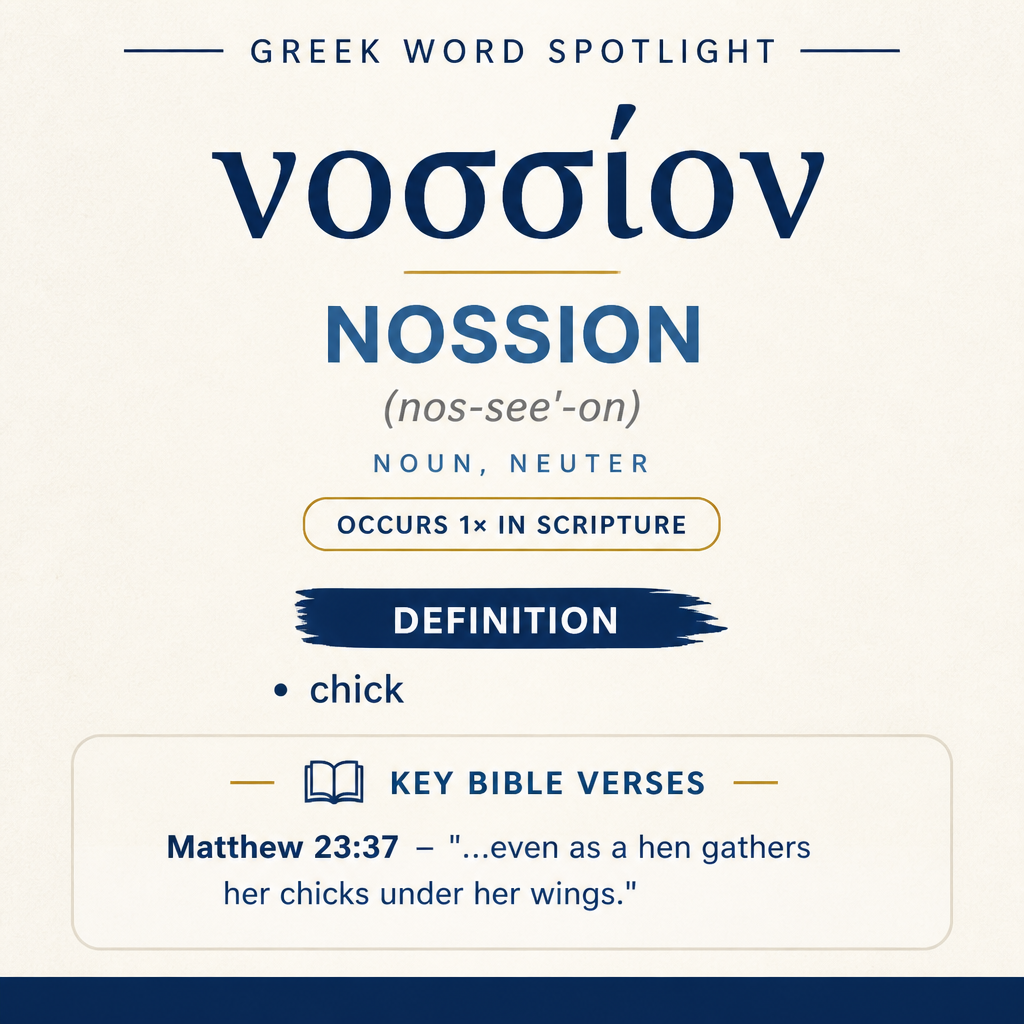
νοσσίον means “chick” and appears once in Scripture, in Matthew 23:37.
Scripture Occurrence
It occurs 1 time in Scripture. The occurrence is in Matthew 23:37.
Learn More →Verse Context
In Matthew 23:37, it appears within Jesus’ lament over Jerusalem: “Jerusalem, Jerusalem…”.
Learn More →νοσσίον means “chick” and appears in a single Gospel saying that pictures a hen sheltering her young. The term functions within a vivid comparison that contrasts protective gathering with a refusal to be gathered.
Root and Related Words
νοσσίον (Nossion) is related to neossos (νεοσσός), “nestling” (Strong’s G3502), from which it derives.

Occurrences
“Jerusalem, Jerusalem, who kills the prophets, and stones those who are sent to her! How often I would have gathered your children together, even as a hen gathers her chicks under her wings, and you would not! (Matthew 23:37)”
Here νοσσίον appears in the phrase “her chicks,” placed within an explicit comparison: “even as a hen gathers her chicks under her wings.” The image is concrete and domestic—small birds drawn close to their mother in a posture of protection. The word “chicks” supplies the picture’s tenderness and vulnerability: chicks are the kind of creatures that do not secure themselves by strength or strategy, but by being gathered and covered. In the sentence, the act of gathering is emphasized (“How often I would have gathered…”), and νοσσίον anchors the comparison in an everyday scene where gathering has a clear purpose—bringing small ones into safety beneath wings.
The context also makes the image more than sentimental. The address names Jerusalem as one who “kills the prophets, and stones those who are sent to her,” and the comparison is immediately followed by refusal: “and you would not!” Against violence and rejection, the picture of “chicks under her wings” highlights the contrast between what is offered (a gathering like a hen’s protective care) and what is resisted. νοσσίον thus helps carry the emotional force of the lament: the children are envisioned not as threats or rivals but as the young of a household, meant to be drawn in, not driven away.

Within the verse’s flow, the noun’s placement also matters. The speaker says, “I would have gathered your children together,” and then restates that desire through the simile, “as a hen gathers her chicks.” The “children” of Jerusalem are linguistically paired with “chicks” in the comparison, so νοσσίον functions as the concrete referent that gives shape to an otherwise general idea of gathering. The word paints what “gathered together” looks like: not merely assembled in one place, but drawn into closeness, under wings, with a protective boundary formed by the hen’s own body.
Sense and Usage
As “chick,” νοσσίον names a young bird in relation to its mother. That relational sense is central in Matthew 23:37: the chicks are explicitly “her chicks,” and the hen’s action is to gather them “under her wings.” The word therefore naturally brings with it the ideas of smallness and dependence that belong to a chick in ordinary experience, and the verse uses that everyday reality to clarify the kind of gathering being described. The force of the comparison is not carried by the chicks acting, but by the hen acting toward them; the chicks are the objects of gathering, not the agents of it.
Within the single occurrence, the term’s meaning is sharpened by two immediate features of the picture: plurality (“chicks”) and shelter (“under her wings”). The plural suggests a brood—many young needing to be brought in together—matching the earlier plural “your children.” The location “under her wings” portrays the goal of gathering as protection and nearness rather than mere organization. The word “chicks,” therefore, is not ornamental; it supplies the reader with a mental scene in which gathering is affectionate, purposeful, and safety-oriented, and it implies that being gathered is fitting for those who are young and exposed.
The saying also uses the chick-image to frame refusal. The concluding “and you would not!” makes the contrast stark: the act of gathering is portrayed as repeatedly desired (“How often I would have gathered…”), and the chick-simile makes that desire feel like the natural, even instinctive movement of a hen toward her young. In that light, νοσσίον contributes to the sense of tragedy in the refusal: rejecting a gathering like this is not rejecting a threat, but turning away from offered shelter. The word’s plain meaning allows the verse to communicate emotional weight without introducing technical terms; the scene itself carries the message.
Finally, νοσσίον functions as a bridge between public history and homely imagery. The verse speaks of prophets being killed and messengers being stoned—public, communal acts with grave consequences—yet it expresses the speaker’s desire through a household scene involving a hen and her young. “Chicks” makes the comparison intimate and approachable, pulling the reader’s imagination from the city’s violent identity into a protective posture that could have been known in ordinary life. The contrast heightens the lament: the city capable of hard resistance is addressed as having “children” who could have been gathered like chicks.
Imagery
Matthew 23:37 ties νοσσίον to the picture of “a hen” and “her wings,” so the word carries the sensory associations of warmth, cover, and closeness. The chicks are envisioned as drawn into a sheltered space created by the hen’s wings—protection offered from above and around. Because the verse ends with refusal, the image also leaves the reader with a tension: the shelter is pictured as available and repeatedly desired, yet not embraced. νοσσίον thus stands at the center of a memorable scene in which vulnerability meets offered protection, and the tragedy lies in the unwillingness to be gathered.
Sources: Lexical data from Strong’s Exhaustive Concordance and the Translators Brief Lexicon of Extended Strongs for Greek (STEPBible, CC BY). Occurrence data from the Translators Amalgamated Greek New Testament (STEPBible, CC BY). Scripture quotations from the World English Bible (public domain).