
Exploring the Meaning of Neossos in Greek
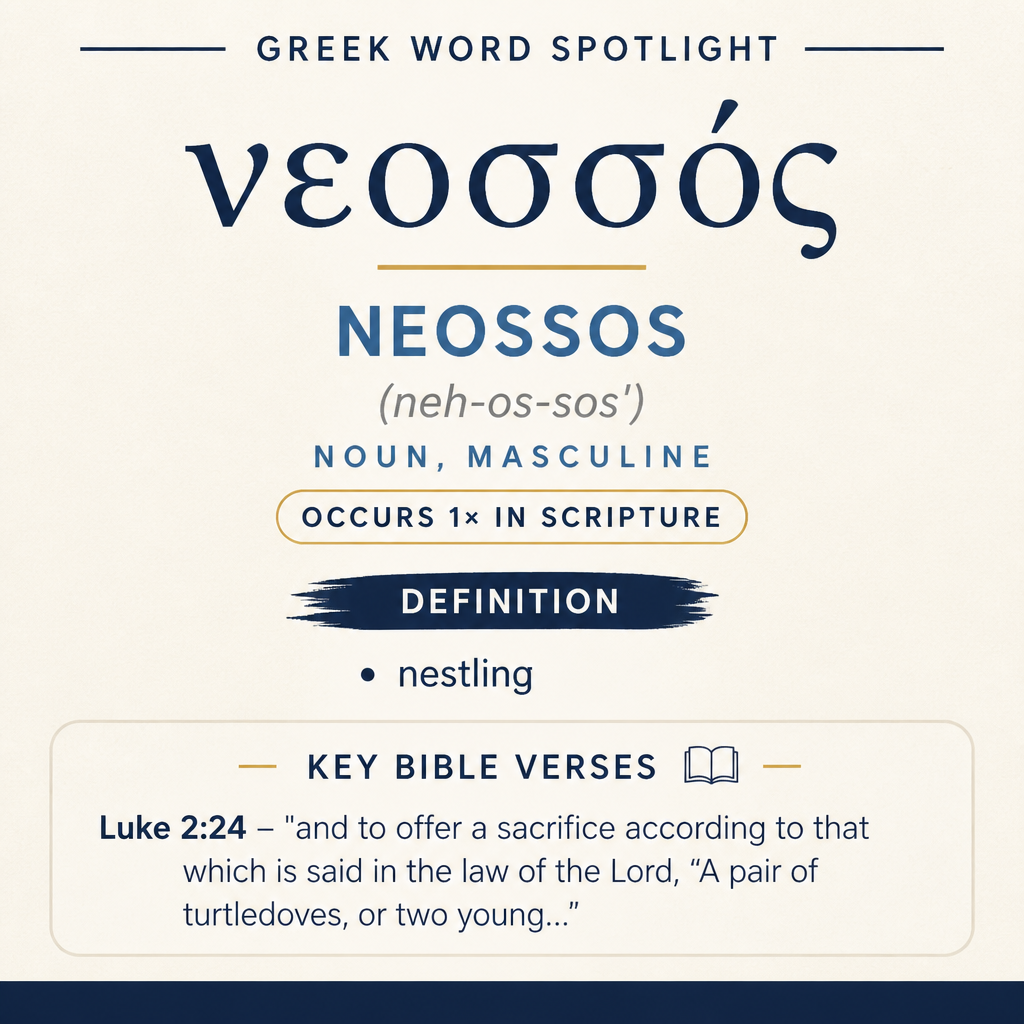
νεοσσός means “nestling” and appears once in Scripture, in Luke 2:24.
Scripture Occurrence
This word occurs 1 time in Scripture. Its recorded occurrence is in Luke 2:24.
Learn More →Verse Context
In Luke 2:24 it appears in a citation of the law: “A pair of turtledoves, or two young pi…”. (Text shown is truncated.)
Learn More →νεοσσός refers to a “nestling,” a young bird still in its earliest stage of life. In the New Testament it appears in a sacrificial setting where young pigeons are named as an acceptable offering.
Root and Related Words
νεοσσός is derived from neos (νέος), “new” (Strong’s G3501). The relationship points toward the idea of newness or early stage as the conceptual backdrop for the term.

Occurrences
“and to offer a sacrifice according to that which is said in the law of the Lord, “A pair of turtledoves, or two young pigeons.”” (Luke 2:24)
In Luke’s description of the sacrifice, νεοσσός supplies the specific description behind “young pigeons.” The verse itself frames the offering as one made “according to that which is said in the law of the Lord,” and the quoted line gives two alternatives: “A pair of turtledoves, or two young pigeons.” Within that paired list, νεοσσός contributes the idea of birds at the earliest stage of life—nestlings—so that the option is not merely “pigeons” in general, but pigeons characterized by youth. The term therefore functions as a concrete qualifier within a ritual action (“to offer a sacrifice”), specifying the kind of animal offered.
The placement of the phrase in a citation-like format (“according to that which is said…”) gives the wording a formal, prescribed tone. In that setting, νεοσσός carries the weight of exactness: the sacrifice is not improvised but aligned with an established specification. The word’s contribution is not primarily decorative; it is part of the identification of what counts as an appropriate offering in the scene Luke narrates.
Sense and Usage
As “nestling,” νεοσσός designates a creature in a notably early life-stage, and its use in Luke 2:24 shows that this life-stage can be a relevant distinction when naming sacrificial animals. The verse’s English rendering (“young pigeons”) captures the core idea by translating the bird’s condition as youth, while the underlying term makes that youth concrete and vivid: a bird still close to the nest, not simply an immature specimen in an abstract sense. In this way the word naturally fits the practical world of offerings, where the kind of animal is described with ordinary, observable features.
The immediate literary context also shapes how the word is heard. Luke presents the action as a careful fulfillment of what is “said in the law of the Lord,” and νεοσσός participates in that carefulness by naming a precise class of birds. Because the term is embedded in a list of acceptable options (“A pair of turtledoves, or two young pigeons”), it functions in a categorical way: it belongs to the vocabulary of permitted offerings. The meaning “nestling” thus does not appear as a metaphor or a poetic flourish in this occurrence; it is a straightforward descriptor used in a concrete, regulated act.
Even in this single attested New Testament use, the definition “nestling” suggests a small, dependent life at the beginning of growth. That impression sits naturally alongside the scene’s simplicity: the offering is made with common birds, identified plainly. The word’s force lies in its specificity—an ordinary term for an early-stage bird pressed into service as the exact wording of what is brought to the Lord.
Imagery
Luke 2:24 pairs νεοσσός with the imagery of sacrifice: a permitted offering described in the simplest terms of everyday life—turtledoves or pigeons, and specifically “young pigeons.” The word evokes a small bird just out of the nest, bringing a quiet concreteness to the scene’s focus on obedience to what is “said in the law of the Lord.”
Sources: Lexical data from Strong’s Exhaustive Concordance and the Translators Brief Lexicon of Extended Strongs for Greek (STEPBible, CC BY). Occurrence data from the Translators Amalgamated Greek New Testament (STEPBible, CC BY). Scripture quotations from the World English Bible (public domain).




