Exploring the Meaning of Nosema in Greek
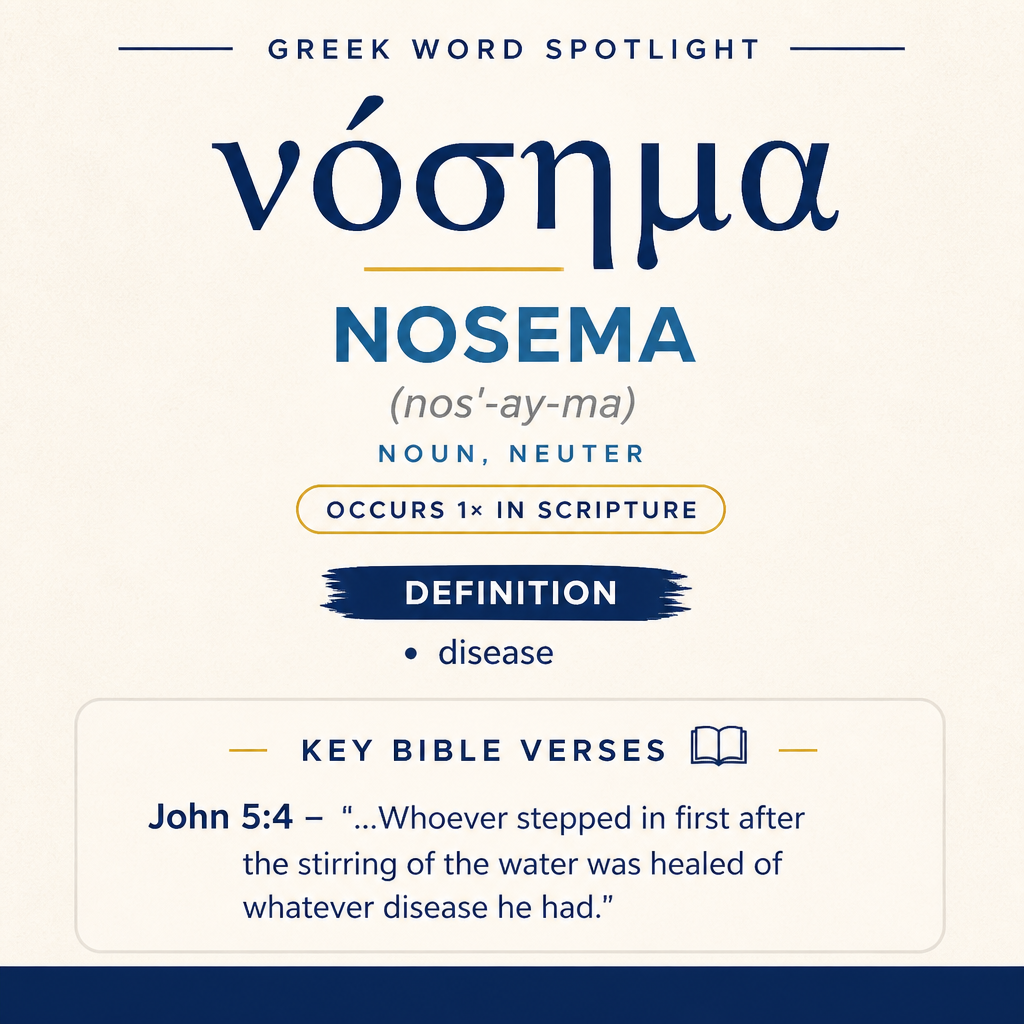
νόσημα means “disease” and appears once in Scripture, in John 5:4.
Scripture Occurrence
This word occurs 1 time in Scripture. Its single occurrence is in John 5:4.
Learn More →Context Note
In John 5:4, it appears within the account of the pool being stirred and the first person stepping in.
Learn More →νόσημα means “disease” and appears in a single New Testament occurrence in the account of healing at a stirred pool. In its one use, it functions as the concrete condition from which a person is healed.
Root and Related Words
νόσημα (Nosema) derives from νοσέω (noseo), “be sick” (Strong’s G3552). The relationship between the verb and the noun frames νόσημα as the named result or state connected to being sick.

Occurrences
“for an angel went down at certain times into the pool and stirred up the water. Whoever stepped in first after the stirring of the water was healed of whatever disease he had.” (John 5:4)
In John 5:4, νόσημα is the ailment that defines the sufferer’s plight and sets the stakes for the action at the pool. The verse describes an event (“an angel went down… and stirred up the water”) and then narrates a rule-like expectation tied to that event: the one who “stepped in first after the stirring of the water” experienced healing. Within that expectation, νόσημα names the concrete burden carried by the person seeking relief—“whatever disease he had.” The phrase places the noun under the scope of “whatever,” presenting the condition as variable from one individual to another while still being genuinely bodily and concrete: the person has a νόσημα, and the outcome is that he is “healed of” it.
The wording also positions νόσημα as something a person possesses (“he had”), and from which he can be freed (“was healed of”). That combination gives the noun a practical, experiential feel in the scene: νόσημα is not an abstract label but the specific condition that marks a person’s need and becomes the target of the healing described. The verse does not specify symptoms, duration, or cause; instead, it uses νόσημα as the catch-all category for the sort of physical malady that brings a person to a pool where healing is sought. In this setting, the noun functions as the object of the healing—what the healing removes or resolves.
Sense and Usage
With the straightforward sense “disease,” νόσημα serves as a medical term for an adverse bodily condition, and in John 5:4 it is deployed in a way that is both personal and comprehensive. It is personal because it is tied to an individual’s condition (“he had”); it is comprehensive because the narrative does not limit it to a particular type (“whatever”). The verse therefore uses νόσημα to encompass a range of ailments without naming any one kind. The noun is the umbrella word that allows the text to speak of healing in general terms while still referring to something real and concrete in each sufferer’s body.
In this usage, νόσημα is also tightly linked to the verb of healing. The clause “was healed of whatever disease he had” makes the disease the direct counterpart to healing: healing is portrayed as release from, or remedy for, the νόσημα. The expression “healed of” treats the disease as the condition that can be separated from the person—something that can be taken away, ended, or overcome—rather than as a defining identity. The noun thus functions within a simple before-and-after logic in the sentence: the person previously had a disease; after the stated action (entering the pool first following the stirring), the person is healed with respect to that disease.
The connection to the related verb νοσέω (“be sick”) helps clarify the perspective of the word choice. The narrative could have described the sufferers only in terms of their weakness or their inability; instead, it names the underlying issue as a “disease.” That word choice keeps attention on the concrete reality that necessitates healing. At the same time, the “whatever” formulation avoids narrowing the scene to a specialized case, allowing the statement to portray the pool as a place people sought relief for many kinds of sicknesses. νόσημα does the work of gathering those possibilities into one category while still remaining a plain word for illness.
Because νόσημα occurs here in a generalizing phrase, its semantic force in this passage is not to distinguish one disease from another, but to specify the kind of problem for which the pool’s stirring is thought to provide an answer: physical disease. The noun is the problem to be solved; the verse’s main clause describes the expected solution. That structure gives νόσημα a functional role in the narrative: it provides the reason someone would urgently seek to be “first” into the water, and it gives content to the promise that the first entrant would be healed. Without naming νόσημα, the verse would lose the clarity that what is being remedied is illness.
Imagery
The imagery attached to νόσημα in John 5:4 is the stark contrast between a person’s private affliction and a public moment of opportunity. The verse evokes a pool of water stirred at certain times, and into that changing water people step with the hope of being “healed of whatever disease” they carry. νόσημα, in this picture, is the silent burden brought to the pool—individual, varied, and real—set against the sudden movement of the water and the immediate prospect of healing.
Sources: Lexical data from Strong’s Exhaustive Concordance and the Translators Brief Lexicon of Extended Strongs for Greek (STEPBible, CC BY). Occurrence data from the Translators Amalgamated Greek New Testament (STEPBible, CC BY). Scripture quotations from the World English Bible (public domain).