
Exploring the Meaning of Nossia in Greek
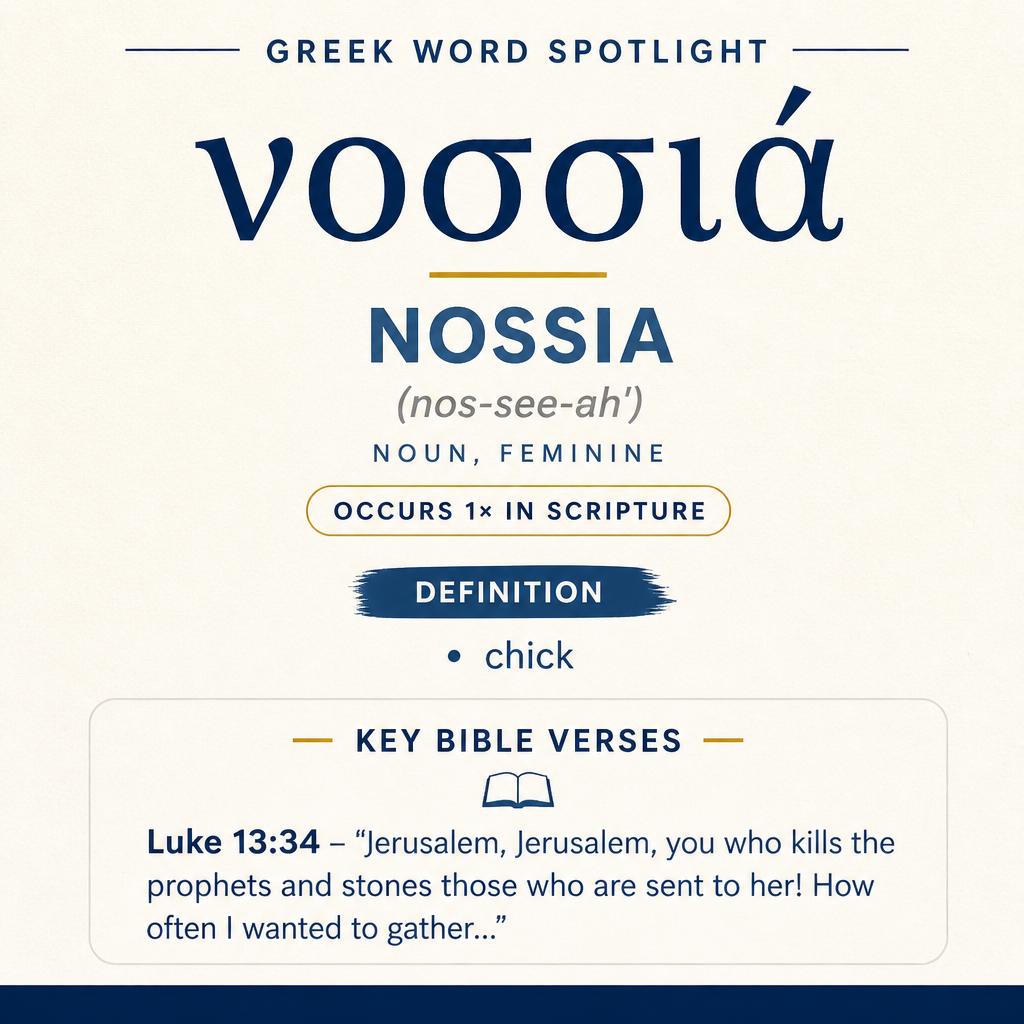
νοσσιά means “chick” and appears once in Scripture, in Luke 13:34.
Verse Context
In Luke 13:34, the verse addresses Jerusalem and speaks of a desire to gather her.
Learn More →νοσσιά means “chick” and appears in Jesus’ lament over Jerusalem, where he compares his desired protection of her children to a hen sheltering her young. The term serves a vivid, domestic image inside a plea that is immediately met with refusal.
Root and Related Words
νοσσιά is related to neossos (νεοσσός), “nestling” (Strong’s G3502), from which it derives. The relationship links the word to the sphere of newly hatched or very young birds, fitting the maternal-bird picture in which the term is used.

Occurrences
“Jerusalem, Jerusalem, you who kills the prophets and stones those who are sent to her! How often I wanted to gather your children together, like a hen gathers her own brood under her wings, and you refused!” (Luke 13:34)
Here νοσσιά belongs to a carefully shaped comparison: “like a hen gathers her own brood under her wings.” The image is not general barnyard scenery but a pointed portrayal of protection that is both tender and urgent. A hen gathering chicks is an action that assumes danger or exposure—young birds are vulnerable, easily scattered, and in need of shelter; the wings form a covering that collects and guards. In the sentence, that animal action becomes the interpretive frame for the speaker’s “How often I wanted to gather your children together.” The comparison communicates that the desired gathering is personal (“her own brood”) and spatially close (“under her wings”), emphasizing proximity rather than distance.
Within the same breath, the verse sets this care against the city’s hostility: “you who kills the prophets and stones those who are sent to her!” The contrast heightens what νοσσιά brings to the line. The “chick” picture is small, dependent life; the preceding description is violence against messengers. The word therefore helps sharpen the emotional and moral tension of the lament: the one speaking wants to perform a protective gathering, but the addressed city is characterized by rejecting those sent to her, and the final clause makes the refusal explicit—“and you refused!” In this setting, “chicks” are not a sentimental garnish; they are the fitting objects of a gathering that is repeatedly desired (“How often”) yet repeatedly resisted.

The phrase “your children” sits in parallel with the hen’s “own brood,” and νοσσιά supports that parallel by supplying the concrete picture for what “children” are like in this comparison: not merely members of a population, but young ones in need of being gathered. The action described is also plural and collective—gathering a brood rather than a single chick—so the word contributes to the sense of many being drawn together into one sheltered place. The verse ends without the gathering happening; the vocabulary of chick and brood makes that loss feel more immediate, because it invokes a scene where the means of safety is near and ready, yet declined.
Sense and Usage
Because νοσσιά occurs within a simile, its sense is carried less by dictionary abstraction and more by the scene it evokes. A “chick” is defined by smallness and dependence, and Luke 13:34 uses those associations to make “gathering” sound like protection rather than mere organization. The verb phrase “to gather…under her wings” implies containment and coverage: chicks are brought close, placed within a safe boundary, and kept there. In ordinary life, a chick does not secure itself; it is gathered. Thus the word suits the asymmetry in the verse: the speaker is the one who wants to act (“I wanted to gather”), while the addressed city is the one who resists (“you refused”).
The expression “her own brood” also shapes how the sense lands. The chick is not generic; it belongs to the hen. That possessive nuance (embedded in the scene as quoted) adds relational weight to the comparison: the gathering intended for “your children” is pictured as the kind of instinctive, rightful care a hen extends to what is hers. In this way, νοσσιά helps the verse communicate that the desired protection is not reluctant or accidental; it is deliberate and recurrent (“How often”). The term’s everyday concreteness intensifies the lament—common sights can carry uncommon grief when they become the vehicle for a refused offer of shelter.
Finally, the word contributes to the tone of address. “Jerusalem, Jerusalem” opens with repetition, then describes severe wrongdoing, then moves to longing. The chick image is the pivot: it transitions from condemnation (killing and stoning) to yearning (gathering under wings). Because a chick is a fragile creature that survives by being kept near, the choice of νοσσιά allows the verse to hold together strong indictment and compassionate desire without softening either. The closing “and you refused!” lands as the tragedy of a simple, protective act rejected.
Imagery
In Luke 13:34, νοσσιά carries the imagery of gathered life under a living cover. Wings form a shelter that is both gentle and enclosing, and the chicks are the ones who benefit from nearness to the hen. The verse’s final refusal leaves the image hanging: the wings are ready to cover, the brood could be gathered, but the gathering does not take place.
Sources: Lexical data from Strong’s Exhaustive Concordance and the Translators Brief Lexicon of Extended Strongs for Greek (STEPBible, CC BY). Occurrence data from the Translators Amalgamated Greek New Testament (STEPBible, CC BY). Scripture quotations from the World English Bible (public domain).





