Exploring the Meaning of Merizo in Greek
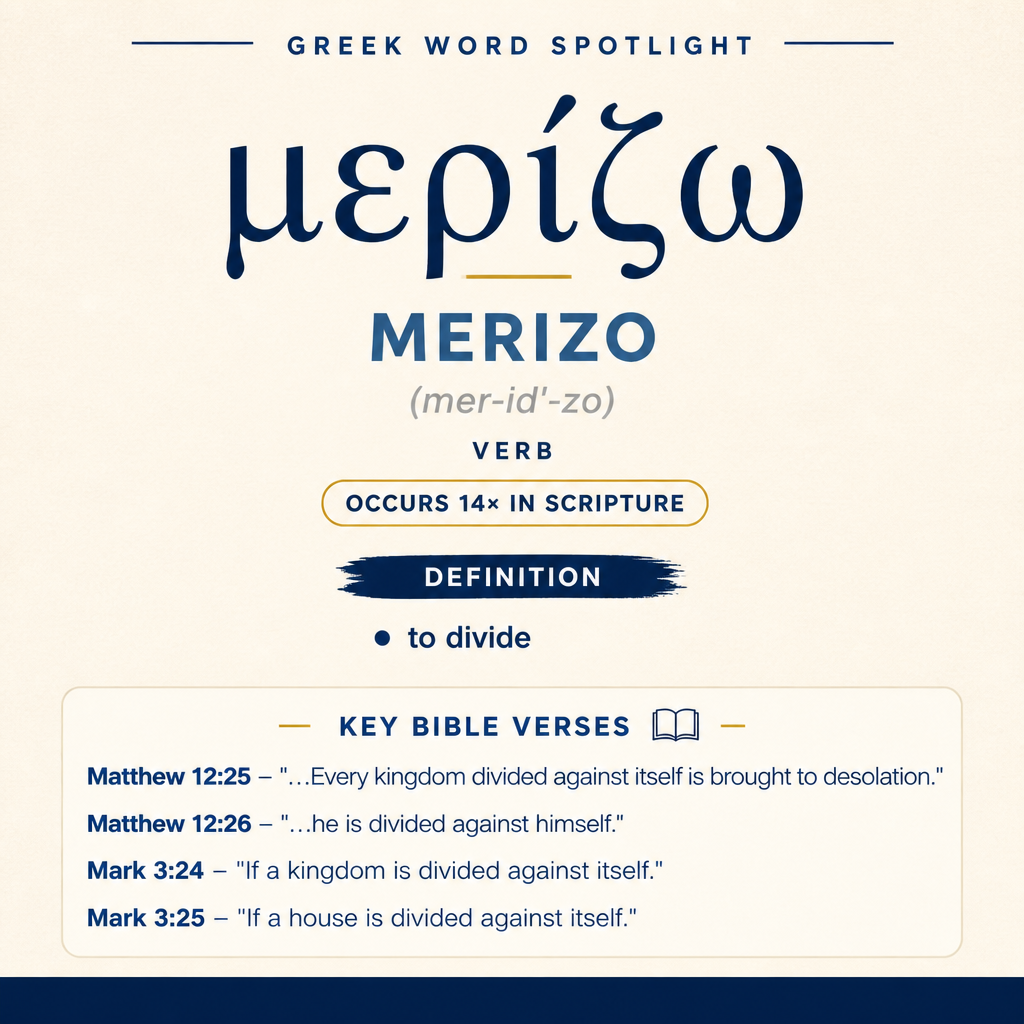
μερίζω means “to divide” and occurs 14 times in Scripture, including Matthew 12:25–26, Mark 3:24–26, Mark 6:41, Luke 12:13, and Romans 12:3.
Core Meaning
μερίζω means “to divide.” It describes separation within a kingdom, house, or person in Jesus’ teaching.
Learn More →Gospel Examples
In Matthew 12:25–26 and Mark 3:24–26, it refers to a kingdom or house divided against itself. In Luke 12:13 it is used for dividing an inheritance, and in Mark 6:41 for distributing bread and fish.
Learn More →Scripture Occurrences
This verb occurs 14 times in Scripture. The provided occurrences include Matthew, Mark, Luke, and Romans.
Learn More →μερίζω expresses the action of dividing, whether that division is destructive (a kingdom or house split against itself) or distributive (food, inheritance, or what God assigns). In the passages where it appears, the verb moves between social fracture, practical apportionment, and the measured sharing of resources or responsibilities.
Occurrences
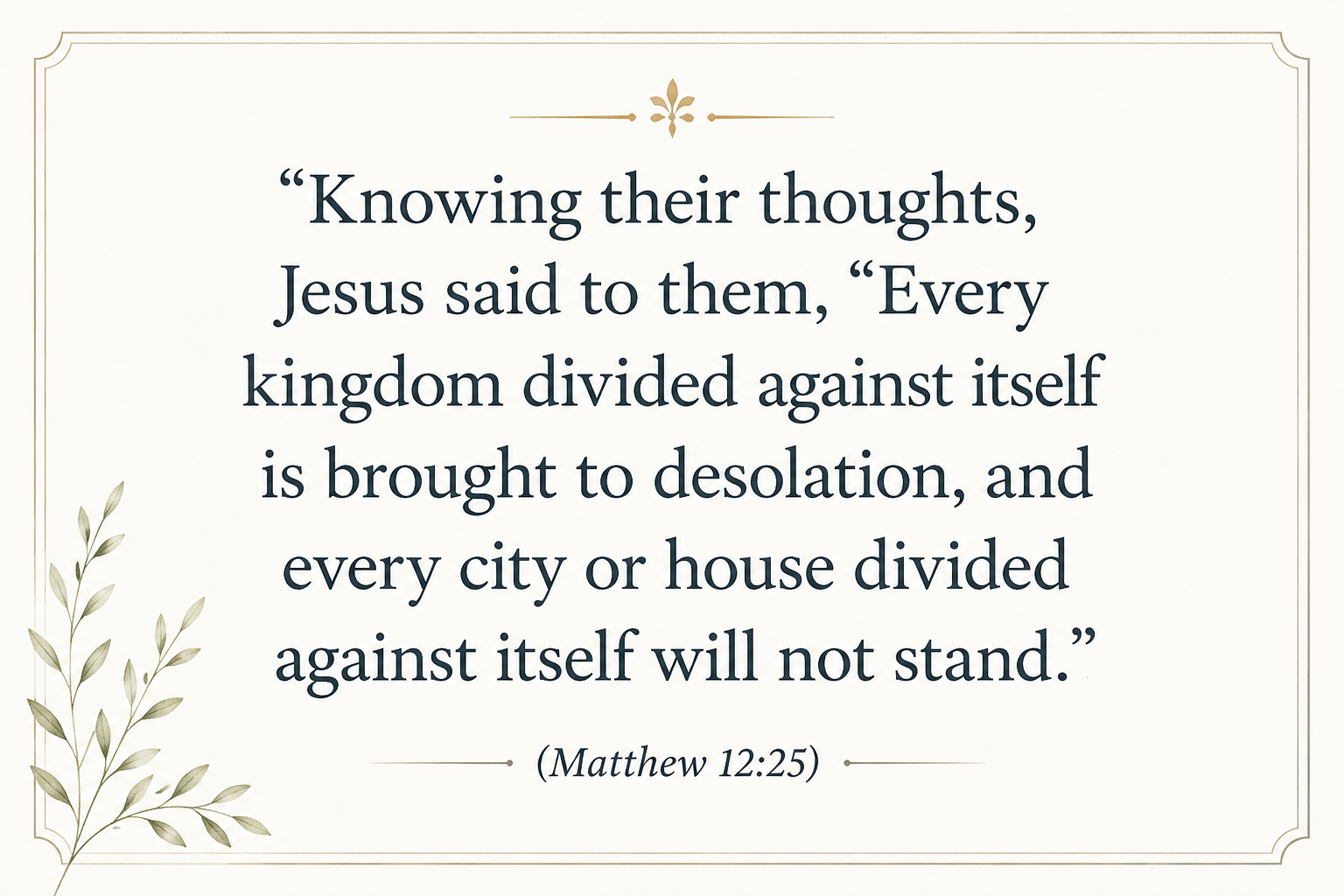
“Knowing their thoughts, Jesus said to them, “Every kingdom divided against itself is brought to desolation, and every city or house divided against itself will not stand.” (Matthew 12:25)
Here μερίζω marks a division that works from within: a “kingdom,” “city,” or “house” becomes its own adversary. The result is not a neutral sorting but collapse—“brought to desolation” and unable “to stand.” The verb frames internal splitting as the engine of ruin for any organized whole named in the sentence.
“If Satan casts out Satan, he is divided against himself. How then will his kingdom stand?” (Matthew 12:26)
In this line of argument, dividing is directed reflexively: “he is divided against himself.” The point depends on the incoherence created by such self-division; the question “How then will his kingdom stand?” treats division as incompatible with stability and continued rule.
“If a kingdom is divided against itself, that kingdom cannot stand.” (Mark 3:24)
Mark condenses the thought into a principle. μερίζω names the condition (“divided against itself”) and the consequence (“cannot stand”), tying the verb to the loss of structural integrity in the very thing that is divided.
“If a house is divided against itself, that house cannot stand.” (Mark 3:25)
The same verb is applied to the smaller unit of a “house.” The force of the line is practical: a household split into opposing parts is portrayed as unable to remain upright and intact. μερίζω supplies the internal fracture that makes endurance impossible.
“If Satan has risen up against himself, and is divided, he can’t stand, but has an end.” (Mark 3:26)
Division here is paired with active opposition—“risen up against himself”—and then stated simply: “and is divided.” The result is finality: “he can’t stand, but has an end.” μερίζω thus functions as a decisive condition that brings a conflict to its conclusion by undermining the subject from within.
“He took the five loaves and the two fish, and looking up to heaven, he blessed and broke the loaves, and he gave to his disciples to set before them, and he divided the two fish among them all.” (Mark 6:41)
In this feeding scene, μερίζω is not about rupture but distribution. After blessing and breaking, the action culminates in “he divided the two fish among them all,” presenting division as a means of sharing so that many receive portions from a limited supply. The verb highlights orderly allocation: the fish are partitioned with the aim of reaching “them all.”
“One of the multitude said to him, “Teacher, tell my brother to divide the inheritance with me.” (Luke 12:13)
Here μερίζω belongs to a request for adjudication. The speaker imagines an inheritance as something that should be divided “with me,” implying a partition into rightful shares among siblings. The verb captures the social and legal expectation that a common estate can be separated into portions assigned to different persons.
“For I say through the grace that was given me, to every man who is among you, not to think of himself more highly than he ought to think; but to think reasonably, as God has apportioned to each person a measure of faith.” (Romans 12:3)
Although the English renders the idea as “apportioned,” the action corresponds to dividing in the sense of assigning out to individuals: “to each person” is matched with a “measure.” The verb’s contribution is the picture of a whole (what God gives) being parceled out in measured form across a community, and this distribution grounds the call to “think reasonably.”
“Is Christ divided? Was Paul crucified for you? Or were you baptized into the name of Paul?” (1 Corinthians 1:13)
Paul uses μερίζω as a rhetorical shock: “Is Christ divided?” Division here is cast as an unacceptable fragmentation of what should be held together. The surrounding questions—about crucifixion and baptismal allegiance—show that the “dividing” in view is driven by party spirit, treating division as a distortion of proper unity.
“Only, as the Lord has distributed to each man, as God has called each, so let him walk. So I command in all the assemblies.” (1 Corinthians 7:17)
Again rendered “distributed,” the verb functions as an allocation from the Lord “to each man,” set parallel to God’s calling of “each.” μερίζω frames personal circumstances as something assigned in portions, and it becomes the basis for the instruction “so let him walk,” linking lived conduct to what has been divided out to the individual.
“There is also a difference between a wife and a virgin. The unmarried woman cares about the things of the Lord, that she may be holy both in body and in spirit. But she who is married cares about the things of the world—how she may please her husband.” (1 Corinthians 7:34)
This verse presents “a difference” and then contrasts two patterns of concern: “the things of the Lord” versus “the things of the world.” In this context, μερίζω contributes the idea of dividing life’s attention into distinct spheres shaped by marital status, so that the person’s cares are pulled toward different objects and obligations.
“But we will not boast beyond proper limits, but within the boundaries with which God appointed to us, which reach even to you.” (2 Corinthians 10:13)
Here the verb is expressed through “appointed,” and the imagery is spatial and measured: “proper limits,” “boundaries,” and a reach that extends “even to you.” μερίζω contributes the concept of division as delimitation—God assigns a portioned field of action, and that apportioned boundary governs what is appropriate to claim.

Sense and Usage
Across these passages, μερίζω operates along two main lines: (1) division that breaks an entity into opposing parts, and (2) division that parcels out a whole into portions for people. In the sayings about kingdoms and houses (Matthew 12:25–26; Mark 3:24–26), the divided state is explicitly “against itself,” so the verb signals internal opposition rather than mere variety. The repeated outcome—unable “to stand,” moving toward “desolation,” reaching “an end”—shows division functioning as a destabilizing force that prevents an organized body from continuing as a coherent unit.
In narrative and practical contexts, the same verb describes allocation rather than collapse. In Mark 6:41, division is the mechanism by which food reaches a crowd: it is directed “among them all,” emphasizing distributive movement from one supply to many recipients. Luke 12:13 places the verb in a family dispute, where dividing is imagined as an equitable separation of an inheritance into shares. Romans 12:3 and 1 Corinthians 7:17 extend distributive division into the ordering of communal and personal life: what God gives is apportioned “to each person” or “to each man,” and that measured distribution becomes a reason for sober self-assessment and faithful walking. In 2 Corinthians 10:13, division appears as the setting of limits: God assigns “boundaries,” and those boundaries define the appropriate scope of boasting and labor.
The contrast in 1 Corinthians 7:34 shows that dividing can also describe a lived differentiation: two states (unmarried and married) are depicted as leading to distinct patterns of care. Without turning the verse into a technical description of inner psychology, the language of contrast places everyday concerns into separable categories. In 1 Corinthians 1:13, the verb’s negative force is sharpened by the subject: asking whether Christ is divided treats division as a misapplication of the verb—splitting what should not be partitioned. Thus, within these texts, μερίζω can describe either a rightful distribution (portions, measures, boundaries) or a wrongful fragmentation (a kingdom at odds with itself; a community pulling allegiance into rival parts).
Imagery
These occurrences frequently picture division in concrete terms: a household or kingdom cracking into rival sections, fish being portioned out to a whole gathering, an estate being split between siblings, and a field marked off by “proper limits” and “boundaries.” Whether the result is collapse or ordered sharing depends on what is being divided and why: division “against itself” ends in desolation, while division “among them all” or “to each” serves provision, order, and restraint.
Sources: Lexical data from Strong’s Exhaustive Concordance and the Translators Brief Lexicon of Extended Strongs for Greek (STEPBible, CC BY). Occurrence data from the Translators Amalgamated Greek New Testament (STEPBible, CC BY). Scripture quotations from the World English Bible (public domain).